

 10 hours ago
5
10 hours ago
5
ARTICLE AD BOX
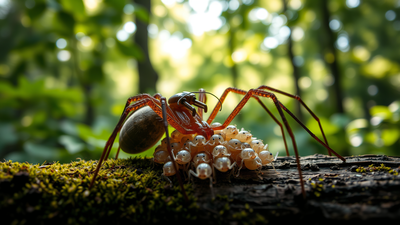
Paternal care, where a father alone looks after his offspring, is one of the rarest parenting arrangements found anywhere in the animal kingdom. Yet inside a single group of spider-like arachnids called harvestmen, commonly known as daddy longlegs, this unusual behaviour has evolved independently again and again throughout their history.
A new international study led by Glauco Machado at the University of São Paulo has used an unlikely research tool, photographs and observations submitted by ordinary members of the public through the citizen science platform iNaturalist, to more than double the number of documented cases of parental care in harvestmen, offering the clearest picture yet of how and why fatherhood evolved in this remarkably diverse group.
Why are harvestmen such a valuable group to study
Harvestmen make up one of the most diverse arachnid orders on the planet, with more than 6,900 recognised species, yet despite accounting for only about 0.6 per cent of all arthropod diversity, they are responsible for more than half of all known independent origins of paternal care across the animal kingdom. According to the study published in the Zoological Journal of the Linnean Society, this makes harvestmen an unusually powerful group for studying how parental care evolves more broadly, since a behaviour this rare in nature has still managed to arise repeatedly within this single lineage, giving researchers multiple independent natural experiments to compare rather than just one isolated case.
How citizen science dramatically expanded the dataset
Building a detailed picture of parental care across an entire arachnid order has traditionally depended on painstaking fieldwork, tracking down elusive species in forests and grasslands and observing their behaviour directly over months or years. Machado's team instead turned to iNaturalist, a platform where members of the public upload georeferenced photographs and observations of wildlife from around the world, and combined this crowdsourced data with nearly three decades of their own traditional field research.
Between 1936 and 2025, formal scientific literature had documented parental guarding behaviour in 80 species of harvestmen, and this new study more than doubled that figure, with 62 additional records coming from iNaturalist alone, work Machado says his team was able to complete in just two days rather than the years such data collection would have taken through museum visits and field expeditions alone.
What the expanded dataset revealed about how fatherhood evolves
With this significantly larger dataset in hand, the researchers were able to reconstruct the evolutionary history of maternal and paternal care across the superfamily Gonyleptoidea for the first time.
The results showed that parental guarding behaviour did not simply emerge once and stay fixed, instead it evolved, disappeared, and then reappeared multiple separate times across the group's evolutionary history.
When the team mapped out exactly how this behaviour developed, they found a clear pattern, maternal care appeared to evolve only from a starting point of no care at all, a pattern that closely mirrors what has previously been documented in insects.
Why paternal care follows a very different evolutionary path
Paternal care told a noticeably different story. Unlike maternal care, paternal guarding was found to arise either directly from a state of no care or, in some cases, from pre-existing maternal care, suggesting that different evolutionary pressures were shaping each pathway. The researchers theorised that when paternal care evolved out of an earlier maternal care system, it likely reflected a sexually selected behaviour known as the enhanced fecundity hypothesis, essentially the idea that females may actively prefer to mate with males who are already demonstrating that they will guard eggs successfully, giving caretaking males a genuine reproductive advantage over males who do not offer this kind of parental investment.
Why the sheer scale of this behaviour makes harvestmen so unusual
Lead author Glauco Machado noted that paternal care is very rare in nature generally, and the fact that this particular behaviour evolved independently so many times within harvestmen gives researchers an unusually rich opportunity to explore exactly which factors led to its evolution in the first place. In species where males act as the sole caretakers, this arrangement typically develops as a sexually selected trait, meaning females actively favour males who are already caring for eggs, a dynamic that helps explain why a behaviour this costly and rare could still spread and persist across so many separate harvestmen lineages over evolutionary time.
Why this research matters well beyond one group of arachnids
Machado has said he hopes the success of this approach encourages other researchers working across very different animal groups to make greater use of citizen science platforms in their own work, describing iNaturalist as a tremendous source of information capable of dramatically speeding up how quickly scientists can accumulate biological data that would otherwise require expensive, time consuming museum visits and fieldwork across the globe.
Beyond simply expanding what is known about harvestmen specifically, the study offers a broader template for scientists studying parental care in insects, frogs and countless other animal groups where both maternal and paternal care patterns exist, showing that the combination of dedicated fieldwork and publicly contributed observations can uncover evolutionary patterns that neither approach could likely reveal on its own.









 English (US) ·