

 8 hours ago
5
8 hours ago
5
ARTICLE AD BOX
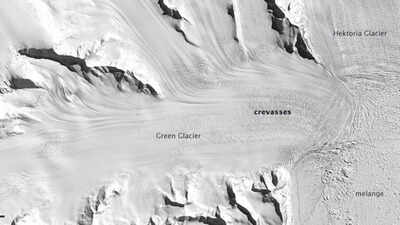
A ‘lightning-fast’ melting event astonished the scientific community when researchers at the University of Colorado Boulder (CIRES) observed the collapse of the Hektoria Glacier in West Antarctica. In a period of only 60 days, the Hektoria Glacier receded 8 kilometres, the quickest observed ground retreat in recent history.
"In a staggering display of glacial instability, an area of ice roughly equivalent to the size of Manhattan (60 kilometres) disintegrated into the Weddell Sea.The rapid, catastrophic, and almost instantaneous disintegration of the Hektoria Glacier occurred after it lost enough of its thickness to become unstuck from its flat-lying bedrock (such as an ‘ice plain’) and allow warm ocean water to erode the base. Lead author Naomi Ochwat in the study stated that this event suggests that larger, higher-stakes glaciers that are on similar bedrock topographies may be at much greater risk for rapid demise than was previously considered.
Why did the Hektoria glacier collapse so quickly on a flat ice plain
The main factor responsible for the recently recorded event is due to a very special type of geological feature called an ‘ice plain'. Most glaciers are held in place by the roughness and uneven surface of the underlying bedrock, but Hektoria was located on a very rare geologic feature called an 'ice plain.' Ice plains are huge areas of the ocean floor covered with very flat terrain; consequently, once the glacier thinned out enough, there was almost no friction to keep it from sliding forward.
Therefore, once the Hektoria Glacier had thinned down by a few metres (before losing contact with that ground), there would no longer be any weight pushing down onto it. This weight would have held the ice in place until it became buoyant and so came completely away from the bedrock. According to CIRES, this resulted in the start of a chain reaction that ultimately resulted in the Hektoria Glacier shattering and retreating at previously undocumented speeds, relative to even during the satellite era.
Hektoria glacier loses ice equivalent to Manhattan in 60 days
The retreat of the Hektoria Glacier is unprecedented: from early 2022 to the conclusion of final data analysis in early 2026, the glacier retreated more than 25 km. However, during its most rapid period, between May 2022 and August 2022, the glacier retreated by more than 8 km in only two months. The evidence that this has occurred was described by Dr Naomi Ochwat (the lead researcher of this study) as ‘out of this world,’ and she indicated that the mass of ice lost in these two months alone is equivalent to the entire island of Manhattan.
This rapid retreat was verified using high-resolution satellite imagery and by measuring the seismic activity associated with the calving of large blocks of ice from the Hektoria Glacier into the Weddell Sea (known as Glacier Earthquakes).
Vulnerability of the doomsday glaciers
The collapse of the Hektoria Glacier serves as an important ‘canary in the coal mine’ for larger, much more dangerous ice masses (e.g., Thwaites Glacier). Although the Hektoria Glacier is relatively small compared to other glaciers, scientists point out that a large portion of West Antarctica is located on similar flat, deep bedrock.
If these larger masses (or so-called ‘Doomsday Glaciers’) reach the same degree of thinning as a result of climate change as did the Hektoria Glacier, they will also have the potential to collapse rapidly due to buoyancy.
Therefore, the findings from this research have revised the current understanding of the ‘speed limit’ that exists for the loss of grounded ice.
How Larsen B’s collapse set the stage for Hektoria glacier’s retreat
According to the Journal of the European Geosciences Union (EGU), the foundations of this collapse were established in the past, beginning with the disintegration of the Larsen B Ice Shelf in 2002. Since the ice shelf no longer serves as a ‘bottleneck’ for glaciers, glaciers such as Hektoria glacier have been rapidly flowing and thinning for the past 20 years. Exceptionally warm ocean currents flowed into the base of the glacier and acted as a catalyst for the final breakdown. The primary reason for the collapse was the warming of the ocean through the melting of the bottom of the ice at its base, which caused the ice to lift off the grounding line, the critical point at which the ice thickens and comes into contact with the seabed. This demonstrates that the deep grounded ice has lost its insulation against the warming of the Southern Ocean and exposed a structural weakness of our earlier estimates of ice sheet stability.







 English (US) ·