

 3 days ago
4
3 days ago
4
ARTICLE AD BOX
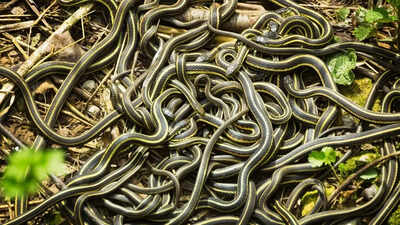
Many wildlife spectacles revolve around big animals, migratory birds, or sea creatures. It is not common knowledge that one of the most amazing natural phenomena on Earth takes place underground with thousands of snakes.Each year during spring, in the Canadian province of Manitoba, the earth literally comes alive with thousands of red-sided garter snakes coming out of their hibernation period in the Narcisse Snake Dens. These snake dens have become famous all over the world for housing one of the biggest concentrations of snakes ever known to man.Approximately 130 km away from Winnipeg, near the centre of Manitoba's Interlake, the Narcisse Snake Dens are not an artificial tourist destination but rather a unique geological feature resulting from climatic conditions and snake behaviour.
The location has underground limestone caverns and fissures created over millennia by water erosion. Because of this, these fissures reach below the frost line to create environments where the temperature never drops below zero in Manitoba's cold winters.
This is why the caverns make an excellent shelter for the red-sided garter snakes so that thousands of these snakes are able to survive extremely low temperatures outside the caves.
The phenomenon takes place at the beginning of spring, which starts somewhere at the end of April and the beginning of May. The snakes emerge from the den in thousands after spending months in the underground caverns. Those who come to the spot during the period of peak activity will see thousands of snakes lying on the ground next to the entrance to the dens.
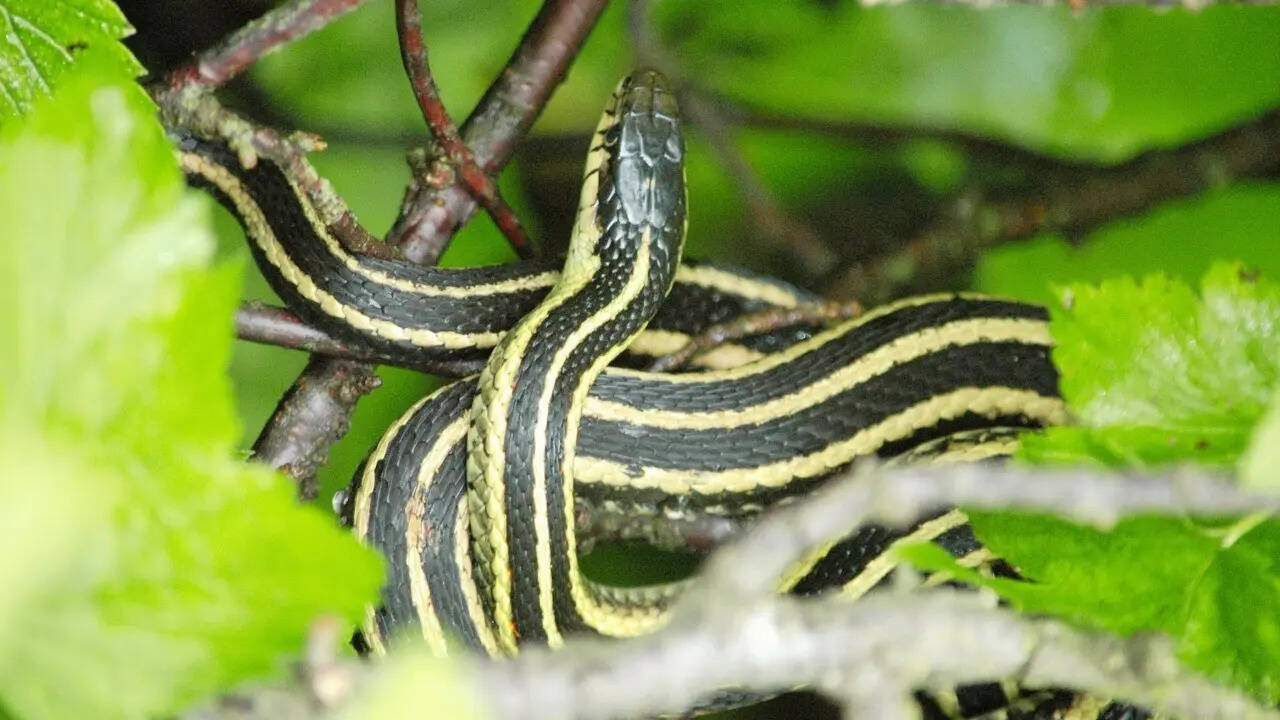
Red-sided garter snakes
What draws the snakes together is reproduction. While the males come out first, they then proceed to congregate at the entrances of the dens until the females show up.
Once a female does surface, numerous males will instantly gather in an entangled mass called a "mating ball" around her. These balls can sometimes be made up of a hundred males fighting for the right to copulate with a single female. This mating process has essentially become the symbol of Narcisse and one of the most widely photographed activities of snakes.The sheer numbers of snakes that can be found at the site are astounding.
Different estimations have been provided each year, but generally, it can be said that there are tens of thousands of snakes at the site, with some sources stating that between 70,000 to 100,000 snakes gather around the den sites.Despite their numbers, it must be mentioned that the snakes are not regarded as potentially dangerous for visitors. The kind of snakes that can be seen there is the red-sided garter snake, which is a subspecies of the common garter snake.
In most cases, these snakes do not represent any danger to humans and are much more engaged in looking for a mate rather than in communicating with visitors. Their abundance may appear intimidating, but the event is known more for its scientific significance than for any threat posed by the animals themselves.
The attraction has evolved into a significant wildlife tourism destination. Manitoba has developed visitor infrastructure around the site, including viewing platforms and a self-guided interpretive trail linking the four active dens.
It goes without saying that the warm, sunny weather provides the best conditions for viewing because the snakes get more active in such conditions. Generally, the mating period lasts up to three weeks before the animals migrate to nearby areas to spend the summer there.The Narcisse Snake Dens are also a notable case of successful animal conservation. Thousands of snakes used to be killed each year when they crossed roads on their way to migrate.
With increasing worries over the loss, it was decided to build wildlife crossings, namely tunnels under the road as well as fences to help snakes travel through the area safely. The initiative has been successful in saving one of the world's most spectacular reptile species.Wildlife spectacles are often associated with the Great Migration in Africa, the monarch butterfly migration in Mexico, or vast seabird colonies in remote coastal regions. However, what makes the Narcisse Snake Dens unique is that it involves creatures usually hard to locate and observe. Snakes, normally secretive creatures, are turned into the stars of one of nature's most spectacular shows.









 English (US) ·