

 5 hours ago
4
5 hours ago
4
ARTICLE AD BOX
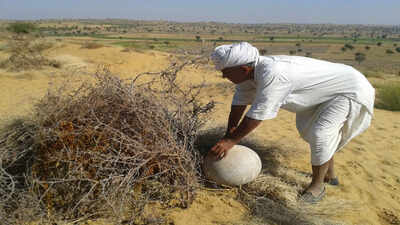
The first thing you notice about the story is how improbable it sounds. In a corner of Rajasthan where sand can move like a slow flood, one farmer kept planting trees until the desert stopped advancing and the edge of his village began to look, against all expectation, like a garden.
The man at the centre of that quiet upheaval is Ranaram Bishnoi of Ekalkhori village near Jodhpur. Over decades, he is widely reported to have planted about 27,000 trees on roughly 25 bigha, or around 10 acres, of desert land, carrying water by hand and returning to the same dunes again and again. Scroll down to read more...
A patch of desert that refused to stay barren
Ekalkhori sits deep in Bishnoi country, where the relationship between people and land is not casual but inherited, almost devotional.
Reports on Ranaram Bishnoi consistently describe the same scene: dunes that once threatened to swallow nearby farmland, and a man stubborn enough to keep them in place with roots instead of walls. Reports from 2015 described how he had “single-handedly stopped the march of the desert,” while later coverage noted that he had transformed a barren stretch adjoining his village into green cover.
One farmer, one well, one earthen pot
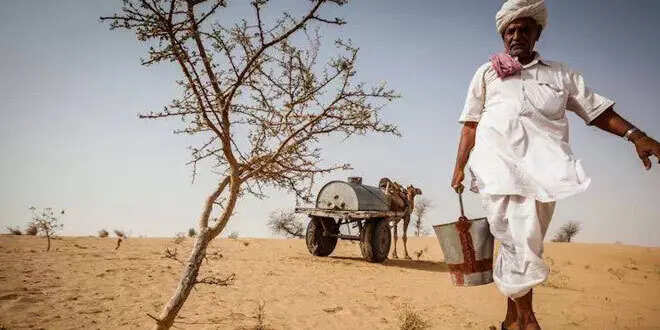
What makes the story so striking is not just the scale, but the method.
According to multiple reports, Ranaram did not arrive with machinery, irrigation systems or government backing. He fetched water from a nearby well or tubewell, often carrying it in an earthen pot on his shoulder, and walked back to the dune to water saplings one by one. The Better India said he travelled about three kilometres to the sand dune and watered the trees every alternate day; reports all note that he walked nearly three kilometres each day with a camel and used big earthen pitchers to keep the saplings alive.
This was not a one-season campaign. It was years of repetition, sweat and a refusal to treat the desert as hopeless.
Trees chosen for survival, not decoration
Ranaram’s trees were not random ornamentals dropped into the sand. The report names a set of hardy indigenous species that fit the land: neem, rohida, kankeri, khejri, fig, babool and bougainvillea. That matters because the story is as much about ecological intelligence as personal grit. Indigenous trees are better suited to arid conditions, and the reports suggest he worked with the logic of the desert rather than against it.
He also protected the younger saplings with thorny fencing to keep cattle and wildlife from damaging them. In that sense, the plantation was less a single act than a daily system of care, built from small decisions that allowed roots to take hold where the wind once ruled. 
Why the Bishnoi context matters
This is also a story about community memory. Ranaram belongs to the Bishnoi community, long associated with conservation in Rajasthan. Accounts of his work place it within that larger tradition, pointing to the Bishnois’ historical protection of wildlife and trees, including the 1730 sacrifice that later became part of the moral groundwork for India’s environmental movements.
That background does not reduce Ranaram’s personal achievement; it explains why his effort feels so deeply rooted.
In a place where nature is treated not as scenery but as kin, planting trees becomes both practical defence and cultural inheritance.
What his work leaves behind
Ranaram Bishnoi’s story endures because it is not really about one heroic day. It is about what happens when protection of land becomes a habit instead of a slogan. The desert did not turn green because someone spoke beautifully about conservation; it changed because someone kept showing up with water, saplings and patience. That is the larger lesson in this unlikely Rajasthan tale. Environmental repair is often imagined as grand policy, but sometimes it begins with a farmer, a pot, a dune and the stubborn belief that even a hostile landscape can be persuaded to yield.
In Ekalkhori, that belief appears to have taken root.









 English (US) ·