

 1 hour ago
5
1 hour ago
5
ARTICLE AD BOX

Representative image (AI)
The AI boom has exposed a problem: moving data, not processing it, is fast becoming the biggest constraint for our unquenchable AI needs. As models grow larger and more complex, thousands of chips must work together, constantly exchanging vast amounts of information.
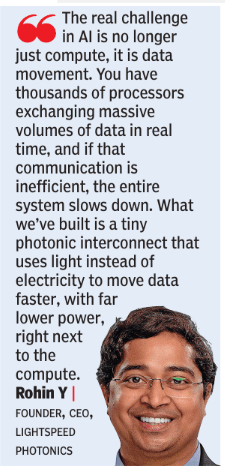
That data movement is a problem LightSpeed Photonics set out to solve years before the current AI surge.“We saw this coming early,” said Rohin Y, founder and chief executive of LightSpeed Photonics.Founded in 2020, LightSpeed Photonics operates out of Singapore, where it leads advanced technology collaborations, and Hyderabad, where its core R&D, design, simulation and testing teams are based. The company is also preparing to expand into the US for business development.
This distributed footprint reflects both the complexity of its technology and the global nature of the ecosystem it relies on.Rohin’s insight into the data bottleneck comes from his background in high-performance computing. While working on large-scale scientific simulations during his PhD, he saw first-hand how systems struggled to move data across thousands of processors. “Even back then, I realised that interconnects — not compute — were slowing everything down,” he said.
That challenge has only intensified with AI. Modern models are trained and run across clusters of machines, with terabytes of data constantly being shared. “These are no longer single-machine problems,” Rohin said. “Every processor needs fast access to data stored across the system. If that exchange is slow, everything slows down.”
.
Traditional approaches are struggling to keep up. Copper connections, once the backbone of data centre communication, cannot scale to the speeds and efficiencies required.
Even existing optical solutions — which use light instead of electricity — face limitations in size, power consumption and how closely they can be integrated with chips.LightSpeed’s approach is to rethink the interconnect entirely, using photonics — the science of manipulating light — to move data faster and more efficiently. But the real innovation lies in how the company has engineered that capability into an ultra-compact device.“The requirement was clear,” Rohin said. “We needed extremely high bandwidth, very low latency, low power consumption, and a form factor small enough to sit right next to the compute chip.”Achieving all of that in a single product took five years of deep engineering work. The result is a fingernailsized photonic interconnect capable of transmitting 400 gigabits per second — significantly smaller, faster and more energy-efficient than conventional modules used in data centres today.Technical challengesBuilding it required solving multiple technical challenges at once. Inside the device are tiny lasers that convert electrical signals into light, detectors that convert light back into electrical signals, and specialised electronics to control and process the data. All of these components must work seamlessly together within an extremely small footprint.“It’s not just one technology,” Rohin explained. “You’re combining photonics, electronics, materials science and precision packaging into a single system.
Everything has to align at a very high level of accuracy.”That precision — down to fractions of a human hair — is achieved through what is known as advanced semiconductor packaging. Because this capability is still developing in India, LightSpeed partnered with collaborators in Singapore and other parts of Asia to build its early prototypes and refine the technology.At the same time, the company invested heavily in building its own talent.
“We had to train people from scratch,” Rohin said. “This is a specialised field, and there isn’t a ready-made workforce for it. Our team learned by working closely with global experts and partners.”The engineering effort extended beyond just shrinking the device. One of the key breakthroughs was bringing the optical conversion as close as possible to the processor. “The closer you are to the compute, the lower the latency and the better the efficiency,” Rohin said.This proximity reduces the distance data must travel as electrical signals — which are slower and consume more power — before being converted into light. The result is faster communication between chips and lower overall energy usage.The timing of this innovation is critical. Interconnects are rapidly becoming one of the largest power consumers in data centres. “They could account for nearly 40% of power consumption,” Rohin noted.
As AI workloads scale, improving efficiency in data movement is essential to keeping costs and energy use under control.LightSpeed is now moving from development to deployment. The company recently launched its product and is working with major players in the AI and high-performance computing ecosystem on pilot projects, with commercial rollouts expected to follow.








 English (US) ·