

 1 hour ago
4
1 hour ago
4
ARTICLE AD BOX
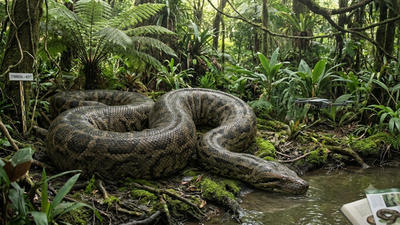
Sixty million years ago, not long after the asteroid impact that ended the age of dinosaurs, a different giant emerged from the swamps of South America. Titanoboa cerrejonensis was unlike any snake alive today.
Reaching lengths of up to 13 metres (43 feet) and weighing more than 1,100 kilograms, it became the largest snake known to science. Its discovery in Colombia's Cerrejón Formation transformed scientific understanding of prehistoric ecosystems and provided rare evidence of how climate influenced the evolution of giant reptiles. Far from being a mythical monster, Titanoboa was a real apex predator that thrived in vast tropical wetlands during the Palaeocene Epoch.
The enormous serpent not only dominated its environment but also left clues about the world's climate shortly after the dinosaurs disappeared.
A giant snake emerged after the dinosaurs vanished
Titanoboa was first described in 2009 following the discovery of vertebrae and ribs from at least 28 individuals in the Cerrejón coal mine of northern Colombia. The fossils were recovered from rocks dating to approximately 58–60 million years ago, making Titanoboa one of the earliest giant predators to evolve after the mass extinction event that eliminated non-avian dinosaurs.
Researchers estimated its size by comparing fossil vertebrae with those of living boas and anacondas. The results revealed a snake far larger than any species alive today.Writing in Nature, the research team concluded:"Titanoboa cerrejonensis is by far the largest snake yet reported." (Head et al., 2009)The species belonged to the boa family and likely occupied the top of the food chain within a warm, swampy rainforest ecosystem populated by giant turtles, crocodile relatives and early mammals.
Why Titanoboa reached extraordinary sizes
Titanoboa's immense size is closely linked to the climate. Modern reptiles depend on environmental heat to regulate body temperature, placing biological limits on their maximum size. Scientists believe the tropical environment of Palaeocene South America was significantly warmer than modern rainforests.According to the original study ‘Giant boid snake from the Palaeocene neotropics reveals hotter past equatorial temperatures,’ the estimated mean annual temperature of Titanoboa's habitat exceeded temperatures found in present-day tropical forests.
Such warmth would have enabled a cold-blooded animal to maintain the metabolic demands associated with gigantic body size.Lead author Dr Jason Head noted:"Large-bodied ectotherms are constrained by ambient temperature."The findings provided independent evidence that equatorial regions following the dinosaur extinction were considerably hotter than previously assumed. Titanoboa therefore became more than a giant snake; it evolved into a biological thermometer preserved in the fossil record.
An ambush predator built for water
Although often compared with modern anacondas, Titanoboa may have behaved differently. Further analysis of its skull and jaw structure suggested an animal highly adapted to aquatic hunting.A study published by researchers from the University of Toronto found that Titanoboa possessed cranial features more consistent with specialised water-dwelling snakes than with terrestrial constrictors.They described Titanoboa cerrejonensis as having an "anaconda-like ecology."
This ecological classification suggests a similar lifestyle and hunting strategy to modern anacondas (Eunectes), which are well-known ambush predators.The study focuses on describing this giant snake based on its vertebral remains. The material used for the description and diagnosis includes:
- Holotype: A single precloacal vertebra
- Referred Material: 184 additional precloacal vertebrae and ribs representing 28 individuals.
The diagnosis of the species is based entirely on vertebral morphology, specifically its robust precloacal vertebrae with a uniquely T-shaped neural spine.
While the researchers calculated the snake's snout–vent length (SVL) and total body length to estimate its massive size, these calculations were derived from regressions of vertebral width rather than cranial measurements.The researchers marked Titanoboa as highly aquatic. Its broad jaws and flexible skull would have allowed it to seize large prey in rivers and swamps. Fossil evidence from Cerrejón indicates that giant lungfish, crocodile relatives and other aquatic vertebrates were abundant in its habitat, providing a substantial food supply capable of supporting such a massive predator.Rather than pursuing prey over long distances, Titanoboa likely relied on stealth. Concealed beneath murky water, it could launch sudden ambush attacks, using its immense strength to overpower animals that would dwarf many modern reptiles.
Titanoboa remains the undisputed giant of snake evolution
More than a decade after its scientific description, no larger snake has been discovered. Even the largest modern green anacondas fall well short of Titanoboa's estimated dimensions.
The fossil record suggests that environmental conditions following the dinosaur extinction created a unique opportunity for reptilian gigantism on a scale rarely seen before or since.Titanoboa remains one of the most extraordinary examples of how life rapidly adapted after Earth's greatest extinction event. Its fossils reveal not only the existence of a giant predator but also a warmer world in which reptiles reached sizes that seem almost unimaginable today.For palaeontologists, Titanoboa is far more than a record-breaking snake. It is a window into a vanished rainforest ecosystem that flourished during one of the most important periods in Earth's history.







 English (US) ·