

 1 hour ago
5
1 hour ago
5
ARTICLE AD BOX
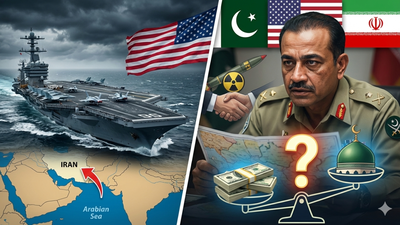
AI image (Picture credit: Google Gemini)
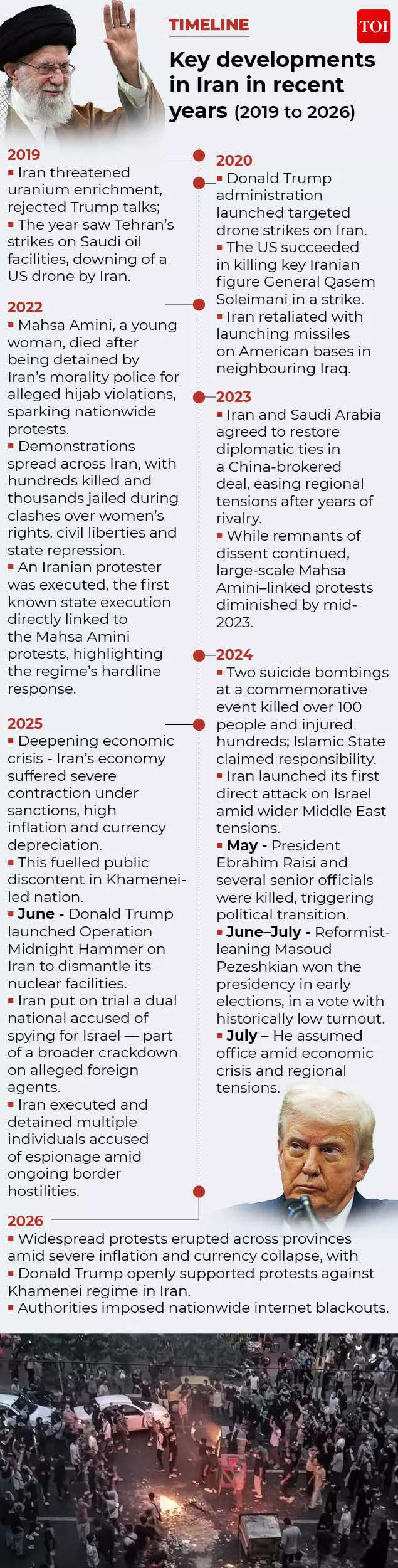
Dark war clouds gather once more over the deserts of the Middle East.As President Donald Trump's "American Armada" — the USS Abraham Lincoln Carrier Strike Group — slices through the Arabian Sea toward Iran's coast, tremors ripple straight to Rawalpindi's military headquarters in Pakistan.With Tehran's crackdown death toll surpassing 6,000 and Trump promising protesters that "help is on the way," Pakistan stares down a familiar, blood-soaked crossroads.
The DNA of a dilemma: A history of "selling the soul"
For the world, Pakistan’s current hesitation is a "rerun" of a decades-old script. Since its inception, Islamabad has mastered the art of leveraging its geography for Western "Dollars" while using the rhetoric of the "Ummah" (the global Muslim community) to maintain domestic legitimacy.Historically, the best example is the post-9/11 era. Pakistan famously became a "Frontline State" for the US war in Afghanistan, pocketing billions in Coalition Support Funds (CSF) to assist in attacks on its Muslim neighbour. Yet, in a masterclass of double-dealing, while Islamabad provided the US with logistics, it simultaneously provided Osama bin Laden with sanctuary in Abbottabad—literally in the shadow of its premier military academy.
This backstabbing strategy allowed Pakistan to stay financially solvent via Washington DC while keeping its "strategic assets" (the Taliban) alive to eventually retain its interests in the region.
The "Dollar" pivot: Munir, Trump, and the post-Operation Sindoor reality
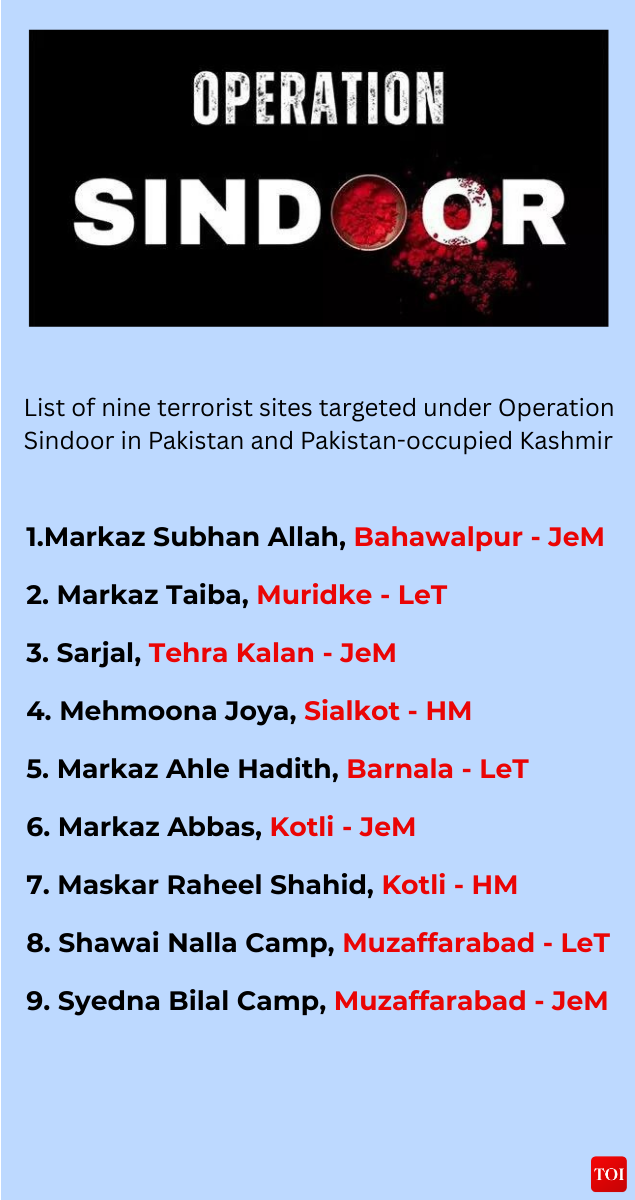
Why is Pakistan so desperate to entangle itself with the US again? The answer lies in the aftermath of Operation Sindoor. When India launched surgical missile strikes on terror hubs in Muridke and Bahawalpur, the resulting strains in US-India relations, triggered by US President Donald Trump’s repeated unverified claims of mediation between the two nuclear neighbours, left Islamabad with an opening.
The Trump administration’s transactional view of New Delhi’s approach to buying Russian energy amidst the Ukraine war and trade deal delays further opened a window for Pakistan to regain its status as Washington’s indispensable partner.Cashing in the opportunity, under COAS Gen Asim Munir and PM Shehbaz Sharif, Pakistan moved aggressively to position itself as a stabilising proxy in exchange for debt relief. According to CEIC, Pakistan’s external debt reached $134.5 billion in September 2025. With such extravagant out-of-reach debt and a sluggish economic growth rate of around 2-3%, the "Dollar" is no longer a choice; it is survival.
The "Ummah" mask: Selective outrage and the Iran relations
To the world, Pakistan portrays itself as the "Fortress of Islam" and the "Saviour of the Ummah." This rhetoric is a cornerstone of its diplomacy, yet it is notoriously hollow. While Islamabad screams about Kashmir and Palestine, it remains deaf and blind to China’s exploitation of Uighur Muslims in Xinjiang, prioritising the "Yuan" over the "Quran."Its relationship with Iran follows a similar pattern of convenience. Though they share a border and Islamic identity, their history is one of deep-seated mistrust. Iran was the first to recognise Pakistan in 1947, yet by the 1990s, they were on opposite sides of the Afghan civil war. The most recent and violent crack in the "Ummah" mask occurred in January 2024, when the two neighbours engaged in a historic and unprecedented tit-for-tat military exchange. On January 16, 2024, Iran’s Revolutionary Guard (IRGC) launched missile and drone strikes into Pakistan’s Panjgur district, claiming to target the Sunni militant group Jaish al-Adl. Pakistan, stunned by what it called a blatant violation of its sovereignty, did not wait for a diplomatic resolution.Within 48 hours, Islamabad launched Operation Marg Bar Sarmachar.The Pakistan Air Force used JF-17s and Chinese-made Wing Loong II drones to strike deep inside Iranian territory near Saravan.
This was the first time a foreign country had successfully struck Iranian soil since the end of the Iran-Iraq War in 1988.
How Pakistan may get involved in the Iran-US conflict
The risk of Pakistan being sucked into a US-Iran vacuum is not a matter of "if," but "how." Historically, Pakistan has played a dangerous game of "neutrality" while providing tactical support to the highest bidder. During the 1980s Iran-Iraq war, Pakistan maintained ties with Tehran while secretly allowing the US to monitor the region.
However, the 2026 landscape is far more lethal.This time, with Gulf countries like the UAE, Qatar and Saudi Arabia formally denying the US the use of their soil for offensive strikes against Iran, the Pentagon may be forced to look at a potential "Eastern Flank." Pakistan’s proximity to Iran's Sistan-Balochistan province, the IRGC's soft underbelly, offers the US a strategic launchpad that the Gulf may no longer provideFor Pakistan, the incentive is twofold. First, the Dollars, to keep its ailing economy functioning. Hence, saying "no" to the US could mean immediate sovereign default.Second, the narrative, by becoming Washington's East-side Hammer against Iran, Islamabad hopes to buy US silence or even active support, for a renewed Anti-India narrative. Following the humiliation of Operation Sindoor, Gen Asim Munir likely sees a US alliance as the only way to re-level the playing field against New Delhi, especially as Trump’s transactional diplomacy has caused a visible chill in the US-India ties.
The elite-street paradox
While the world watches Islamabad’s tactical maneuvers with skepticism, the domestic reality within Pakistan tells a story of manufactured consensus. According to a Gallup Pakistan Public Pulse Survey (May 2025) conducted just after the ceasefire following Operation Sindoor, a staggering 97% of Pakistanis rated the military’s performance as "good or very good." This surge in popularity—with 93% of respondents reporting an improved image of the Army—provides Gen.
Asim Munir with a unique "security mandate."However, this mandate is brittle. The same survey reveals a widening elite-street gap. While the military elite eyes US Dollars for survival, public affinity remains tethered to the Ummah. In the post-conflict sentiment check, Pakistan's friendship with Iran saw a significant positive boost among the masses, whereas the United States remained the most polarizing ally, with only 39% of the population viewing the relationship favourably. This development likely indicates towards the 'General’s Gamble', where Munir is using a mandate built on anti-India sentiment to sell a pro-US policy that the Pakistani street instinctively distrusts.
The sandwich nightmare: Refugees and rebels
Nowhere is the Ummah or Dollars crisis more physical than at the Taftan Border. The Iranian Rial has collapsed to 10,93,048 to the Dollar, turning the multi-million barter trade, the lifeline of Balochistan, into a ghost economy.Pakistan now faces a 'sandwich' security nightmare. Already bleeding on its border with a hostile Taliban-led Afghanistan in the north and the eastern border with India remaining a powderkeg, a conflict with Iran on the western side would open a third front. Also, a full-scale war in Iran would trigger a catastrophic refugee crisis, with millions of war-stricken Iranians likely to surge across the 900km porous border into Pakistan’s Balochistan.This is where the self-goal occurs. Pakistan may try to use the chaos to eliminate Baloch rebels (BLA/BLF) who operate on both sides of the border. However, just as the Afghan refugee crisis fueled the TTP (Tehrik-i-Taliban Pakistan), an Iranian influx could fan the flames of the Baloch insurgency.
Groups like the BLA would likely find "human shields" and fresh recruits among the displaced, turning a tactical opportunity into a decade-long security nightmare for Rawalpindi.
The Shia factor
If the "Dollar" drives the state, the "Ummah" drives the street. Pakistan houses the second-largest Shia population in the world (approx. 17-26 million), according to Encyclopaedia Britannica. Siding with the US isn't just a foreign policy shift; it is a domestic explosive.
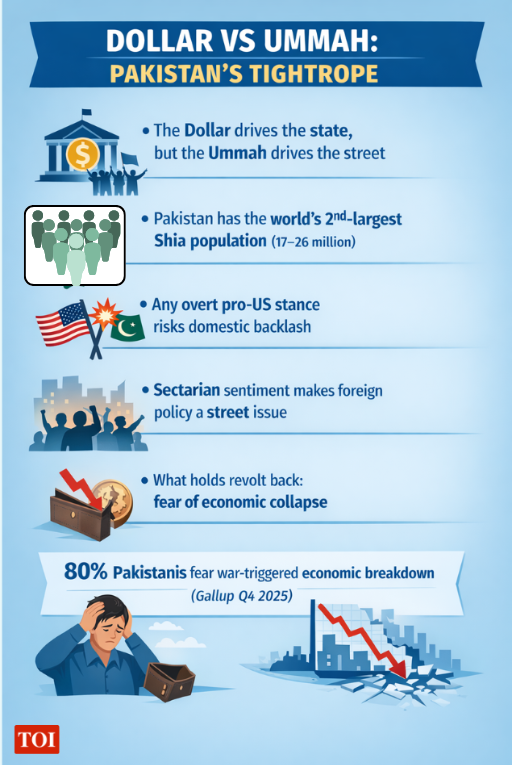
This nearly 15%-20% Shia population in Pakistan makes any overt siding with the US a domestic suicide mission. However, a crucial deterrent has emerged that may keep the "Ummah" from revolting: The Fear of the Breadline.According to a Gallup Pakistan Public Sentiment Survey (Q4 2025), an overwhelming 80% of Pakistanis—regardless of sect—reported that 'economic collapse' resulting from a regional war is their primary fear. This survivalist instinct is a powerful leash. While the Shia community in cities like Parachinar and Quetta feels a deep religious pull toward Tehran, the trauma of 40% inflation and the memory of the 2023-24 economic brinkmanship may have created a "pragmatic pause."The research suggests that for a population where 49% now identify as 'poor,' the fear of a total "Dollar" cutoff and the subsequent famine would often override the sectarian loyalty. This 'stomach over Sect' reality is precisely what the Munir-Sharif administration is banking on. By voting "No" at the UN resolution condemning Iran recently to pacify the street's religious identity, while quietly advancing US interests in the region to keep the IMF taps open, the state is performing a high-wire act. They are betting that as long as the "Dollar" prevents a total blackout, the "Ummah" will grumble, but it will not burn the house down.
The Saudi angle
The dilemma is further complicated by the September 2025 Strategic Mutual Defense Agreement (SMDA) signed with Saudi Arabia. This Nato-style pact states that an attack on one is an attack on both. If a cornered Iran strikes US bases or oil assets on Saudi soil, Pakistan is treaty-bound to intervene.This leads to the Nuclear Paradox. During the 2025 June strikes, an Iranian official claimed Pakistan had promised its "nuclear umbrella" for Tehran against Israel. Ishaq Dar quickly moved to pacify the West, telling Parliament that Pakistan’s nukes are "only for Islamabad." It was likely a calculated retreat intended to reassure Trump and Israel that Pakistan will not be the world's first 'Islamic Nuclear Martyr' for a neighbour it secretly distrusts.
The 23rd Street bridge: The great mediator?
Ultimately, Pakistan’s only "out" is its unique diplomatic role. At 1250 23rd Street NW in Washington, DC, the Pakistan Embassy continues to house the Iranian Interests Section. This building is the physical manifestation of Pakistan’s double life. This unique diplomatic infrastructure makes Pakistan the only nation capable of directly mediating between a vengeful Trump and a cornered Tehran. Also, in June 2025, reports emerged of Gen. Asim Munir holding clandestine meetings with Trump officials to discuss the Iran-Israel tensions. Hence, by acting as the bridge, Pakistan may hope to keep the "Dollars" flowing without fully burning the "Ummah" bridge. But as the USS Abraham Lincoln takes its position, time for mediation is running out. Pakistan is no longer just balancing; it is standing on a razor’s edge.




 English (US) ·