

 1 hour ago
4
1 hour ago
4
ARTICLE AD BOX
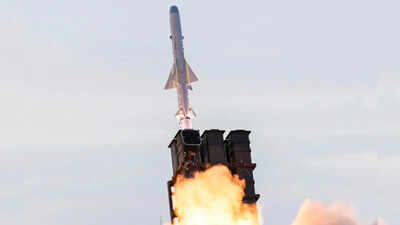
Understanding missile technology: Types, speeds and what Mach really means
Missiles today sit at the core of military strategy, acting as both deterrents and decisive battlefield tools. From long-range ballistic systems capable of crossing continents to low-flying cruise missiles designed for precision strikes, their evolution reflects advances in physics, engineering and guidance systems.
One of the most important aspects of missile technology is speed, often described in terms of “Mach”. Understanding what this means, along with the different types of missiles, helps decode how modern warfare is being reshaped.
What is Mach speed and why it matters
The term Mach is derived from Ernst Mach, and it refers to the ratio of an object’s speed to the speed of sound in the surrounding medium. At sea level, the speed of sound is roughly 1,235 kilometres per hour, although it varies depending on altitude and temperature.
When a missile travels at Mach 1, it is moving at the speed of sound, while Mach 2 indicates twice that speed, and so on.This classification is not just about numbers; it reflects a shift in aerodynamic behaviour. As a missile crosses from subsonic to supersonic speeds, shockwaves form, drag characteristics change and air resistance behaves differently. At hypersonic speeds, the interaction between air and the missile generates intense heat, requiring specialised materials and design techniques.
These physical realities make Mach speed central to both missile design and defence strategies.
Subsonic missiles: Accuracy and stealth in focus
Subsonic missiles operate below Mach 1 and are typically associated with cruise missile systems designed for precision targeting. Weapons such as the Tomahawk missile and India’s Nirbhay missile are prime examples of this category.These missiles rely on turbojet or turbofan engines and are capable of flying at very low altitudes, often just tens of metres above the ground or sea surface.
This flight pattern allows them to avoid radar detection by blending with the terrain, a technique known as terrain-hugging. While they are slower compared to other missile types, their strength lies in precision and flexibility. They can adjust their path mid-flight, making them particularly effective against fixed targets such as infrastructure or military installations.
Supersonic missiles: Reduced reaction time, higher impact
Supersonic missiles travel faster than the speed of sound, typically between Mach 1 and Mach 5. This jump in speed significantly reduces the time available for defensive systems to detect and intercept incoming threats. A notable example is the BrahMos missile, which travels at nearly three times the speed of sound.Such missiles often employ ramjet propulsion, which becomes efficient only at higher speeds. As a result, they combine speed with sustained flight capability. The faster approach means enemy radar systems have less time to respond, increasing the probability of a successful strike. However, these advantages come with challenges, including higher fuel consumption and greater thermal stress on the missile’s structure.
Hypersonic missiles: Speed beyond defence systems
Hypersonic missiles represent the cutting edge of modern weapons technology. Travelling at speeds greater than Mach 5, they can exceed 6,000 kilometres per hour, making them extremely difficult to track and intercept. Systems like Russia’s Avangard missile and China’s DF-ZF demonstrate how this technology is reshaping global military competition.What sets hypersonic weapons apart is not just their speed, but their manoeuvrability.
Unlike traditional ballistic missiles, many hypersonic systems can change direction mid-flight, making their trajectory unpredictable. Some are launched atop ballistic missiles before gliding through the atmosphere, while others use advanced scramjet engines that allow sustained hypersonic cruise. The combination of extreme speed, unpredictable movement and lower flight paths makes them particularly challenging for current missile defence systems.
Ballistic missiles: Speed through trajectory and altitude
Ballistic missiles follow a fundamentally different flight profile compared to cruise missiles. Instead of sustained powered flight, they are launched into a high arc, exiting the atmosphere before re-entering towards their target. Systems such as India’s Agni-V and the United States’ Minuteman III exemplify this class.These missiles achieve extraordinary speeds, often exceeding Mach 20 during their midcourse phase in space.
Their velocity, combined with high-altitude travel, makes interception extremely complex. Ballistic missiles are typically designed for long-range missions, including intercontinental strikes, and can carry conventional or nuclear payloads. Their speed is largely a function of powerful rocket propulsion systems that operate both within and beyond the atmosphere.
Propulsion systems: The engines behind missile speed
The type of propulsion system plays a crucial role in determining how a missile performs.
Rocket engines, commonly used in ballistic missiles, generate immense thrust by carrying both fuel and oxidiser, allowing them to function even in space. This makes them ideal for rapid acceleration and long-range delivery.In contrast, subsonic cruise missiles use air-breathing engines such as turbojets, which are efficient for sustained, lower-speed travel. Supersonic missiles often rely on ramjets, which compress incoming air at high speeds without moving parts.
Hypersonic systems take this a step further with scramjets, where combustion occurs in a supersonic airflow, enabling unprecedented velocities. Each propulsion method reflects a trade-off between speed, efficiency and operational complexity.
Beyond speed: What truly defines missile effectiveness
While speed is often highlighted, it is only one aspect of a missile’s effectiveness. Guidance systems, for instance, play a crucial role in ensuring accuracy. Modern missiles use a combination of inertial navigation, satellite guidance and terrain mapping to reach their targets with precision.Stealth is another important factor. A slower missile flying at low altitude may evade detection more effectively than a faster one with a larger radar signature. Manoeuvrability, payload capacity and resistance to interception also shape overall performance. In essence, missile design is about balancing multiple variables rather than maximising speed alone.
The evolving landscape of missile technology
The future of missile technology is increasingly centred on hypersonic systems, artificial intelligence-driven targeting and advanced countermeasures.
Countries around the world are investing heavily in research to develop weapons that can outpace and outmanoeuvre existing defence systems.At the same time, missile defence technologies are evolving in response. From advanced radar networks to next-generation interceptors, the race between offensive and defensive capabilities continues to intensify. This dynamic ensures that missile technology remains one of the most rapidly advancing fields in modern defence.
Decoding speed in modern warfare
Missile technology is a complex interplay of speed, engineering and strategic intent. From subsonic cruise missiles designed for precision to hypersonic weapons that challenge current defence systems, each category serves a distinct purpose. Understanding Mach speed and the technical principles behind it provides a clearer picture of how these systems operate.Ultimately, the significance of missiles lies not just in how fast they travel, but in how effectively they combine speed with accuracy, stealth and survivability. As technological advancements continue, the role of missiles in shaping global security is only set to grow further.









 English (US) ·