

 4 days ago
8
4 days ago
8
ARTICLE AD BOX
The United States' Department of State has announced that it is expanding the procedures in place for the screening of visas. The expansion includes the implementation of the requirement for social media vetting for additional non-immigrant visa applicants starting March 30.
The expansion is part of the United States' continuous improvement and implementation of stronger security procedures during the process of the adjudication of visas.The new policy was announced and published on the United States' Department of State website on the 25th of March, 2026. The expansion now includes the requirement for vetting on the social media presence of applicants in various categories of visas. The expansion now includes A-3 and G-5 visas that are issued to personal employees or domestic workers of diplomats and international organization employees.
The expansion also includes the requirement for the vetting of the social media presence of applicants in the category of C-3 visas when they are issued to domestic workers, H-3 applicants who are trainees and their dependents who hold H-4 visas, also the fiancé and family-based category K visas and the dependent, Q visas that are issued to cultural exchange participants, R visas that are issued to religious workers and their dependents, and the S and T and U visas.
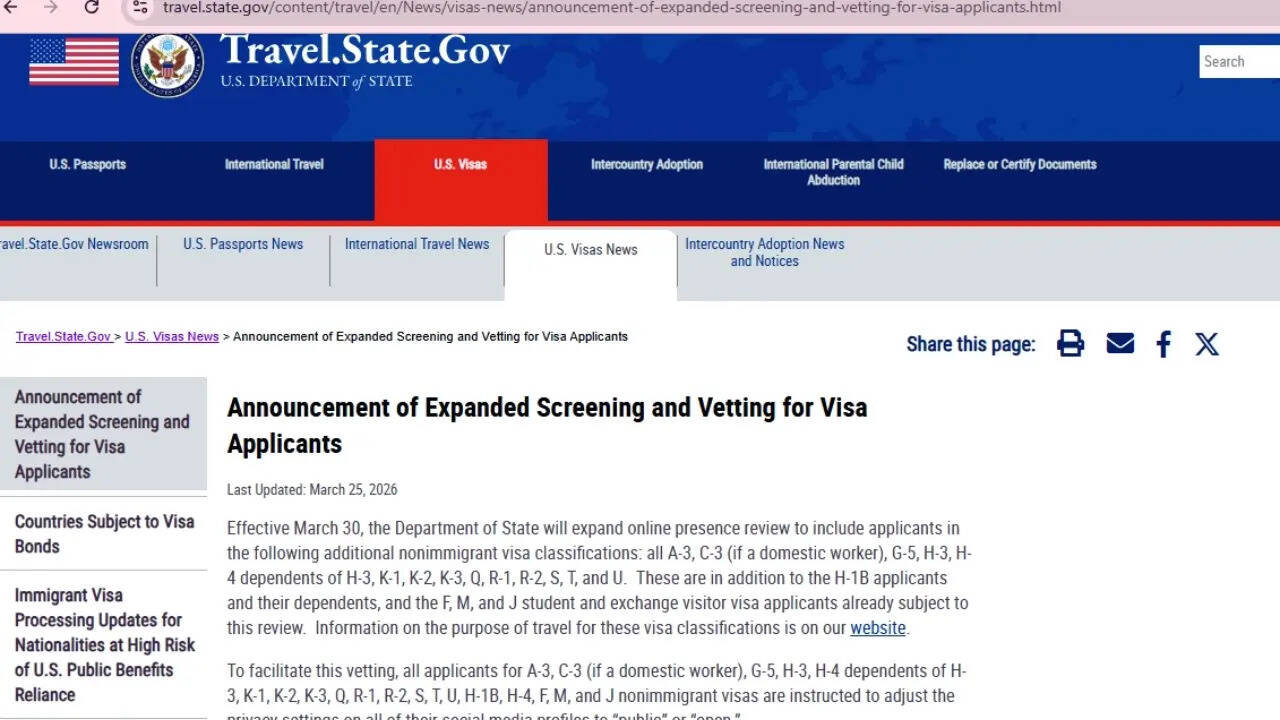
US Department of State
These changes are based on the requirements that already exist and are currently applied to H-1B holders of specialty occupations and dependents, in addition to F, M, and J visa applicants who include students, vocational trainees, and exchange visitors. This expansion means that a majority of the non-immigrant visas will be subject to the new digital screening.For the process to be effective, the State Department has asked applicants in all these categories to make the privacy settings of their social media accounts public or open.
This is to ensure that the consular officers have access to the information that the applicants have online. The department has not mentioned the specific sites that applicants should make public but stated that all the information they have access to will be used in the evaluation process.The State Department further indicated that the social media data is part of an overall framework of background checks intended to identify those persons who may be inadmissible to the United States.
This includes those persons who may pose a potential threat to national security or public safety. In this case, it is worth noting that the department undertakes an exhaustive process of vetting every individual. In addition, it uses various sources of information in order to make an informed decision.“Every visa adjudication is a national security decision,” said the department in its statement. In this case, it is worth noting that authorities are keen to ensure that every individual does not intend to cause harm to U.S.
citizens or its interests. In addition, it is also imperative to ensure that every individual meets every criterion relating to their category of visa.In addition to national security concerns, every individual is expected to ensure that their intentions in the U.S. are consistent with those of their category of visa. In this case, it is imperative to note that every individual is expected to provide credible evidence of purpose.This policy, therefore, supports the long-standing position of the U.S. government that a visa is not a right, but a privilege that is bestowed upon eligible applicants. The consular officers are expected to review each application on a case-by-case basis, considering not only the documentation but also any available background information, including online presence.Though the department has sought to assure that this additional vetting of applicants is a security necessity, the fact that applicants are expected to make their social media profiles publicly available represents a significant shift in the visa application process.Additional information on the purpose of travel and the qualifications for specific types of visas can be accessed on the official website of the State Department. It is recommended that applicants seek to familiarize themselves with the guidelines before seeking to submit their applications.








 English (US) ·