

 9 hours ago
6
9 hours ago
6
ARTICLE AD BOX
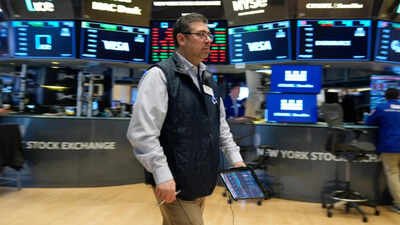
File photo (Picture credit: AP)
US stocks opened sharply lower on Thursday as a fresh surge in oil prices, rising Treasury yields and a cautious stance from major central banks rattled investor sentiment, with the escalating war in the Middle East continuing to dominate global markets.Wall Street retreated early after the latest jump in energy prices, while central banks held interest rates steady amid mounting inflation risks.About five minutes into trading, the Dow Jones Industrial Average was down 0.7 per cent at 45,909.86, the broad-based S&P 500 had fallen 0.9 per cent to 6,565.60, and the tech-heavy Nasdaq Composite had tumbled 1.3 per cent to 21,872.69.
Oil shock keeps pressure on equities
The main drag on Wall Street was another spike in crude prices after fresh attacks on Gulf energy infrastructure.
International benchmark Brent crude surged as much as 10 per cent before pulling back, while European gas prices rose 35 per cent following the latest strikes linked to the Middle East war.Brent briefly climbed above $119 per barrel before easing to $112.70, still up 5 per cent from the previous day. US benchmark crude was also higher, rising 1.4 per cent to $96.78, as Iran stepped up attacks on oil and gas facilities around the Persian Gulf in response to an Israeli strike on a major Iranian natural gas field.
The attacks have deepened fears that oil and gas output in the Gulf could be disrupted for an extended period, raising the risk that higher energy prices could feed through into global inflation.“Obviously energy prices and the war is going to be front and center for a while until investors understand what the path forward is,” Jack Ablin of Cresset Capital Management said, according to news agency AFP.
Fed and other central banks add to investor anxiety
The sell-off was also driven by concerns that central banks may stay hawkish for longer if energy-driven inflation persists.European Central Bank raised its inflation forecast while keeping rates unchanged, while the Bank of England and Bank of Japan also held rates steady, following the Federal Reserve’s decision on Wednesday to leave rates unchanged.Traders were particularly unsettled by comments from Fed Chair Jerome Powell, which were seen as discouraging hopes for rate cuts in 2026.Market expectations have shifted dramatically. Traders are now pricing in about a 10 per cent chance of a Fed rate hike by year-end and a nearly 84 per cent chance rates will at least remain unchanged, according to CME Group data. Just a month ago, those same traders were betting on a 74 per cent probability of two or more rate cuts this year.“The shift in rate-cut expectations has been a major buzzkill for the stock market, which is also sobering up at the sight of rising Treasury yields,” Briefing.com analyst Patrick O’Hare said, as quoted by AFP.
Treasury yields rise as economic data stays firm
Treasury yields moved higher as markets reassessed the path of US monetary policy.The two-year Treasury yield rose to 3.85 per cent from 3.76 per cent late Wednesday, touching its highest level since the summer.The 10-year Treasury yield climbed to 4.28 per cent from 4.26 per cent late Wednesday and from 3.97 per cent before the Iran war began.The rise in yields was supported not just by oil-driven inflation fears, but also by stronger-than-expected US economic data. One report showed fewer Americans filed for unemployment benefits last week than economists expected, while another showed manufacturing activity in the mid-Atlantic region accelerated unexpectedly.Higher yields typically pressure equities by increasing borrowing costs and reducing the appeal of risk assets.
Micron drops despite strong results; Rivian jumps on Uber deal
Among individual stocks, Micron Technology was among the notable laggards.Micron fell 7.3 per cent, even though the chipmaker posted a strong quarter with record revenue and profit that beat analyst expectations. Analysts cited profit-taking after the stock’s earlier rally.On the upside, Rivian surged after a major deal with Uber.Rivian jumped 7.5 per cent after Uber said it would invest up to $1.25 billion in the EV maker to buy 10,000 fully autonomous robotaxis, with an option for 40,000 more. Uber shares rose 0.9 per cent.
Global sell-off extends beyond Wall Street
The weakness in US stocks followed sharp declines across international markets.Stock indices fell 3.4 per cent in Japan, 2.7 per cent in South Korea, 2.6 per cent in Germany and 2.6 per cent in the UK as investors globally reacted to the widening energy shock.While Wall Street’s losses were more moderate than those seen in Asia and Europe, AP noted that US companies are relatively less dependent on Gulf oil than some overseas peers.









 English (US) ·