

 1 week ago
12
1 week ago
12
ARTICLE AD BOX
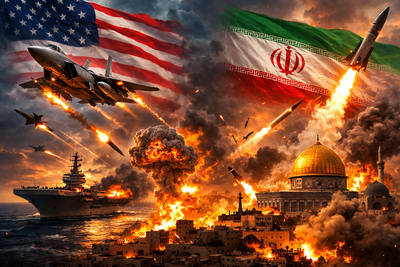
As tensions between the United States, Iran and Israel escalate following sustained strikes and counterstrikes, a senior Indian Army veteran believes Washington may not seek a prolonged military engagement and could move towards an exit within days.Maj Gen Rajan Kochhar, VSM (Retd), a senior Indian Army veteran from the Army Ordnance Corps with nearly 37 years of command and strategic logistics experience, says the coming phase of the conflict is likely to see peak intensity before diplomatic recalibration sets in.He warns that the immediate window will be the most volatile."The next 24 hours will be even more intense for both the US and Iran. As the US keeps weakening Iran's military and missile capabilities, Iran won't hold back on its attacks—every day chips away at its arsenal.
Gulf nations remain soft targets and will keep bearing the brunt."According to him, Iran has little incentive to scale down its retaliation in the short term because each passing day reduces its operational strength under sustained American strikes.At the same time, he argues that Washington may not be interested in a drawn-out war.“Trump may not like to prolong this war as a regime change cannot happen through missiles and drones.
USA will exit after few days with a negotiated settlement on the nuclear issue.”He suggests that the broader objective would be to weaken Iran militarily before pivoting towards diplomacy.“Having sufficiently degraded the war-waging potential of Iran, attempts to influence the population in Iran for change of leadership will continue. We will see a change among the Gulf countries. They will now need to spend more on building a stronger military, especially air defence architecture.
US influence on these countries is likely to get reduced. Iran will now see more isolation in this region as it has committed harakari by targeting its neighbours.
”
Regime change through air power?
Maj Gen Kochhar also questions whether military strikes alone can drive political change in Iran. He connects the Iran conflict to parallel developments in Pakistan and Afghanistan, arguing these are cases of "short wars, long consequences."At the heart of Kochhar’s assessment is the belief that Washington will seek to limit the duration of the conflict.
The economic consequences for global markets, oil flows and Gulf economies allied with the United States would be severe if the war drags on.He suggests that after degrading Iran’s missile and military infrastructure over the coming week, Washington may shift towards negotiations centred on curbing Tehran’s nuclear programme. Any attempt at political transformation within Iran, he argues, would likely be gradual and driven by internal factors rather than immediate military action.In his view, while the next few days could witness maximum military intensity, the broader conflict may not extend much beyond a short window. What follows could instead be a prolonged phase of negotiations, strategic recalibration in the Gulf, and internal political pressure within Iran over the coming years. theatres may be strategically connected.“The Iran and US War as well as the Pakistan and Afghanistan war seem to be related events.
And why I say that is because the United States, in case of extended conflict with Iran, is likely to use air bases in Pakistan. And the security of those air bases in Pakistan would be paramount to ensuring there is no interference from Afghanistan.”He points to recent developments in Afghanistan as part of this evolving equation.“So what is happening now in Afghanistan is in today's present update. Pakistan Air Force has struck at Bagram Air Base, also in Afghanistan, as well as the other important military installations to weaken the military potential of Afghanistan.
This war with Afghanistan is not going to last for a very long time because Pakistan is not going to get into a conventional war considering the terrain in Afghanistan. And therefore it will be restricted to airstrikes, whereas Afghanistan is likely to indulge in asymmetric war.
And we may see a number of suicide attacks and ID blasts and sniper actions on the Pakistani military from Taliban, Taliban BLA within Pakistan coming to the Iran war right now.”Turning back to Iran, he underlines that the American political objective appears to have translated into leadership targeting.“The political aim of the Americans was a regime change and therefore it got translated to the military aim in which the political and the military leadership was targeted. And we have seen this happening in the last 24 hours. Most of the political leadership has been eliminated. A second rung of the political as well as IRGC leadership is in place today.”However, he stresses that regime change is ultimately a domestic process.“A regime change can only happen in case the people of Ghana, people of Iran, you want that to happen. So far it's not happening and it's likely to be a drawn out process.”In his view, the current military phase is about inflicting maximum damage within a limited timeframe.“Donald Trump has infected enough damage on Iran to exit from this war maybe after a week or so.
And in this ensuing week he is likely to inflict maximum damage on the war waging potential of Iran because I don't think this conflict is going to be prolonged very long because it has a devastating effect on the world economy also and as also the economy of the other Gulf countries which are an ally of United States.”He believes that once Iran’s war-making capacity is sufficiently degraded, negotiations could follow.“So I think this conflict will help in another seven days, weakening Iran to a very large extent. And the objective of pushing back the nuclear program would have been achieved thereafter. A kind of negotiations will take place in which Iran will agree to cut down on its nuclear program.”Finally, he suggests that any deeper political shift inside Iran would take years rather than months.“Slowly, slowly America will try to make ingress into this kind of a civil war, kind of a situation in Afghanistan in which it may try to create conditions within Iran, sorry, within Iran, a civil war, a situation, unrest from the people within and maybe a regime change at a subsequent stage, but not in the recent couple of days or couple of months.
I think it'll take possibly a couple of years where the regime change in Iran will take place.
”
Short war, long consequences
Army veteran Kochar suggests that after degrading Iran’s missile and military infrastructure over the coming week, Washington may shift towards negotiations centred on curbing Tehran’s nuclear programme. Any attempt at political transformation within Iran, he argues, would likely be gradual and driven by internal factors rather than immediate military action.In his view, while the next few days could witness maximum military intensity, the broader conflict may not extend much beyond a short window. What follows could instead be a prolonged phase of negotiations, strategic recalibration in the Gulf, and internal political pressure within Iran over the coming years.






 English (US) ·