

 1 hour ago
5
1 hour ago
5
ARTICLE AD BOX
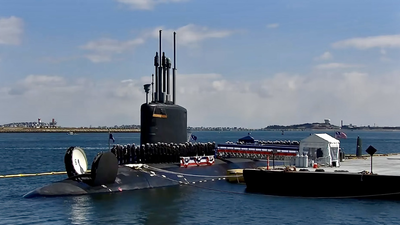
USS Massachusetts (Image/X)
The USS Massachusetts (SSN 798) officially joined the US Navy on Saturday following a commissioning ceremony in Boston Harbor. The vessel has become the 25th submarine to be commissioned and the first to be named after Massachusetts.
The commissioning ceremony celebrated Massachusetts’ long-standing ties to the nation’s maritime and military history. Massachusetts Governor Maura Healey emphasized the symbolic significance, calling it “a proud moment for the state and the country” as the nation approaches its 250th anniversary.The vessel is the 25th Virginia-class submarine co-produced by General Dynamics Electric Boat and Newport News Shipbuilding and the fifth US Navy vessel named after Massachusetts, according to Associated Press.
Specifications and capabilities of USS Massachusetts
The USS Massachusetts is a Virginia-class fast-attack submarine, designed for a wide range of missions, including anti-submarine and anti-surface warfare, intelligence gathering and special operations support. Measuring 377 feet in length and 34 feet in beam, the submarine displaces approximately 7,800 tons submerged, increasing to 10,200 tons with the Virginia Payload Module.
The submarine is nuclear-powered and capable of diving to depths greater than 800 feet (240 meters).
It is designed for multiple roles including anti-submarine warfare, anti-surface warfare, intelligence gathering, strike missions and support for Special Operations Forces (SOF).The vessel can exceed speeds of 25 knots. It is armed with 24 Tomahawk cruise missiles and Mk 48 torpedoes, offering both long-range strike capability and precision underwater combat. The crew of 147 includes 39 women based on the Navy’s gender-integrated personnel policies introduced 16 years ago, according to US Navy's official website. The USS Massachusetts represents a new era for the US submarine force, being intentionally designed for both men and women to serve onboard. The inclusion of women in the crew follows the Navy’s lifting of previous restrictions on female submariners.
Design innovations in the Virginia-Class
The Virginia-class submarines incorporate numerous technological advancements over previous classes. Traditional periscopes have been replaced with photonic masts that feature visible and infrared digital cameras, allowing improved situational awareness and enhanced control room layouts. The reconfigurable torpedo room supports the accommodation of Special Operations Forces and their equipment, enabling prolonged missions. The introduction of Virginia Payload Tubes has replaced the smaller Vertical Launch System, allowing for more flexible and powerful missile deployment.Furthermore, the Virginia Payload Module adds additional missile capacity and provides dry deck shelters for SOF operations, expanding the submarine’s operational versatility.
Comparison: Los Angeles-Class vs Seawolf-Class vs Virginia-Class Submarines
The US Navy currently operates three primary nuclear-powered fast-attack submarine (SSN) classes: Los Angeles, Seawolf and Virginia. Los Angeles-class submarines, first deployed in 1976, have served as the backbone of the fleet for over 40 years. They are smaller, versatile and carry a combination of Tomahawk missiles and Mk 48 torpedoes. Seawolf-class submarines, commissioned beginning in 1997, are larger, quieter and optimized for deep-ocean stealth missions, with advanced payloads and eight torpedo tubes.
The USS Jimmy Carter (SSN 23) includes a multi-mission platform for additional classified capabilities. Virginia-class submarines, including the USS Massachusetts, combine the strengths of both previous classes, offering advanced littoral operational capabilities, enhanced missile payloads and integrated support for special operations forces.The commissioning of the USS Massachusetts enhances the US Navy’s undersea capabilities at a time of growing global submarine proliferation.
With nuclear propulsion, advanced stealth technology and multi-mission flexibility, the submarine ensures the United States maintains strategic dominance in both open-ocean and coastal environments. The Virginia-class bridges the gap between older Los Angeles-class vessels and the specialized Seawolf-class, incorporating innovations that allow for modernization and rapid introduction of new systems over the submarine’s operational life. The USS Massachusetts not only strengthens national defense but also exemplifies the Navy’s adaptation to evolving technological and operational requirements in the 21st century.








 English (US) ·