

 1 hour ago
5
1 hour ago
5
ARTICLE AD BOX
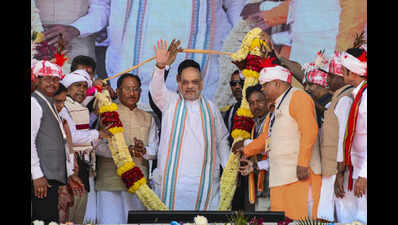
RAIPUR: Union home minister Amit Shah on Monday sought to stitch the Centre’s endgame against Maoists with a deadline-driven governance push, stating at the concluding programme of Bastar Pandum that the govt is prepared to meet violence “weapon to weapon” if Maoists don't surrender, but will extend a “respectful” exit to those who surrender. He promised that soon after Maoism ends, the state will move at scale to deliver electricity and digital connectivity to Bastar’s remotest villages before December 2027 under the Niyad Nellanar roadmap.Addressing the gathering in Chhattisgarh's Jagdalpur, Shah said President Droupadi Murmu’s association with Bastar Pandum has elevated the festival’s national standing. He said winners across the 12 categories would get an opportunity to present their talent at Rashtrapati Bhavan and have meal with the President. Niyad Nellanar roadmap: power and connectivity by Dec 2027Projecting Niyad Nellanar as a roadmap for welfare and governance in remote villages, Shah laid out time-bound targets that, he said, would accelerate once Maoist violence ends. He said Bastar’s villages that still do not have electricity and digital connectivity would receive both before December 2027, along with a more predictable delivery of basic services.
Among the commitments he announced were: a post office or bank branch within every 5 km, paddy procurement support at ₹3,100 per quintal, free 5 kg grain per tribal person per month, household support such as gas cylinders and tap-water connections, and strengthening grassroots institutions through elected representatives at panchayat, tehsil and district panchayat levels.Shah said the end of Maoist violence would open the door for a larger economic and tourism pivot, citing possibilities such as adventure tourism, homestays, canopy walks and glass bridges, and said Bastar is already emerging “as a brand”.Shah announced that a new 118-acre industrial area is being developed to generate employment for tribal youth. He also highlighted plans to address irrigation deficits, saying Bastar remains heavily dependent on rainfall. He said an Indravati river irrigation project is being planned to irrigate around 2.75 lakh hectares across villages in Bijapur, Sukma and Dantewada, and projected it would generate 120 MW of power, with an estimated outlay of ₹3,600 crore.On connectivity, Shah referred to the Dallirajhara–Rowghat rail line, pegging it at ₹3,500 crore, and said other large projects—including river-linking works are also being pursued. He added that more than 90,000 youth are being trained in different skills to improve employability.Citing the festival’s footprint of 55,000 participants from seven districts, 1,885 gram panchayats and 32 janpad headquarters, Shah said that the public reclaiming of cultural spaces is itself a marker of how Bastar has moved from the era of mortars, gunfire and IED blasts to mass participation in food, folk dance, theatre, attire, ornaments, crafts, regional literature and forest-based knowledge.Shah repeated an appeal to the “remaining” cadres to lay down arms, saying the govt would take care of their concerns with dignity. He had reviewed the latest rehabilitation package and found it unusually attractive. He expressed particular concern that among those still trapped in the remnants of the insurgency are tribal girls, urging that they be sent for rehabilitation as their “whole life is still ahead.”"Let me make it clear, those who fire in tribal villages, burn schools, blow up mobile towers or plant IEDs “will not be spared."
Sharpening the moral argument against IEDs, Shah asked why those who plant explosives ignore the fact that it is often ordinary tribal civilians who lose limbs or lives. “An innocent child can be blown up… people can be crippled for life,” he said, adding that the govt's fight is not with any community “even if they are Naxals,” but for the security of tribal people.Shah said he had come to Bastar even before becoming home minister and returned after taking charge in 2019, and that the atmosphere has visibly shifted.
“Now there is no curfew atmosphere. Children are seen playing,” he said, calling it a major change for the region.He said several schools that had remained shut for decades have been reopened, arguing that shutting schools did no good to tribal society and instead created deprivation and illiteracy. He thanked personnel of the DRG, CRPF, ITBP and BSF, calling the operations against Maoists a “decisive battle” that came at a heavy cost, including lives lost and permanent injuries, and expressed confidence that Bastar would become Maoist-free within the stipulated timeline, enabling the development roadmap to move faster once violence ends.








 English (US) ·