

 1 hour ago
5
1 hour ago
5
ARTICLE AD BOX
West Bengal Chief Minister Suvendu Adhikari on Sunday lauded the Kolkata Municipal Corporation's decision to rename a road currently known as Suhrawardy Avenue after Gopal Mukherjee, also known as Gopal Patha, a controversial but influential figure associated with the Hindu response to the Direct Action Day violence of 1946. However, Adhikari's post sparked a row as the road was named after Hassan Suhrawardy the academician, and not Huseyn Suhrawardy, the politician associated with the Calcutta Killings of 1946.
Calling the move "historic", Adhikari said the decision, taken on Paschimbanga Divas on Saturday (June 20), was a step towards correcting what he described as a long-standing historical wrong. "Suhrawardy Avenue will now be renamed Gopal Mukherjee Road," he wrote on X on Sunday.
Adhikari argued that one of Kolkata’s major arterial roads had for decades carried the name of a man who, according to him, misused state power and presided over violence against innocent citizens for political gain.
People saw the remarks being directed at Husseyn Shahid Suhrawardy, the last premier of undivided Bengal, who is accused by historians of playing a key role in the Direct Action Day communal violence that engulfed Calcutta in August 1946.
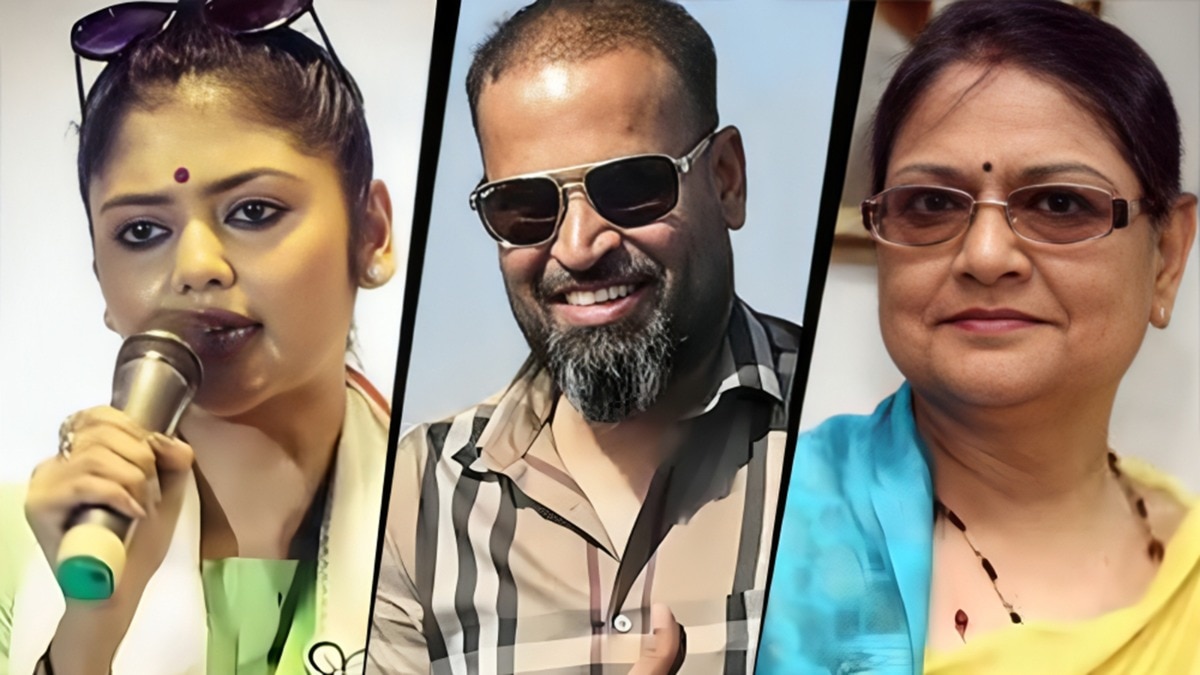
Saket Gokhale, a former MP and national spokesperson of the Trinamool Congress, wrote on X, "The road was NOT named after Huseyn Suhrawardy who is known as the Butcher of Bengal."
Adhikari in his post said renaming the road after Gopal Mukherjee would help restore historical justice by honouring a "true guardian and saviour". "It's time West Bengal remembers, corrects and honours the real heroes," the CM added.
WHO WAS HASSAN SUHRAWARDY, AFTER WHOM SUHRAWARDY AVENUE WAS NAMED?
While Adhikari has framed the renaming as the correction of a historical injustice, critics have raised a different question altogether: Is the road actually named after Husseyn Shahid Suhrawardy?
Gokhale was among the first to point out that the road was not named after the former Bengal Premier, Husseyn Shahid Suhrawardy — often referred to as the "Butcher of Bengal" — but after his uncle, Hassan Suhrawardy, a distinguished academic, surgeon and public figure.
"I think KMC has done a great mistake," wrote TMC's Kunal Ghosh on X, pointing out how the two Suhrawardy were uncle and nephew. "Hon'ble Chief Minister must check the fact, should instruct KMC to check the records. If, by mistake, instead of the nephew, they punish his uncle, that will be unfortunate," Ghosh added.
Hassan Suhrawardy was the first Muslim Vice-Chancellor of the University of Calcutta, serving between 1930 and 1934. He was also only the second Muslim from the Indian subcontinent to become a Fellow of the Royal College of Surgeons of England.
In 1945, a year before his death, he was appointed Professor of Islamic History and Culture at the University of Calcutta. Beyond academia, he served as an adviser to the Simon Commission and was a member of the Bengal Legislative Council, where he held the position of Deputy President between 1923 and 1925.
Historical records suggest that in 1933, while Hassan Suhrawardy was still alive, the Calcutta Municipal Corporation decided to name the road connecting Park Circus and Kasaipara Lane after him. His residence, "Kashana", a well-known hub frequented by some of India's leading political figures in the 1920s and 1930s, stood on the same road.
The road also occupies a unique place in South Asian history. According to historical accounts, a colonial-era building on the avenue housed the provisional government of Bangladesh during the 1971 Liberation War. Before being handed over to the government-in-exile led by Sheikh Mujibur Rahman, the building had served as the Pakistani Deputy High Commission.
WHO WAS GOPAL MUKHERJEE OR GOPAL PATHA?
Few figures in Bengal’s history evoke as much debate as Gopal Mukherjee, popular as Gopal Patha.
'Patha', which means goat in Bengali, was a nickname Mukherjee acquired because his family ran a well-known mutton shop in Calcutta (now Kolkata).
To some, he was a hero who organised resistance and protected Hindus during one of the darkest chapters in Calcutta’s history. To others, he was a gang leader whose methods reflected the brutal realities of communal violence.
During the Direct Action Day riots of August 1946, large parts of Calcutta descended into chaos as communal clashes between Hindus and Muslims left thousands dead. In the midst of the violence, Mukherjee emerged as one of the most prominent leaders of the Hindu response.
Supporters credit him with organising local defence groups, mobilising Hindu youths, providing shelter to displaced families and widows, and helping save countless lives during the riots.
From August 18 onwards, Mukherjee is said to have led organised resistance against the attacks. Accounts sympathetic to him argue that his actions played a key role in preventing further massacres and in blunting the Muslim League’s political ambitions in Bengal.
When it had become clear that the League's hopes of bringing Calcutta into Pakistan were unlikely to succeed, League leaders eventually appealed to Mukherjee to halt the bloodshed. For his admirers, these actions cemented his reputation as one of the men who helped ensure that Calcutta remained part of India.
GOPAL MUKHERJEE AND THE BENGAL FILES CONTROVERSY
For decades, Gopal Patha remained a largely forgotten figure outside specific historical and ideological circles. His name returned to public discourse following the controversy surrounding filmmaker Vivek Agnihotri's upcoming film The Bengal Files.
The film revisits the communal violence that followed the Muslim League’s Direct Action Day call on August 16, 1946, an episode that left Calcutta scarred by some of the worst communal bloodshed in its history.
However, The Bengal Files sparked controversy even before its release.
Following the trailer launch, Shantanu Mukherjee, the grandson of Gopal Patha, filed an FIR against Agnihotri, alleging that the filmmaker had referred to his grandfather in a social media reel as "Ek Tha Kasai Gopal Patha (There was a butcher named Gopal Patha)".
Shantanu described the portrayal as “derogatory” and “misleading”, arguing that it tarnished the legacy of a man he considers a protector of Hindus during the riots.
Agnihotri denied any attempt to malign Mukherjee and has maintained that the film portrayed Gopal Patha as a hero who led Hindu resistance during the 1946 Calcutta killings.
Now, there is a fresh controversy over Gopal Mukherjee, one of Bengal's most-contested historical memories. And this time around, the controversy has to do with the attempt to honour him by renaming a Kolkata road after him just because it might happen to a very different Sohrawardy.
- Ends
Published By:
Aprameya Rao
Published On:
Jun 21, 2026 21:19 IST



 English (US) ·