

 3 days ago
4
3 days ago
4
ARTICLE AD BOX
A total solar eclipse creates an eerie twilight, prompting scientists to study animal responses. Researchers deployed acoustic recorders to monitor soundscapes before, during, and after the April 2024 event. Surprisingly, sound activity increased, with some species vocalizing more, offering insights into how sudden light loss affects wildlife.
A total Solar eclipse turns day into an eerie twilight. Even if it last just for a couple of minutes, it feels as if the world has slowed down, and that makes it almost magical.For a brief spell, birds hush, crickets chirp early, and the air cools. So do these cosmic moments reveal how deeply creatures depend on sunlight for everything; from feeding to singing?
What happens to animals during a total solar eclipse? Study tells how different animals had bizarre reactions to the eclipse
What is a Total Solar Eclipse?
A total solar eclipse happens when the Moon passes directly between the Sun and Earth, perfectly aligning to block the Sun's bright face from our view. This creates a narrow path on Earth, called the path of totality, where daytime turns to twilight for a few magical minutes, often up to four or five.At that moment, the sky darkens a bit, temperatures drop, and the Sun's glowing outer atmosphere, the corona, becomes visible to the naked eye.
It's a rare celestial arrangement, occurring somewhere globally every 18 months or so, but only along a thin strip about 100-150 km wide.Outside totality, viewers see a partial eclipse, with the Moon covering just a part of the Sun.
Eclipse is also often used as a nature lab
Total solar eclipses plunge daylight into darkness, similar to dusk mid-day, and changing temperature and wind. According to the earth.com, Scientists utilise this natural test, using the April 2024 event across US grasslands to check out animal responses.
A team tracked prairie soundscapes that included birds chirping, insects buzzing, and frogs calling to see how sudden darkness alters routines.
Scientists tested sound over just the appearance
Instead of having a look at animals, researchers deployed acoustic recorders at Ohio sites like Larry R. Yoder Prairie and Highbanks Metro Park. These captured voices before, during, and after totality without disturbance. The method shows ecosystem changes through sound diversity and intensity.
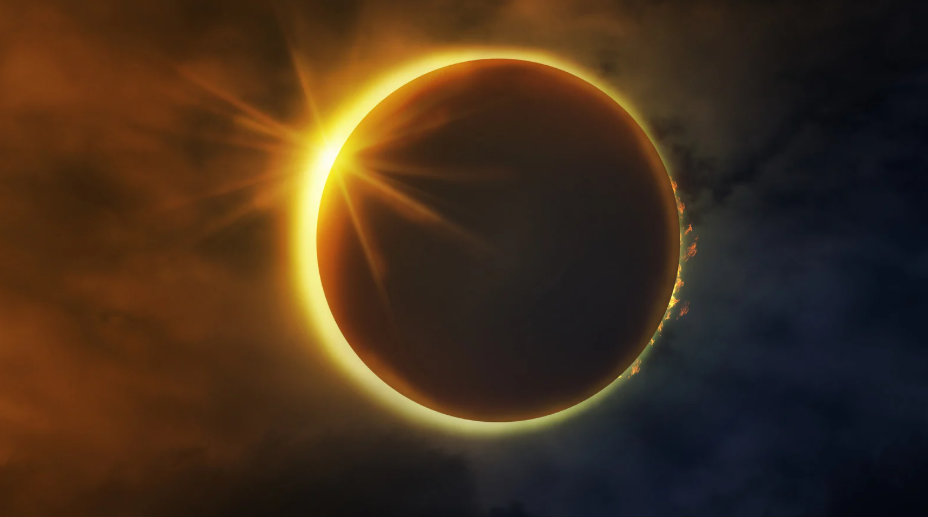
Total Solar Eclipse- Representative Image
Surprisingly, animals responded differently on eclipse day
According to study, sound activity increased on eclipse day, bucking expectations of dusk-like quiet. Some species amped up calls, others went quiet, but overall complexity held steady. Timing hit breeding season, when birds vocalise heavily, adding context beyond just light hints like temperature changes.
Expert shares information on animals' reaction to the eclipse
“Solar eclipses are wonderful events that let us experiment in natural settings what sudden losses of light could be doing to animals,” said Madison Von Deylen, Ohio State PhD student and lead author of a study published in Ethology, Ecology & Evolution.
She says that light extremes harm physiology, with few prior studies on eclipses.
Promise for tomorrow?
Although results are site-specific but give ways for more acoustic monitoring in ecology. “I’m really excited to see where soundscape work goes in the next couple of decades,” Von Deylen added. It could track climate impacts or habitat loss via subtle audio changes.









 English (US) ·