

 2 hours ago
3
2 hours ago
3
ARTICLE AD BOX
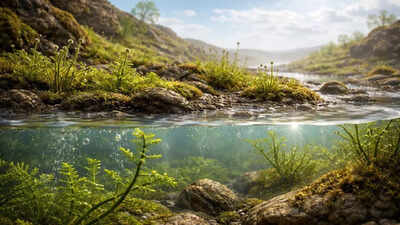
The history of the first plant on Earth is not as simple as the identification of a particular species of plants, but it is a long history of evolution that started in the water and changed the planet over time.
According to scientists, the earliest ancestors of plants were not trees or flowers, but microscopic plants that lived in the oceans billions of years ago.The earliest photosynthetic organisms, likely cyanobacteria, are believed to have appeared at least 2.7 to 3.0 billion years ago, based on geological and fossil evidence. These organisms played a key role in gradually releasing oxygen into the atmosphere, leading to the Great Oxidation Event around 2.4 billion years ago.
How green algae became the first ancestors of plants on land
The earliest organisms considered “plant-like” were photosynthetic algae, particularly green algae, which share a common ancestor with modern land plants. Over time, the group of green algae developed characteristics that would eventually become the defining traits of plants. Scientists agree that modern land plants developed from the green algae, especially the freshwater types closely related to the charophytes.
This transition is supported by fossil evidence, including a study published in Science, which reports the discovery of approximately 470–480 million-year-old fossil spores that represent early land plant ancestors transitioning from aquatic algae.The early algae lived in water, an environment that was stable and conducive to life. However, at some point, some of the algae started adapting to living outside water.
This was one of the most defining moments in the history of the Earth: the advent of plants on land.
The first land plants: Small, simple, and 470 million years old
The first real land plants date back to around 470 million years ago during the Ordovician period. These ancient plants are very different from the ones that exist today. They are small, simple, and lack roots, stems, or leaves.Many scientists believe the earliest land plants were similar to modern bryophytes, such as mosses and liverworts, although their exact form remains uncertain.
They grew near the ground and needed lots of moisture because they did not have advanced ways of transporting water.The primitive plants had to overcome many challenges, such as drying out and the extreme effects of the sun. However, the primitive plants survived and began to colonise the earth.
How early plants changed the planet
The appearance of plants on land had a profound effect on the Earth. Before the emergence of land plants, terrestrial environments were largely barren of complex life, although microbial life may have existed on land surfaces.
The initial plants started breaking down the rocks.Plants were also crucial in controlling the composition of the atmosphere. This was achieved through photosynthesis, in which plants absorbed carbon dioxide and released oxygen.In addition, the initial plants formed symbiotic relationships with fungi, which helped them absorb nutrients from the soil. This was crucial for their survival, especially since they lacked developed roots.
The evolution of more complex plants
After the initial development of the first plants on land, evolution led to more complex life forms. Vascular plants, which are able to transport water and nutrients through specialisation, evolved later.This allowed them to grow taller and over larger distances.Early forms of vascular plants, such as Cooksonia, which display branching patterns and are considered significant in the evolution of modern plants, are found in the fossil record.Some molecular studies suggest that the ancestors of land plants may have begun evolving as early as 600–700 million years ago, although fossil evidence for land plants appears much later.
Why the “first plant” is difficult to define
The idea of the first plant does not exist because evolution takes a long time. There was no sudden development of the first plant. Evolution happened slowly from photosynthetic life to algae and then to land plants.Scientists are still studying fossils, genetics, and ancient environments to learn more about evolution.
Discoveries indicate that the evolution of plants happened on land as far back as 700 million years ago.
A slow beginning that shaped life on Earth
The first plants were small and simple, but their impact has been gigantic. They transformed a barren world into a thriving ecosystem, allowed animal life to evolve, and produced the atmosphere we breathe today.The story of the origin of plants is not just significant because of its historical importance but also because it is part of the larger story of how life is able to adapt, survive, and change the planet.









 English (US) ·