

 1 hour ago
3
1 hour ago
3
ARTICLE AD BOX

A legal dispute involving renewable energy infrastructure and wildlife conservation has put one of India’s rarest birds under the spotlight. The Supreme Court of India is currently considering a case on how to protect the Great Indian Bustard, a critically endangered bird that is found mostly in the desert regions of Rajasthan and Gujarat.The case has put a spotlight on a larger problem that is becoming more prominent in various tourist spots in India.
Bird on the brink
The Great Indian Bustard is the heaviest flying bird in the world, and it was once found in abundance in the grasslands of India. However, the distribution of the bird has shrunk drastically in recent times.The Great Indian Bustard has already been classified as Critically Endangered by the IUCN, and it is believed that there are fewer than 150 of these birds left in the wild, mostly found in the Thar Desert region of India.
Therefore, it is the last location that tourists and wildlife enthusiasts may be able to spot the species in its natural environment, as well as the location of the conservation breeding programs for the species in Rajasthan.
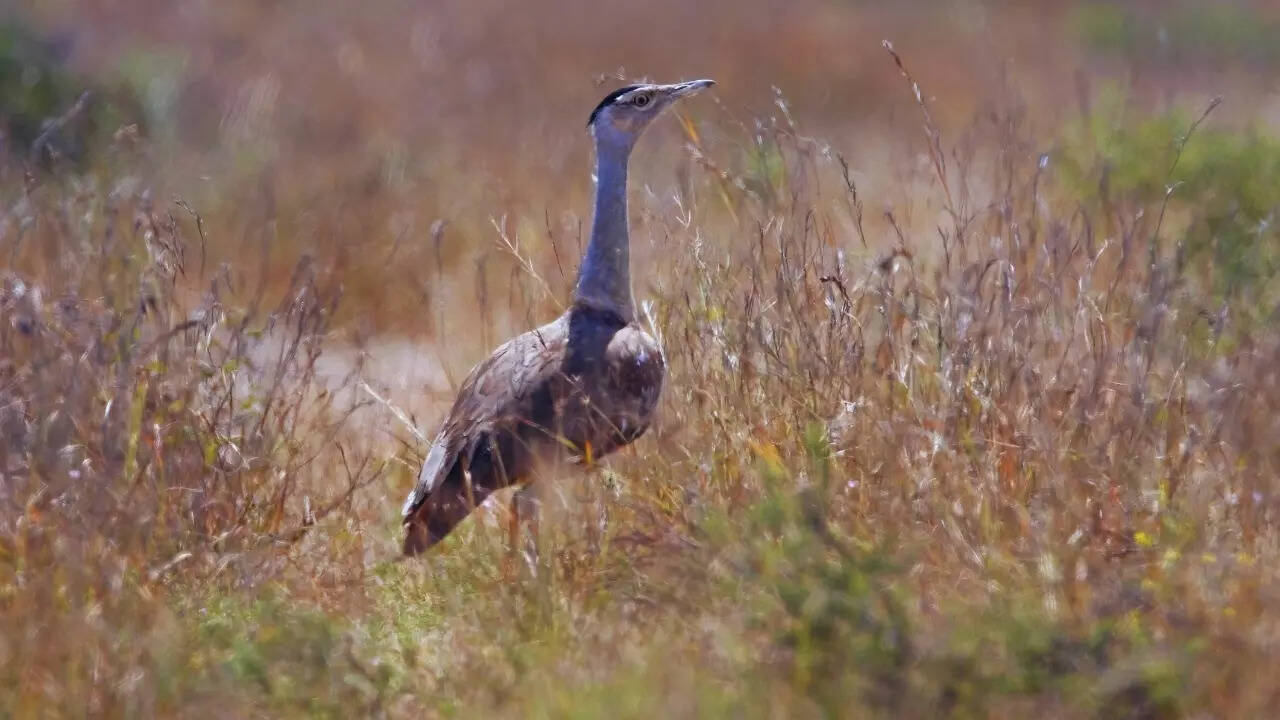
Great Indian Bustard in Rajasthan
An unexpected threat in open landscapes
In the recent past, the species was found to face one of the greatest threats from overhead power lines. The open and sunlit landscapes of Rajasthan make the region one of the best destinations for solar and wind farms, but they also make the area overlap with the bustard’s habitat.
The birds are large, and have no frontal vision, hence they cannot change direction in the air fast enough. They are not able to see the power lines in time and are killed by collisions with them. According to researchers, this is not just a threat to the bustard but also to other large birds in the area, such as cranes and raptors.
What the Supreme Court has said
The issue was referred to the courts as the conservationists asked for more measures to be taken to protect the birds.
The Supreme Court of India passed a ruling in the year 2021 by saying that the power lines in the key habitats of the birds should be made underground and should also be equipped with bird diverters.However, as the implementation of the measures was not feasible, the court again took up the issue in the year 2024 and formed an expert committee to suggest ways to implement the measures effectively. The measures included the identification of the key conservation zones and the feasibility of laying the cables underground.As per a report published by Down to Earth, the Supreme Court took a balanced decision in its verdict passed in the month of December in the year 2025 by saying that the key habitats of the birds should be increased in the states of Rajasthan and Gujarat. The reports also states that a Supreme Court bench led by Justices P S Narasimha and A S Chandurkar has reaffirmed that protection of the Great Indian Bustard is “non-negotiable” while finalising priority conservation areas spanning 14,013 sq km in Rajasthan and 740 sq km in Gujarat.
Within these zones, new wind turbines, large solar parks (above 2 MW), and expansion of existing renewable projects are not permitted, effectively limiting further energy development in these habitats. The court has also issued clear directions on power infrastructure: 80 km of 33 kV lines in Rajasthan must be undergrounded immediately, while other lines in priority areas must be rerouted or insulated within two years.
Additionally, higher-voltage transmission lines must be diverted away from bustard habitats.
Why this matters for travellers
For the traveler, the case highlights the importance of the ecological environment of the desert in India, which is often overlooked in favor of the forest and mountain environments. The Thar Desert, along with the protected grasslands in Rajasthan, remains one of the last strongholds of the Great Indian Bustard.It also highlights the importance of the role that tourism destinations play in the decisions that are made regarding the environment. Today’s decisions regarding the environment are likely to impact the way these environments are experienced in the future.While the legal process continues to evolve, the case highlights the ongoing journey to ensure that development and conservation continue to move forward, preserving one of the most unique and endangered species in India.








 English (US) ·