

 2 days ago
11
2 days ago
11
ARTICLE AD BOX
“That was just unexplainable,” Nodirbek Abdusattorov said in the heady moments after taking down world champion Gukesh Dommaraju in the sixth round of the Tata Steel Chess tournament at Wijk aan Zee. The Uzbek prodigy was speaking about Gukesh’s blunder, which not only left his pawn and a rook defenceless, but also left the door open for his king to be checkmated soon. That’s why, almost immediately after making the blunder, Gukesh had resigned.
That blunder from the 19-year-old world champion had made headlines, simply because of how unexplainable – as Abdusattorov termed it – it was. In the following round, too, Gukesh had another blunder against Anish Giri in a game he went on to lose.
The first round saw multiple players blundering away pieces, none more jarring than Vladimir Fedoseev casting away his knight into a pawn’s path only to be captured as early as the 14th move. It was a blunder so bad that Fedoseev had to resign on the 16th move.
ALSO READ | ‘Feel very sorry for him… absolutely horrible feeling’: Gukesh loses to old foe Nodirbek Abdusattorov at Tata Steel Chess
In the same round, Giri had also blundered away his bishop on the 22nd move: the Dutchman had captured Vincent Keymer’s undefended pawn on d4 with his bishop without realising that Keymer’s rook would hop on c4 to leave both of his bishops into a fork. As soon as Keymer had played rook to c4 (Rc4), Giri had resigned, with just 23 moves played in the game.
The spate of blunders is rare at an elite event. “What’s going on in Wijk?” Latvian grandmaster Arturs Neiksans wrote on X. “I can’t recall the last time there were so many one-move blunders in a super-tournament.”
So why are super-elite players suddenly making school-boy blunders?
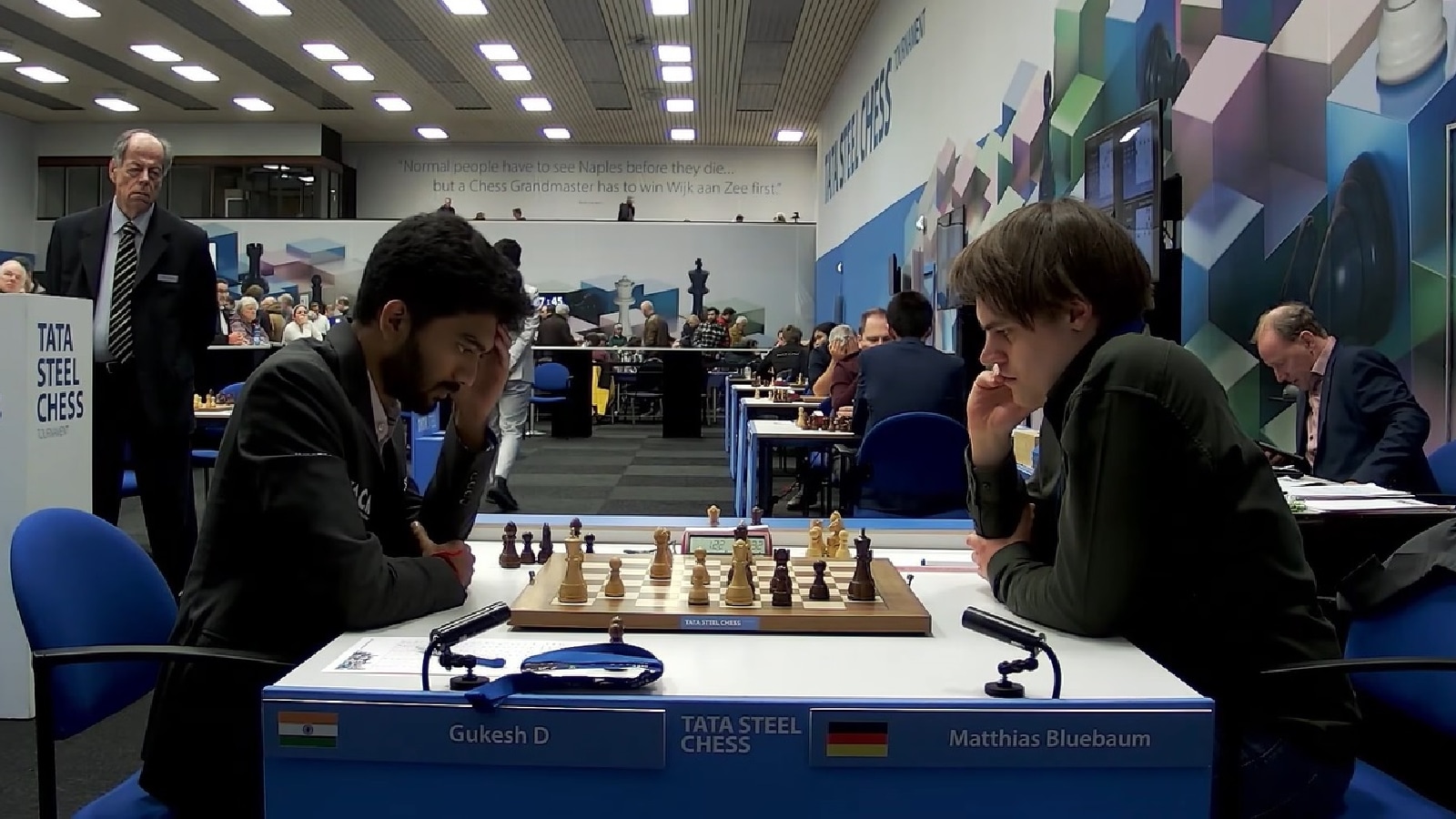
 A disappointed Gukesh after blundering an equal position against Nodirbek Abdusattorov. (PHOTO: Lennart Ootes)
“I have some chess-specific theories, but mainly I think it’s tiredness. Players competing/travelling far more than ever, all different time controls, not to mention media obligations etc. Feels like it’s becoming harder to stay consistent and ‘stable,’” British grandmaster David Howell, who called the spate of blunders a ‘worrying trend’, wrote in response to Neiksans.
Story continues below this ad
Meanwhile elite grandmasters playing in the event have a few explanations why they are making so many blunders.
German grandmaster Vincent Keymer pointed out the new rule at Wijk about not having any increments for the first 40 moves—which is the norm for most classical tournaments. Players have 120 minutes for the first 40 moves and then get
ALSO READ | Magnus Carlsen on Gukesh: ‘Expectations placed on world champion were unrealistic… in part he brought it upon himself’
“We play so many different time controls nowadays, even for classical chess, but we almost never play without an increment. It’s quite a significant change, and I do believe it matters,” Keymer told the YouTube channel of Tata Steel Chess in an interview. “The time control is a factor, and not being used to it changes things. You can feel the difference. Normally, you have an automatic rhythm that you’re used to, but here, we just don’t have it.”
Story continues below this ad
This year at Wijk, fans have been allowed to come in closer to the elite players’ playing area, which means that even whispers are probably audible to the players. In the first round, Gukesh had been irritated by some talkative fans standing near him, and had gestured them to shush with his finger on his lips, just before he had let Javokhir Sindarov escape with a draw from a completely lost position.
Giri, who blundered away his game in the first round, before benefiting from Gukesh’s blunder in round 7 agreed with Keymer about the time control before adding another aspect: the fans being too close to the action.
“The atmosphere in the playing hall is also a bit different. I don’t feel as at peace as I used to be in previous years. The audience is closer than before, and it creates this weird sense that someone is near me all the time. I’m used to having a very wide playing area. Don’t get me wrong, there is still a lot of space between us and the audience, but I’m so used to more that I feel cramped by comparison. I’ve played here for 18 years, so I know how it’s supposed to feel. Now, everyone feels closer,” Giri added.





 English (US) ·