

 4 days ago
8
4 days ago
8
ARTICLE AD BOX

Why freshers must spot internship red flags early (Representative image)
For millions of young graduates entering India’s workforce each year, internships have become more than just a stepping stone—they are often the first and most critical gateway into professional life.
As per a recent hiring outlook report cited by Business Standard, nearly 73% of employers are expected to hire freshers in 2026, signalling strong demand for early-career talent.However, beneath this optimism lies a more complex reality. Not all internships are structured for learning—some operate in grey areas, where expectations are unclear and safeguards are missing.A recent post on Reddit by a fresher full-stack developer is an example that demonstrates how an apparently good opportunity can go awry in a short time.
The post claims that an internship that was initially supposed to be for a short period, with promises of stipends and job prospects, eventually led to months of underpaying and changing expectations without any formal documentation. However, this is only an example of a larger trend that is being seen in the early job market in parts of India.
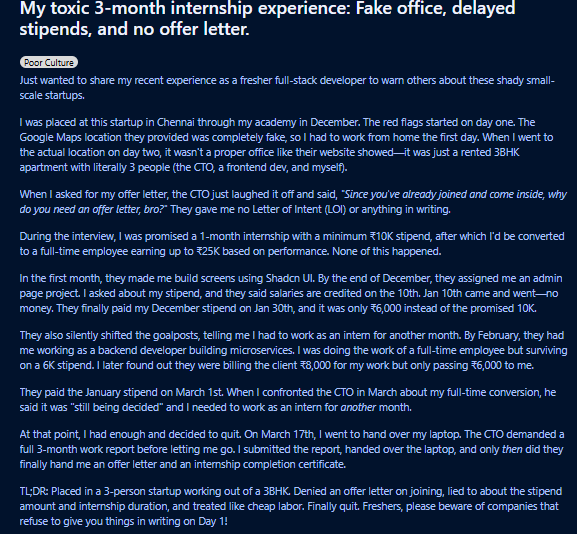
Reddit Post
The promise of opportunity and the vulnerability it creates
India’s job market for graduates shows a clear gap between what students study and the jobs they actually get.
According to the Economic Survey 2024–25, only 8.25% of graduates work in roles that match their qualifications, pointing to widespread underemployment in the country.At the same time, concerns around job-readiness shape hiring trends, with many employers indicating that freshers often lack hands-on, industry-relevant skills. This creates a difficult transition from classroom learning to workplace expectations.
As a result, many graduates accept internships quickly—often without thoroughly evaluating their legitimacy or long-term value—simply to gain practical exposure and remain competitive.In such a scenario, internships are no longer optional; they become a necessity, often taken up with limited scrutiny.
A case study in red flags: When structure is missing
In the Reddit post, the candidate described joining a small startup with verbal assurances of a one-month internship, a ₹10,000 stipend, and the possibility of full-time employment.
However, the absence of a formal offer letter from the outset created immediate uncertainty.The issues extended beyond documentation. The office location reportedly did not match what was advertised, and the organisation appeared to function without a defined HR structure. Over time, the gap between promise and reality widened. The stipend was reduced and delayed, and the internship duration was extended without clear agreement.Without written terms, the candidate had little recourse, effectively operating in an informal setup where expectations evolved but accountability did not.
The blurred line in internships
Internships are intended to be structured learning experiences, but in practice, the line between training and labour can blur—particularly in unregulated environments.According to the Internshala Annual Internship Trends Report 2024, internship opportunities in India have increased by 25% in a single year, underscoring their growing role in early-career pathways.
However, this rapid expansion has also led to wide variation in how internships are structured and managed.In the case of the Reddit poster, their role gradually shifter from simple frontend tasks to more complicated backend work. The level of work increased, however the pay and designation remained the same. What started out as an internship meant for learning eventually turned into full-time employment, minus the benefits.
Why freshers stay even when red flags appear
Despite visible inconsistencies, many freshers continue in such roles due to broader structural pressures.As reported in a survey conducted by AllThingsTalent, almost 44% of fresh graduates are worried about their lack of work experience and hence are likely to seize any opportunity that presents itself. Moreover, as reported in Indeed India, it is observed that there is considerable competition for entry-level positions, and there is a considerable number of applicants for a small number of positions available.
The possibility of being offered a full-time position is also a factor that affects decision-making.
For many, quitting an internship halfway through is also a concern and hence affects decision-making.
Exit without closure: A recurring pattern
In the final phase of the experience, the candidate reported difficulties during the exit process. Formal documentation, including an offer letter and internship certificate, was allegedly provided only after resignation formalities were completed.Such practices highlight a broader issue in loosely structured organisations, where standard processes—onboarding, evaluation, and exit—are often inconsistent or delayed. The absence of clear systems leaves freshers navigating uncertainty at every stage.
A systemic issue, not an isolated incident
Though not all startups follow this pattern, these cases reflect the lack of awareness and supervision in the internship system. As the startup ecosystem in India is increasing, the inconsistencies in the definition of internships are becoming more apparent.For freshers, the challenge is not just about getting the opportunities but also about the authenticity of the opportunities. The fundamental measures of ensuring a contract and open communication are important, yet are often ignored in the enthusiasm of seeking experience.
The cost of “any experience”
For young professionals, in particular, the pressure of gaining experience may sometimes override prudence. As can be seen in this case, experience is not always beneficial in terms of career progression, as it may also require sacrifices in terms of time, effort, and pay.In an ever-changing employment landscape, it is imperative to be aware. Just as there is an expansion of job openings, it is also vital to ensure that these are well-structured, transparent, and fair for those starting their professional journey.









 English (US) ·