

 1 week ago
11
1 week ago
11
ARTICLE AD BOX

Why do women continue to pay a heavy price for wanting motherhood and success?
A 35-year-old woman mayor of Yawata, Japan, announced she would take the government provided 16-week maternity leave. A lot of men in Japan went mad. There’s a familiarity to this story.
It’s not new. But it keeps coming up from time to time, even into the quarter of the 21st century. The latest one being of Shoko Kawata, mayor of Yawata in Kyoto Prefecture, Japan. When she announced she would take a 16-week maternity leave, she became the youngest female city mayor in Japan’s history and the first incumbent mayor to take maternity leave.In a country grappling with one of the world's fastest-declining birth rates, it should have been a heartening story about a young leader embracing both public service and parenthood.
Instead, it became a national controversy. While supporters congratulated her and celebrated what many hoped would become an unremarkable precedent, critics accused her of abandoning her responsibilities, questioned whether she should have become pregnant while in office at all.
They even said that leadership demanded sacrifices motherhood simply could not accommodate. Kawata was harassed to the extent that she had to turn off her social media accounts completely.
Kawata's announcement does more than expose lingering sexism in Japanese politics. It illuminated a prejudice that stretches far beyond Japan's borders, one that continues to shape boardrooms, parliaments, hospitals, universities and courtrooms across the world. Women can't be mothers and have successful careers too.Dipanwita Ray, media personality, author and recipient of the Bal Sahitya Puraskar, 2024, understands what Kawata is going through all too well.
When she was pregnant in 2002, her doctor asked her for complete bedrest for 3 months. Her previous ectopic pregnancy meant complications could arise. When she approached management to ask for leaves beyond the mandated three-month one at that time, her request was plainly rejected.
“No” was the answer. She says, “Eventually I had to give my complicated pregnancy history, and get my doctors and senior members of my family and profession involved to get those extra three months. You could say it was emotional blackmail. The management relented eventually. But why did I need to go through that?”

I somehow realized for the first time just how much discrimination still exists, said Shoko Kawata.
What is the Japanese concept of matahara?
This is a question women have asked for ages. Why does every society that worship mothers and motherhood make ambition and success the mother of all problems for women who work? For women who have ambition? The irony is evident to all women, but the problem persists.In Japan, discrimination against young mothers is still so common that they have a word for it: matahara, or maternity harassment. Some women feel pressure to avoid taking extended maternity leave, worried their careers might suffer. The roots of this contradiction run deeper than employment policies. Modern workplaces were largely designed around an employee who never became pregnant, never needed extended caregiving responsibilities and could devote uninterrupted decades to professional advancement.
That employee was historically male – supported by someone else—his wife—managing the invisible labour of family life.
Although economies have transformed dramatically, many institutions continue to reward precisely that model of uninterrupted availability. The ideal leader is still imagined as someone who is endlessly present, endlessly mobile and endlessly productive.
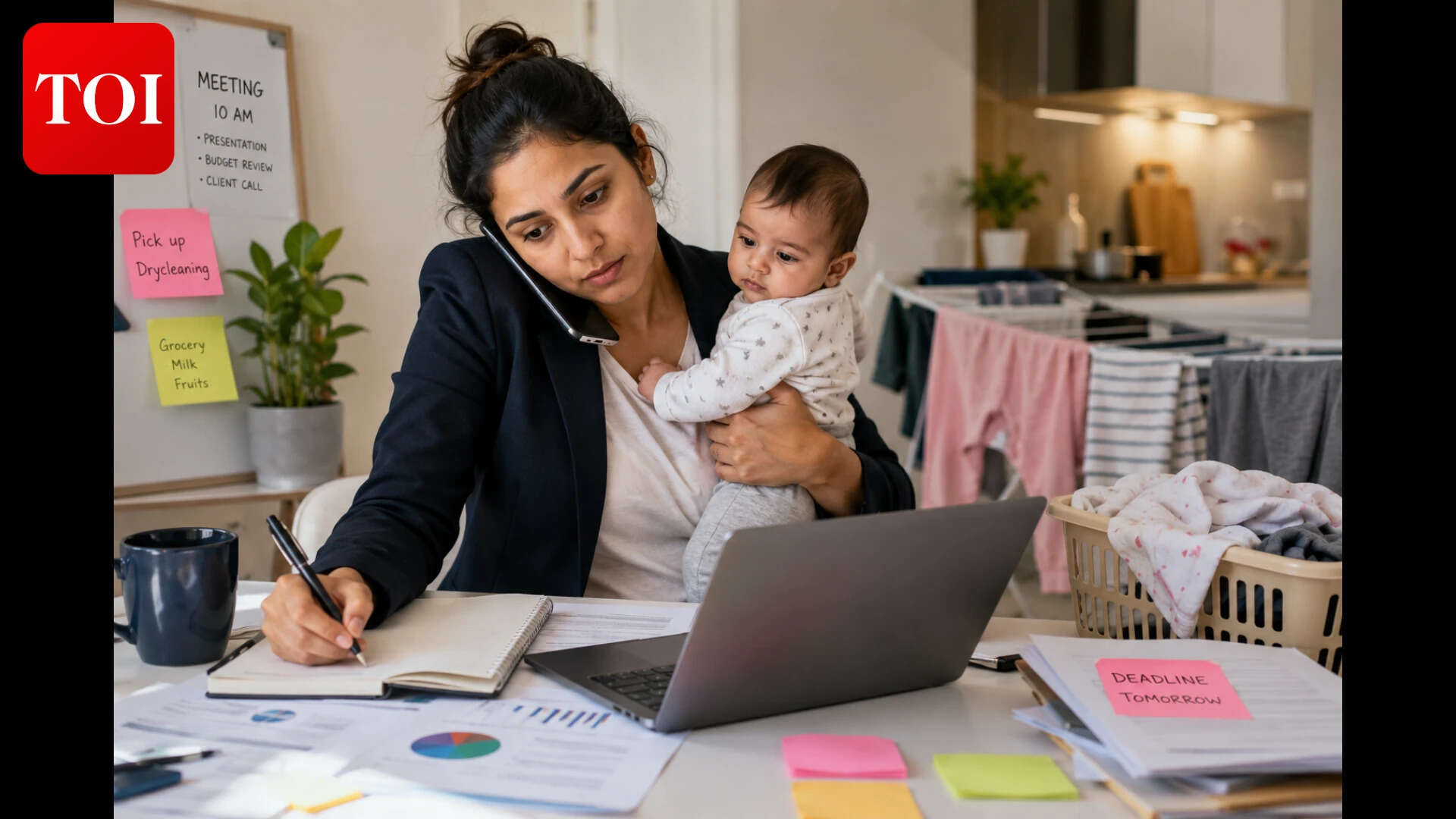
Working mothers experience a drop in earnings, are passed over for promotions, and are perceived as less competent
Why are women still paying The Motherhood Penalty in the 21st century?
Pregnancy interrupts that illusion, and societies far beyond Japan react ignorantly about it not because women are incapable of leading, but because it reminds organisations that leadership has always rested upon assumptions that excluded half of humanity.
Economists and sociologists extensively document a sharp divergence in career trajectories after parenthood. They call it The Motherhood Penalty. And The Fatherhood Premium.
- The Motherhood Penalty: Research shows that working mothers experience a drop in earnings, are passed over for promotions, and are perceived as less competent or committed, regardless of their actual performance.
- The Fatherhood Premium: Conversely, men often receive a salary boost and are viewed as more responsible and dedicated to their careers after having children.
Human Rights lawyer, Mrinalini Majumdar believes this happens because even now all societies fail to distinguish between gender equality and biological equity. “The debate surrounding Japan's Shoko Kawata is not really about one mayor.
Pregnancy is not a privilege; it is a biological reality that ensures the continuation of humankind. Yet women continue to bear professional penalties for menstruation, pregnancy, childbirth and caregiving, while society benefits from their reproductive labour.
”This conversation is particularly relevant to the legal profession in India. Majumdar adds, “There is no recognition of maternity leave for independent practitioners, no institutional childcare support in most court complexes, and little accommodation for the realities of pregnancy and early motherhood.
Crèche facilities, where they exist, are often inadequate or exist only on paper. So we see a large number of women advocates who eventually opt out of practice due to absence of a meaningful framework for such support.
”So the question is not really whether women should take maternity leave. Rather, why do societal institutions continue to treat pregnancy as a disruption instead of recognising it as a social function that deserves structural support.
The measure of a truly equal society is not whether women can occupy positions of leadership, but whether they can do so without being forced to choose between work and motherhood, believes Majumdar.Ray agrees with her completely. “Now, we have a better government framework at least for women working in the government sector in India. But in the private sector, even with the mandatory six month leave in India now, there are judgemental issues that have to be fought.
“Oh, you were not even in office for almost a year. Why should you get a promotion?” It doesn’t matter if a woman even through a pregnancy leave has achieved targets or proved herself to be brilliant at her job.

When Jacinda Ardern became Prime Minister of New Zealand, she made history by giving birth while in office.
Political leadership magnifies these biases even further because it has long been wrapped in myths of constant visibility and physical endurance. Women seeking elected office continue to confront questions their male counterparts rarely hear.
Can they balance the demands of office with childcare? Will family distract them from national responsibilities? Are they emotionally prepared for difficult decisions? The questions masquerade as practical concerns, but beneath them sits an enduring belief that motherhood fundamentally alters a woman's capacity to govern.When Jacinda Ardern became Prime Minister of New Zealand, she made history by giving birth while in office.
The year was 2018. She said: “I am not the first woman to multitask. I am not the first woman to work and have a baby... there are many women who have done this before,” she said, as women across the world cheered for her, while social media trolls did what they do best. Reduce her to being a woman who had dared to have it all.
“We don’t need to fix women. We need to fix the workplace”
American lawyer, activist and entrepreneur Reshma Saujani wrote in her book, Pay Up: An Future for Women at Work, about the corporate resistance to motherhood: “We don’t need to fix women; we need to fix the workplace.
For decades, we’ve told women to ‘lean in’ to a system that was never designed for them. True equity means building a workplace that accommodates the reality of caregiving.” Saujani is best known as the founder of Girls Who Code, a nonprofit organization focussed on reducing the gender gap in technology.This problem is particularly vexing in the 21st century also because gynecologists and maternal health advocates have been stressing that maternity leave is a health necessity, not a professional luxury or a “vacation”, since the last century.
Dr. Indira Venkatraman, senior gynaecologist, Apollo Medical Centre, Chennai, has been advocating for women's right to longer maternity leaves because "no two pregnancies are the same, and no woman should be made to feel hers isn't hard enough.
" Adds Dr Venkatraman, "A woman's body gives everything to create life — it deserves rest, not resilience, in return. Pre- and post-natal recovery isn't downtime, it's the foundation of a healthy mother and baby."
Growing a life and recovering from birth are both full-time jobs for a woman's body that simply cannot be compromised or become a choice for women anywhere in the world.Structural stress combined with a premature return to a demanding workplace can lead to higher rates of postpartum depression, burnout, and physical complications. Dr. Gayathri Karthik Nagesh, programme director, obstetrics & gynecology and robotic surgery, Aster RV Hospital, says one of the challenges that women have to face around the world is a standardization process after giving birth to a baby.
Every case of pregnancy and childbirth is completely unique.
"For example, while one woman may have an easier time during recovery, another woman has to deal with complicated surgeries, injuries and even postpartum depression. But contemporary social pressure makes a woman feel as if she needs to get her life together right away. As a result, many women have to cope with the demands of work without proper recovery."History offers countless examples of accomplished women who concealed pregnancies, returned to work before they had physically recovered or delayed motherhood altogether because they feared the consequences. Corporate executives have described scheduling Caesarean sections around board meetings, underscoring the extraordinary pressures of leadership. Lawyers have answered emails from hospital beds.
Academics have postponed children until tenure decisions were complete, only to discover biology was less patient than institutional timelines. These individual stories differ in detail but share a common thread: women repeatedly adapt their lives to fit workplaces that rarely adapt to them.Anjali Ajaikumar, director of Milann Fertility & Birthing Hospital believes India has taken a meaningful step by providing six months of maternity leave, "placing us ahead of many countries".
But she adds, "If we truly aspire to be a developed nation, our conversation must move beyond maternity leave alone. We need to change the mindset around hiring and supporting young women. The question should never be, 'Will she get married or have children?' It should always be, 'What value does she bring?'.
Equally important is creating flexible workplaces. Many roles can accommodate phased returns, part-time schedules, or flexible hours without compromising productivity.
This allows parents to balance both career and family."In her landmark book, Why Women Still Can't Have It All, Anne-Marie Slaughter, CEO of New America, detailed her decision to leave a high-level position in the US State Department to be present for her teenage sons. Reflecting on the “sense of loss, and a sense of betrayal to my own younger, more idealistic, ambitious self.” Slaughter noted that the current structure of professional advancement demands a choice that men are rarely forced to make.

Gynecologists have been stressing that maternity leave is a health necessity, not a professional luxury. (AI generated)
In her memoir, Becoming, former American First Lady Michelle Obama reflected on how motherhood and career intersect. “For me, being a mother made me a better professional, because coming home every night to my girls reminded me what I was working for. And being a professional made me a better mother, because by pursuing my dreams, I was modelling for my girls how to pursue their dreams.”The next conversation India must have is around paternity leave.
Says Ajaikumar, “Parenthood is a shared responsibility. It takes two to raise a child. Countries are increasingly recognising this by allowing parental leave to be shared between both parents. Research consistently shows that children benefit when fathers are actively involved in their early years. As a society, we must also redefine success. Career growth and parenthood should not be competing choices.
Supporting families means creating workplaces where both parents can contribute professionally while also being present for the moments that matter most.”Some progressive corporations and nations have recognized that the single most effective way to eliminate “the motherhood penalty” is to normalize caregiving for both genders. When only women take leave, they default to primary caregivers while men remain in “catch-up” mode. When both genders take leave, the corporate “risk” of hiring a woman of childbearing age also disappears. Sweden and Iceland have successfully pioneered this shift.There are times in history when an idea may have sounded radical. Like expectant moms and dads getting leaves together. But ideas by themselves aren’t always good or bad, pragmatic or unrealistic. At times, it’s just an idea whose time has come. Kawata knows this as a mayor, a woman and an expectant mother. Even if some men in Japan have yet to catch up to it.








 English (US) ·