

 1 week ago
10
1 week ago
10
ARTICLE AD BOX
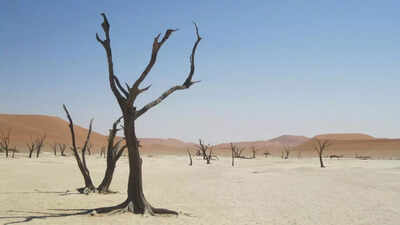
Why Earth never runs out of water all at once: scientists explain (Image Source - Canva)
Global drought rarely arrives as a single, sweeping event. Some years feel widespread, with dry conditions stretching across continents, yet the whole planet does not tip into drought together.
A recent analysis of historical climate records suggests there is a reason for that unevenness. Researchers examined moderate drought conditions between 1901 and 2020 using the self-calibrating Palmer Drought Severity Index, comparing those patterns with long-term sea surface temperature changes. They mapped when droughts began and whether those onsets lined up across regions. What emerges is not a picture of global lockstep drying, but one of partial overlap.
Connections appear, then loosen. Ocean cycles shift. Rainfall patterns resist neat alignment, even as warming deepens the strain.
Ocean cycles prevent worldwide drought from occurring simultaneously
Moderate drought alone is enough to unsettle harvests. In key agricultural regions, wheat, maize, rice and soybean yields drop sharply when dryness crosses certain thresholds. In some areas, the probability of failure during these periods rises above half.Yet those risks are scattered. Maize in parts of North America may falter while rice fields in South Asia hold steady.
Soybean losses in South America do not always coincide with wheat stress in Central Asia. The timing drifts. Failures cluster, but they do not merge into one global collapse.
Pacific ocean cycles disturb synchrony
According to the study, “Regional responses to oceanic variability constrain global drought synchrony”, attention turns often to the Pacific. El Niño years tend to concentrate drought in Australia and parts of Southeast Asia. La Niña shifts dryness elsewhere, towards regions of Africa or South America. The pattern is familiar but not fixed.Network models show that El Niño can tighten regional drought links, creating pockets of coherence. La Niña spreads things out, weakening that clustering. The geography changes shape from one phase to another. There is influence, certainly, but not uniform control.
Rising temperatures add pressure without uniformity
Temperature trends move more consistently. Warmer conditions increase evaporative demand almost everywhere. That signal appears steadier than rainfall.Even so, heat does not dictate location. Rainfall still decides much of that. Some continents warm and dry together. Others warm while rainfall fluctuates in less predictable ways. The layers overlap without fully matching.
Rainfall variability keeps the system uneven
Over decades, precipitation accounts for most of the observed drought trend. Temperature contributes, increasingly so in recent years, but rainfall remains the larger share. Because rainfall responds to regional ocean patterns and atmospheric circulation, its shifts are rarely global at once. Teleconnections link distant places, yet they also fragment them. One ocean basin warms, another cools. Moisture is displaced rather than erased.
So the planet does not dry out in a single breath. It strains, region by region. Synchrony grows in places, then recedes. The system resists perfect alignment.






 English (US) ·