

 4 days ago
11
4 days ago
11
ARTICLE AD BOX
The Centre's proposed changes to the FCRA law have been put on hold for now, following protests from Opposition parties and Kerala church groups. They criticised the Bill, saying it would allow the Centre to take control of minority assets built with foreign donations.
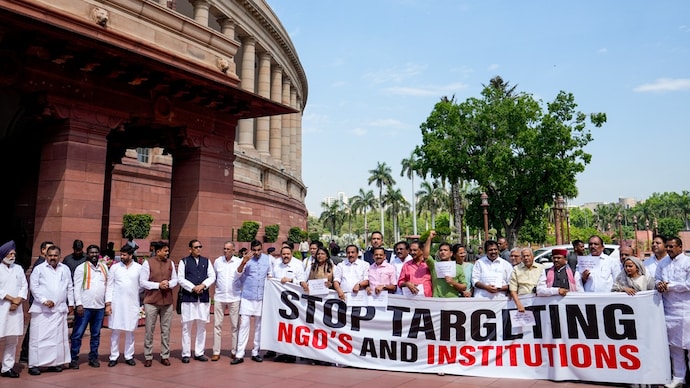
Opposition MPs stage a protest against the FCRA Bill in the Parliament Complex on Wednesday. (PTI Image)
The Centre on Tuesday put on hold the Foreign Contribution (Regulation) Amendment Bill, 2026, after protests in the Parliament Complex and concerns expressed about it. The proposed bill, scheduled to be taken up for discussion on Wednesday, triggered a political storm since it was introduced in Parliament on March 25.
Opposition parties called it "draconian" and accused the Centre of giving itself sweeping powers over NGOs and minority-run institutions. The BJP-led Centre found itself in a Catch-22 situation, as pushing the bill to amend the Foreign Contribution (Regulation) Act (FCRA) of 2010 risked alienating Christian voters in Kerala, where Assembly polls are scheduled for April 9. However, withdrawing the Bill revealed that the party was going soft on foreign-funded NGOs.
On Wednesday, sources said, the government had put the FCRA Bill on hold amid protests from Opposition parties and certain Christian groups based in Kerala. Church leaders in Kerala, especially Catholic bishops, had warned that if the bill was passed, schools, hospitals and charities built with foreign donations could come under government control.
With Kerala heading into Assembly polls, the row quickly turned into a major political issue. Kerala's ruling party, the CPI(M), and the principal Opposition party, the Congress, tried to corner the BJP-led Centre over the proposed bill, which has now been put on hold.
Later in Lok Sabha on Wednesday, Parliamentary Affairs minister Kiren Rijiju accused the Congress and the CPI(M) of "misleading people of Kerala" over the FCRA Amendment Bill.
The FCRA, 2010 is a law enacted to regulate the acceptance and utilisation of foreign contributions or hospitality by individuals, associations, and companies. It aims to prevent foreign funds from affecting activities detrimental to national interest, ensuring transparency, and requires NGOs to register with the Ministry of Home Affairs to receive foreign funds, says the official FCRA Online website.
1. WHY DID THE FCRA BILL BECOME CONTROVERSIAL?
The bill seeks to amend the Foreign Contribution (Regulation) Act, 2010.
The biggest change the amendment proposed is the creation of a "designated authority". This authority would take provisional or permanent control of foreign funds and assets of NGOs if their FCRA registration expires, is cancelled or voluntarily surrendered.
That means schools, hospitals, hostels or welfare centres built partly with foreign donations could be taken over. The proceeds from any sale or transfer would go into the Consolidated Fund of India, the primary account of the Centre.
The Centre argued that the present law does not clearly explain what happens to foreign-funded assets when an NGO loses its licence.
The government said the amendment is needed to plug legal gaps and prevent misuse of foreign funds.
It also says the bill creates a proper framework for supervision and disposal of such assets. Around 16,000 organisations are currently registered under FCRA and together receive nearly Rs 22,000 crore in foreign funds every year, according to the Ministry of Home Affairs.
2. WHY DID OPPOSITION CALL FCRA BILL DRACONIAN?
The Opposition said the bill gives excessive powers to the executive.
Leaders of the Congress, Left parties and the TMC argued that the Centre-appointed authority could seize assets even in cases of minor violations or technical lapses.
The Congress on Tuesday accused the Centre of attempting to "bulldoze" amendments, and announced a protest by its MPs outside Parliament on Wednesday.
On Wednesday, Opposition MPs staged a protest at Makar Dwar in Parliament premises, demanding the withdrawal of the FCRA Amendment Bill, 2026. Leaders from multiple Opposition parties gathered ahead of proceedings.
Congress MP Manish Tewari said the bill suffers from "excessive delegation" of legislative powers.
Congress general secretary (organisation) KC Venugopal claimed that the government was planning to push through the proposed amendments at a time when several Opposition parties were engaged in an "intense election season".
Opposition parties further alleged that the law could be used selectively against NGOs, charities and civil society organisations that are seen as critical of the government.
3. WHY DID KERALA BISHOPS SEE A THREAT IN FCRA BILL?
Strong reaction also came from the church leadership in Kerala, where Assembly polls are scheduled for April 9.
Christian groups feared that institutions run by minority organisations could become vulnerable if FCRA licences were cancelled.
Groups like the Kerala Catholic Bishops' Council and the Catholic Bishops' Conference of India (CBCI) described the bill as "dangerous, undemocratic, unconstitutional and contrary to principles of natural justice".
The CBCI, expressing "grave concern" over the proposed amendments, said the changes, "brought under the pretext of licence renewal", could enable "executive overreach" into constitutionally guaranteed freedoms. The bill, the CBCI said, raised serious concerns about "undue interference" in the functioning of minority institutions and civil society organisations.
Church leaders said foreign donations have long been used to run schools, hospitals, orphanages and welfare schemes in remote areas.
4. DID KERALA POLL TIMING MAKE THINGS WORSE ON FCRA BILL?
The timing of the FCRA bill added to the anger.
Kerala votes on April 9 and Christians make up nearly 18% of the state's population. They also run a large network of schools, colleges, hospitals and charities.
That is why both the ruling CPI(M)-led LDF and opposition Congress-led UDF opposed the bill.
Kerala CM Pinarayi Vijayan wrote to pm Narendra Modi seeking withdrawal of the proposal.
For the BJP, the controversy over the FCRA Bill came at a difficult time. The party has been trying to improve its support among Christian voters in central Kerala. Church opposition has now complicated that effort.
5. WHY HAS CENTRE HIT PAUSE ON FCRA BILL NOW?
After sources said that the bill was put on hold for discussions in the Lok Sabha on Wednesday, Union Minister Rijiju clarified the Centre's stance on its recent move.
The BJP-led Centre denied that the bill targets minorities. It said that the amendment only aims to stop misuse of foreign money and ensure transparency.
"Kerala MPs are under a serious misunderstanding. The FCRA Amendment Bill was introduced earlier, which is why it has come up now. I had informed senior Congress leaders yesterday and again today that the FCRA would not be taken up for consideration today. There is indeed misinformation being spread about the FCRA," Parliamentary Affairs Minister Kiren Rijiju said.
"The amendment is aimed at regulating foreign contributions, ensuring proper utilisation in the national interest and national security, and preventing misuse of funds. It is not against any religion or organisation. Congress and the Communist Party are misleading the people of Kerala in view of the elections. They should not mislead the House or the people of Kerala for the sake of elections," he added.
While the Centre said the bill was deferred because of disruptions in Parliament, politically, the pause gives it some breathing room. For now, the government appears to have stepped back. But it was not withdrawn. It has just kept it on hold. But the fight over foreign funding, NGO powers and minority institutions is far from over.
- Ends
Published By:
Sushim Mukul
Published On:
Apr 1, 2026 15:02 IST








 English (US) ·