

 7 hours ago
6
7 hours ago
6
ARTICLE AD BOX
Bees are the soul of our agriculture, and every morsel of food we eat is indebted to their existence. From mustard and sunflower to countless fruits and vegetables, the production of many crops depends on these tiny pollinators. They hold together the entire food chain, from farms to forests. Yet, it is alarming that chemicals known to kill them continue to be sold and sprayed across Indian farms, allegedly prioritising corporate profits over the country's food security.
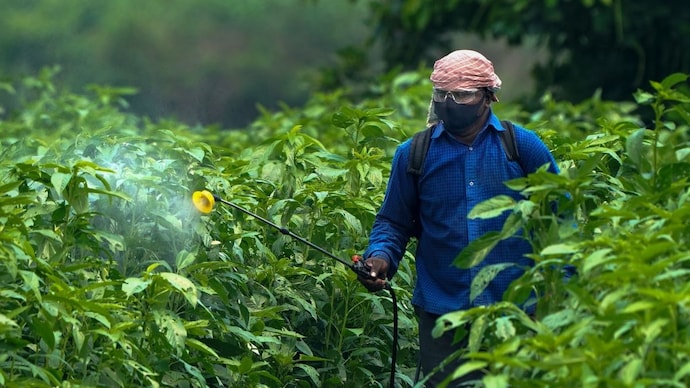
Carbofuran is a highly potent systemic insecticide used against insects, termites and nematodes. (Photo: PTI)

New Delhi,UPDATED: Jun 25, 2026 16:28 IST
The poison that America and Europe banned years ago after declaring it a threat to humans, birds and bees—the farmer's greatest ally—continues to be used in Indian agriculture in the name of crop protection. Government documents themselves reveal how weak regulation, corporate interests and policy decisions have allowed this to continue.
The chemical in question is Carbofuran.
Its story began in the 1960s, when scientists at the American agrochemical company FMC Corporation developed a chemical capable of penetrating every part of a plant. It was promoted as an insecticide that could eliminate almost every pest attacking crops.
In India, it was introduced as bright blue granules. Carbofuran is a highly potent systemic insecticide used against insects, termites and nematodes.
However, over time, researchers found that it did not distinguish between harmful pests and beneficial insects.
It is a deadly neurotoxin for bees, the pollinators that form the backbone of biodiversity. On contact, it attacks their nervous system, often killing them before they can return to their hives. The impact on these vital pollinators has long alarmed environmentalists.
WHY WAS IT BANNED IN AMERICA AND EUROPE?
In 1994, the United States found that nearly two million migratory birds were dying every year after mistaking carbofuran granules for food. The US government responded by banning its granular formulation.
Later, in 2008, the European Union imposed a complete ban on all forms of carbofuran across its member states, citing concerns over risks to humans, wildlife and pollinators.
In 2009, the US Environmental Protection Agency (EPA) adopted a "zero tolerance" approach, banning even its liquid formulations. Under US regulations, any fruit, vegetable or grain found with even trace residues of carbofuran would have to be destroyed.
The irony is striking. The country that invented carbofuran eventually banned it to protect its environment, birds and bees. Yet decades later, the chemical continues to remain a mainstay in Indian agriculture.
THE PRETENSE OF A BAN AND THE 'BACKDOOR'
In 2020, the Union Ministry of Agriculture issued a draft notification proposing a complete ban on 27 pesticides, including carbofuran. It appeared that long-standing concerns were finally being addressed.
But that was followed by strong resistance from pesticide manufacturers.
Industry associations reportedly threatened legal action, arguing that a ban would severely affect their business. When the final gazette notification was issued in October 2023, it revealed a significant exception.
The government banned all formulations of carbofuran except Carbofuran 3% CG (granular form).
This exemption is significant because more than 95% of carbofuran sold in India was already in the 3% granular formulation. Critics argue that while the government announced a ban, the formulation dominating the market remained untouched.
TESTIMONY OF A GOVERNMENT DOCUMENT
Official government documents raise several serious concerns about carbofuran.
The draft notification issued in May 2020 categorised carbofuran as a "Red Triangle" pesticide, indicating high toxicity under Indian classification systems.
It also notes that the World Health Organisation (WHO) classifies carbofuran under Class 1B, recognising it as highly hazardous.
ACCEPTABLE DAILY INTAKE NEGLIGIBLE
The document states that the acceptable daily intake (ADI) is only 0 to 0.001 milligrams per kilogram of body weight, indicating that even extremely small quantities can pose health risks.
A POSSIBLE ENDOCRINE DISRUPTOR
The document further states that carbofuran falls under the European Union's Priority-2 category of endocrine-disrupting chemicals and is included in Tier-1 screening under the Endocrine Disruptor Screening Programme (EDSP).
These chemicals have been associated with hormonal disruption, potentially affecting fertility, fetal development and thyroid function.
BANNED IN 63 COUNTRIES
Perhaps the most striking part of the government document appears in Points 2 and 4.
According to the document, manufacturers did not submit adequate residue or persistence data.
In other words, the government noted that companies had not provided sufficient scientific evidence showing how long carbofuran residues remain in crops or soil.
The document also notes that carbofuran has been banned in 63 countries. According to data from the Pesticide Action Network (PAN), it is prohibited across the European Union as well as countries including the United Kingdom, Canada, Argentina, South Korea and New Zealand.
WHY INDIA DOESN'T USE ALTERNATIVES?
One of the most important questions raised by the document appears in Points 5 and 6.
The government itself acknowledges that alternatives to carbofuran are available.
If agricultural experts and government committees agree that safer and effective alternatives already exist, then why does carbofuran continue to remain in the Indian market?
The draft recommendation was unequivocal.
It stated that carbofuran is toxic to bees, birds and aquatic life, and recommended that its import, manufacture, sale, transport, distribution and agricultural use be prohibited.
If official investigations themselves recommended prohibiting every stage of its use, critics ask why the final 2023 notification retained an exemption for the 3% granular formulation.
WHO WILL TAKE RESPONSIBILITY?
When public health, biodiversity and food security appear to be weighed against commercial interests, many believe public awareness becomes the only remaining safeguard.
Kerala chose to prohibit carbofuran despite industry pressure. Sikkim declared itself a 100% chemical-free state.
The larger question remains.
How long will a pesticide that many countries have rejected continue to be used in Indian agriculture? And how long will chemicals linked to risks for bees—among farmers' greatest allies—continue to find space in the country's fields?
- Ends
Published By:
Koustav Das
Published On:
Jun 25, 2026 16:28 IST







 English (US) ·