

 1 hour ago
5
1 hour ago
5
ARTICLE AD BOX
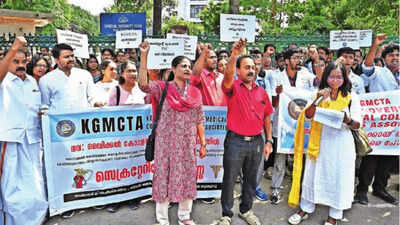
Govt medical college doctors in Kerala are now on strike for 74 days. Long known for being part of one of the best public health delivery systems in the country, they are accusing the state of broken promises — from unpaid arrears, chronic vacancies to unsafe workplaces.During the thick of Covid, the biggest public global health crisis in recent memory, they were feted as heroes — govt doctors in Kerala working round the clock, often for weeks without rest, with just one aim: saving lives.
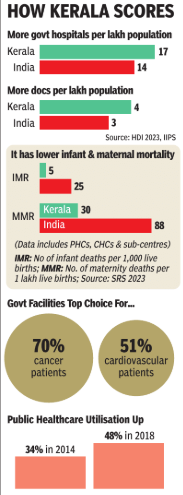
In fact, the entire healthcare model of the state was hailed globally for delivering health outcomes comparable to developed nations, despite modest income levels, with several govt hospitals winning acclaim for performing rare and advanced surgical procedures that were traditionally available only at top private or specialised centres.About six years down the line, the picture is vastly different. The Kerala healthcare model stands at a critical crossroads — hospital infrastructure is fast expanding, but manpower and equipment are in dangerously short supply.
Sounds Of ProtestSo, what went wrong? The same govt doctors who sustained Kerala’s acclaimed public health model — stethoscopes and scalpels in hand — now carry protest banners on the streets instead.On one side are the govt medical college doctors, who have been on protest for the past 74 days and have now declared indefinite boycott of outpatient services, academic duties and even surgeries, except emergency ones.On the other side are the district and taluk govt doctors manning the state’s district hospitals and health centres, who have been protesting since last Thursday at Thiruvananthapuram, demanding basic workplace safety and protection from assaults — after a doctor at Nedumangad district hospital was suspended, following the death of a newborn, due to alleged medical negligence.
Overworked, undervalued and allegedly unsupported by their employer, the govt doctors here alleged that repeated verbal and written assurances from the state govt have been violated.For teachers in govt medical colleges, the key demands are to correct pay anomalies in entry and promotion scales; release pending salary revision arrears since 2016 (which work out to Rs 10 lakh to Rs 20 lakh per doctor); create long-pending teaching and non-teaching posts; end unscientific redeployments; and improve infrastructure for patient care. The remaining govt doctors demand basic workplace safety and protection from assault, alleging that they are often made scapegoats for systemic failures: chronic staff shortage, poor infrastructure, and lack of clear treatment protocols.According to the Indian Medical Association, Kerala, there are five attacks on doctors recorded every week here on average — and zero convictions.‘Health System Will Collapse’Dr Rosnara Beegum T, president, Kerala Govt Medical College Teachers’ Association (KGMCTA), foresees a “complete collapse” of Kerala’s public health system in five years if these issues are left unaddressed, even though it has been the country’s “strongest public health system”.The early signs of an imminent collapse are already visible, she added, explaining that very few young doctors now join the public health sector, resulting in several vacant posts at the entry level.In govt medical colleges, of the sanctioned 2,106 posts, as many as 375 posts — or 18% — are lying vacant. In the directorate of health services (under which the primary health centres, community health centres and district hospitals function), there are around 6,200 sanctioned posts, but nearly 600 (or nearly 1 in 10) of those are vacant.As the govt medical college teachers’ protest grows, state govt has declared that they will not get paid if they don’t work.‘Hosps Severely Understaffed’Kerala has 14 govt medical colleges, 18 district hospitals and taluk hospitals each, 226 community health centres, 849 primary health centres with 10,868 modern medicine doctors.Despite many cracks, Kerala’s public healthcare system is seeing a steady rise in both outpatient visits and hospital admissions.
This is not just due to improved facilities, but due to rising (even unaffordable) medical costs, as an increasing number of small and medium hospitals have shut shop and around six tertiary care private hospitals have seen foreign direct investment.Although overall figures are hard to obtain, going by figures provided by the Thiruvananthapuram Medical College — the most popular — patient numbers have risen steadily since the pandemic.
Pre-Covid, there used to be 3,000-3,500 outpatients on an average per day; this number has risen to about 4,500-5,000 (sometimes even 6,000). Admissions, too, have risen — from fewer than 3,000 preCovid to around 3,500 now.There are the govt insurance schemes, technically valid in several private hospitals, but due to delay in payments, many private hospitals are reluctant to treat insured patients. This forces them to pay out of pocket, resort to crowdfunding for critical care, or seek treatment at govt hospitals, despite long wait times.“It is a complex situation,” said public health expert Dr Raman Kutty. “Statistically, Kerala continues to outperform most Indian states on health indicators — and that is commendable. But those numbers hide a harsh ground reality: our public hospitals are severely understaffed. As new institutions are opened, instead of recruiting more personnel, existing staff are shuffled around. Add to that unpaid dues and unkept promises — frustration is inevitable.
If this continues, it threatens the very foundation of the Kerala health model.”‘We Are All Suffering’In Thiruvananthapuram, Sumaiya still struggles to breathe after a surgery gone wrong. Her family has been running from office to office for last two months, trying to get her medical records to pursue a negligence case (a guide wire was left in her chest after thyroid-gland surgery that was detected later via X-ray) — but the hospital refuses to give them, or even put that refusal in writing.
“They are making us run from pillar to post.
Along with Sumaiya, we are all suffering,” said her brother-in-law, Sabeer Kattakada.Sumaiya had first met the govt doctor, who performed the surgery, at his private clinic. Later, the surgery was conducted at the govt hospital, where consultation and procedure were free, as she is covered under the govt health insurance.As discontent grows, it is the common person who is put to inconvenience, with increased stories of neglect, indifference, and medical negligence.
A small cut that should have healed became a wound that has changed a child’s life forever. At the Palakkad District Hospital, a nine-year-old girl was taken in for a fracture — but what followed was nothing short of a nightmare. Her father, Vinod D, a daily wage worker, alleged that doctors worked on the fracture but ignored a wound until it was too late and the girl’s hand had to be amputated.“The govt says ‘health for all’ — but where is that health when the poor have to pay with their limbs, dignity, and lives? Govt claims to have made the state extreme poverty-free, but what about hundreds of people like us, who are fast sinking to extreme poverty under the burden of hospital expenditure even in govt hospitals,” said Vinod.“The worst affected are the poor and the terminally ill, especially cancer patients. Many choose to suffer in silence at home rather than push their families from poverty to extreme poverty through out-of-pocket treatment costs,” said Fr John Choorapuzhayil of the Wayanad Social Service Society (WSSS).Dr Sunil P K, president, Kerala Government Medical Officers’ Association said standardisation of public healthcare was the need of the hour. “The quality of care varies drastically across districts. One general hospital may have super-specialty facilities, while another in the same district may lack even basic ones. These gaps in patient care are rarely acknowledged, let alone fixed,” he said.Kerala built a reputation on outcomes; it now faces a test of governance — whether it will match new hospitals with people, pay, and protection, or let a celebrated model erode ward by ward.





 English (US) ·