

 1 hour ago
6
1 hour ago
6
ARTICLE AD BOX
Iran has invited Prime Minister Narendra Modi to attend Ayatollah Ali Khamenei's state funeral. How New Delhi responds to the invitation could reveal how it plans to balance ties with Iran, the US and Israel. It's a tightrope walk for New Delhi for sure.
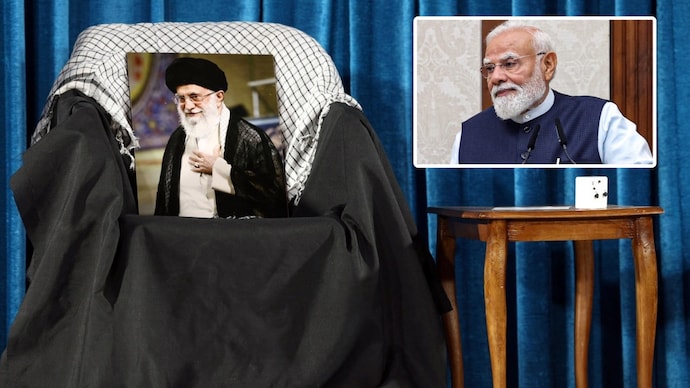
Prime Minister Narendra Modi is unlikely to attend Ayatollah Ali Khamenei's funeral. But who represents India will be watched closely by capitals across the world. (Images: Reuters/PTI)
The invitation from Iran for Prime Minister Narendra Modi to attend the state funeral ceremonies for the late Supreme Leader Ayatollah Ali Khamenei has presented New Delhi with a diplomatic dilemma. Khamenei, who was killed in US-Israeli strikes on February 28, will be buried in Mashhad after funeral processions in Tehran, Qom and parts of Iraq. The funeral will be scheduled between July 4 and 9.
How India responds to Iran's invitation, and whether it sends a high-level representative or not, is likely to be watched closely by countries across the region and beyond. India has had longstanding ties with Iran based on energy, trade, connectivity and cultural links as well. At the same time, its strategic relationships with the US, Israel and key Gulf nations like the UAE have grown significantly over the years. Any decision on representation at the funeral will, therefore, require careful consideration.
India has dealt with similar situations before. When Iranian President Ebrahim Raisi died in a helicopter crash in May 2024, New Delhi declared a day of national mourning and sent then Vice President Jagdeep Dhankhar to Tehran for the funeral. The move reflected the importance India attaches to its relationship with Iran while remaining consistent with diplomatic protocol.
The circumstances surrounding Khamenei's death, however, make the situation more sensitive. He was killed on the first day of the military confrontation involving the US and Israel. India initially maintained silence following the strikes, with its first formal gesture being Foreign Secretary Vikram Misri signing the condolence book at the Iranian Embassy in New Delhi. Prime Minister Modi has repeatedly called for dialogue between Iran and the US, restraint and respect for sovereignty, arguing that conflicts cannot be resolved through military means alone.
A decision to send a senior representative would be in line with India's earlier approach. It would also underline New Delhi's commitment to maintaining ties with Iran regardless of external pressures. At the same time, such a move could attract attention in Washington and Jerusalem, given their role in the events leading to Khamenei's killing.
Khamenei, as the Ayatollah, was also the leader of Shia Muslims worldwide. After Iran, India is home to the biggest Shia population in the world. That makes the funeral of Khamenei even more important for New Delhi.
WHY IRAN MATTERS TO INDIA, AND THE US-ISRAEL FACTOR
India's relationship with Iran goes well beyond symbolism. The Chabahar Port project, a flagship strategic investment for New Delhi, has faced significant challenges in recent months amid the expiry of the US sanctions waiver in April 2026 and the broader regional conflict. Nevertheless, it continues to hold immense long-term importance, offering vital access to Afghanistan, Central Asia, and Europe while bypassing Pakistan. New Delhi remains engaged with both Tehran and Washington to explore ways to sustain and eventually revive the project's full potential.
Energy security is another important factor. Although India has diversified its oil imports, Iran's location near the Strait of Hormuz means developments there have a direct impact on India's energy interests. The presence of millions of Indian expatriates across the Gulf also makes regional stability a priority for New Delhi.
At the same time, India's ties with the US and Israel are among its most important strategic relationships. Defence cooperation with Israel has expanded significantly, while the United States remains a key partner in areas ranging from defence and technology to trade and the Indo-Pacific. India's growing engagement with Gulf countries further adds to the complexity.
Against this backdrop, any prominent Indian presence at Khamenei's funeral could be interpreted differently by different countries. For some, it would reinforce India's independent foreign policy. For others, it could raise questions about New Delhi's positioning at a sensitive moment.
Strategy and geopolitics expert Brahma Chellaney said, "This forthcoming multi-day state funeral for Ayatollah Ali Khamenei in July places New Delhi in an exceptionally delicate diplomatic position. On one hand, India faces a potential 'diplomatic debt' after maintaining a conspicuous silence following his US-Israeli assassination in February. On the other, too high-profile a presence at the funeral risks antagonising Washington and Tel Aviv."
"Sending a senior representative, however, would signal that New Delhi is unwilling to allow its Iran policy to be dictated entirely by the US or Israel, particularly given India's substantial investments in Iran's Chabahar Port — a critical trade gateway to Afghanistan and Central Asia," he also said in a post on X.
WILL PM MODI TRAVEL TO IRAN FOR KHAMENEI'S FUNERAL?
Going by reports, it is unlikely that PM Modi will be travelling to Iran for Khamenei's funeral.
According to a report by The Indian Express, New Delhi has not yet announced the level of representation for the funeral ceremonies. However, a multi-nation visit by the PM is planned around the same time.
India is expected to consider sending a senior-level representative to Tehran, said a report in The Times of India on Thursday.
During the recent conflict, India did not directly condemn the strikes on Iran, even as it had earlier criticised Iranian attacks on its Gulf neighbours.
A final decision on India's representation is expected in the coming days, The Times of India reported, quoting sources.
INDIA'S DECISION TO DEPEND ON MULTIPLE FACTORS
PM Modi is unlikely to travel to Iran for the funeral. But who will India send? India's decision will likely depend on several factors, including the level of representation, the messaging accompanying the visit and the broader diplomatic environment.
Indian Army veteran and author Pravin Sawhney said, ""Prime Minister Modi attending or not attending the funeral of Iran's late supreme leader Ali Khamenei will be the limitus (sic) test of India's foreign policy which will be watched by world leaders. I am certain that Modi will not attend it (happy to be proved wrong)..."
The invitation highlights the challenges of conducting foreign policy in a multipolar world, especially when India's global profile is on an upward graph.
The choice might not be easy, but it will offer another example of how India seeks to navigate competing interests without compromising its strategic autonomy. New Delhi has successfully done a tightrope walk whenever it needed fine balancing.
- Ends
Published By:
Anand Singh
Published On:
Jun 25, 2026 15:44 IST


 English (US) ·