

 4 hours ago
6
4 hours ago
6
ARTICLE AD BOX
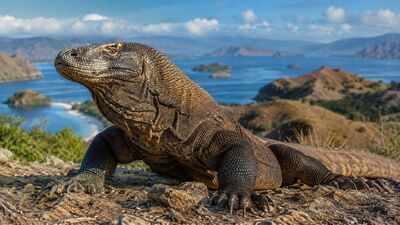
Komodo dragons are one of the relatively few species of lizards whose huge size seems almost impossible for this type of reptile. These animals can grow up to three meters in length, which makes them bigger than any other modern-day lizard.
However, neither the animal’s huge size nor the lizard’s appearance was acquired overnight. Also, this reptile is far from being an ancient dinosaur species because its peculiar body structure has evolved due to many different factors. Being isolated in the Indonesian islands, the reptiles were able to develop the features which made them successful predators. Nevertheless, the main mystery of the lizard remains why evolution created such a huge size specifically in them?
Why the Komodo dragon stands apart from other lizards
The Komodo dragon (Varanus komodoensis) is the largest member of the monitor lizard family.
Adult males are usually the bigger of the two sexes, commonly growing between 2.4 and 3 metres long. Some of the largest individuals can weigh well over 100 kilograms, with exceptional records reaching around 160 kilograms.That scale sets them apart even from other large reptiles. Many lizards rely on speed, camouflage or small prey to survive, but Komodo dragons occupy a different ecological role. Their size gives them the ability to hunt animals such as deer and wild pigs, prey that would be impossible for most reptiles to overpower.
Today, they are found only on a few Indonesian islands, including Komodo, Rinca, Flores and Gili Motang. Their restricted range is one of the reasons their evolution took such a distinctive path.
How island life transformed a lizard into a giant
The peculiarly big size of Komodo dragons is directly related to the phenomenon of island gigantism, which occurs in some insular populations. The moment a species becomes isolated from other representatives of its kind on the mainland, new evolutionary influences come into play.In general, islands lack competition and predators, which may result in some organisms getting larger as time goes by. Increased size helps animals to hunt larger prey and cover longer distances in pursuit of it; furthermore, it gives them more chances to survive during periods of food scarcity.This is confirmed with the study published in Nordic Society Oikos, titled ‘Maximum body size among insular Komodo dragon populations covaries with large prey density’, adds a more detailed point: the size of Komodo dragons differs even between islands, and the main factor linked to those differences appears to be food availability, especially deer density.Komodo dragons' ancestors found themselves in an environment that supported gigantism as a successful evolutionary strategy. They were able to evolve into big-sized reptiles without having to compete against numerous predators living on the mainland.Islands do not necessarily make an organism bigger. Due to the food shortage and low necessity of a large size, some species evolve into smaller organisms. However, for the Komodo dragons it was another story.
The ancient past that explains the Komodo dragon’s size
The large size of the Komodo dragon is not an exception in evolution. The ancestors of Komodo dragons belong to the family of monitor lizards, and they represent some of the largest species of reptiles ever existing.For instance, Varanus priscus, better known under its common name Megalania, represents a giant species of monitor lizards living in Australia long ago. This creature is believed to be several meters bigger than the current Komodo dragon and much heavier, as well.The extinction of this creature made the Komodo dragon become the largest lizard on Earth today. The size of the Komodo dragon is not caused by evolution but just by the combination of inherited genes and environment.Strong body, muscular limbs and predator behavior are typical for monitor lizards. Environmental conditions only developed these features.
The physical traits that make the Komodo dragon a top predator
A large body is only useful if an animal has the physical tools to control it.
Komodo dragons have evolved a combination of strength and hunting adaptations that allow them to function as top predators.Their muscular legs support their heavy bodies and help them move quickly during short bursts of speed. Their tails provide balance and can add force when they strike or defend themselves.Their mouths are equally specialised. Rows of sharp, curved teeth are designed to tear through flesh, while powerful jaw muscles allow them to remove large pieces from prey.
Unlike animals that chew their food, Komodo dragons often swallow large chunks and rely on digestion to break them down.They also produce venom, which affects their prey by lowering blood pressure and interfering with blood clotting. A bite can leave an animal weakened, allowing the dragon to track it until it becomes easier to catch.
Why size became an advantage
Life on the Indonesian islands comes with periods when food is not always available.
Komodo dragons cope with this by storing energy in their large bodies. They can consume enormous meals when the opportunity arises, sometimes eating a significant portion of their own body weight in one feeding. Their relatively slow metabolism allows them to make use of these reserves over time.Their size also protects adult dragons from many potential threats. Young Komodo dragons face far more danger and often spend their early years in trees, avoiding larger animals, including adult members of their own species.As they mature, they move into a different role within the ecosystem. Their bodies become powerful enough to hunt larger prey and compete for territory.
Growth from a tiny hatchling to a giant reptile
Newly hatched Komodo dragons are not giant. As reported by the Australian Reptile Park, they measure about 40 cm in length and are considerably more susceptible to dangers compared to grownups. In the initial years, they climb a lot on trees because that way they can avoid any predators and hunt easier.The speed of growth is high in the early stages, but as they grow up, it starts decreasing. As a matter of fact, many reptiles keep growing until they die, even though it is barely noticeable.The lifespan of wild Komodo dragons is usually estimated around 50 years. The size of an individual dragon depends on some factors such as nutrition and habitat conditions.
Could Komodo dragons become even larger
Evolution does not always reward greater size. A larger body can provide benefits, but it also requires more energy and a reliable supply of food.If their environment changed dramatically over very long periods, Komodo dragons could evolve in new directions. In theory, populations with abundant resources and few limitations could develop different body sizes. However, there are natural limits to how large any animal can become.For modern Komodo dragons, survival depends less on becoming bigger and more on maintaining the balance that allowed them to thrive for so long. Their current size is the result of millions of years of adaptation to a very specific island world.









 English (US) ·