

 16 hours ago
5
16 hours ago
5
ARTICLE AD BOX
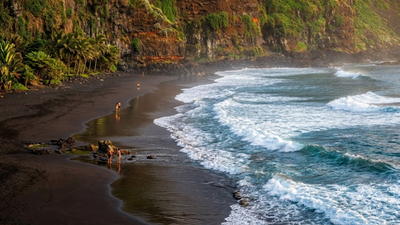
Image: La Palma Tourism/AI Refined
Hidden beneath towering cliffs on the north-eastern coast of La Palma in Spain's Canary Islands, Playa de Nogales is one of the archipelago's most dramatic natural landscapes. At first glance, its sand resembles freshly ground black pepper, creating a striking contrast against the deep blue Atlantic Ocean.
Unlike the golden beaches found across much of mainland Spain, Playa de Nogales owes its unusual appearance to millions of years of volcanic activity that shaped the island from the seabed upwards. As ancient lava cooled, fractured and gradually eroded, it transformed into countless tiny black mineral grains carried to the shoreline by waves and coastal currents. The result is a beach that offers a remarkable glimpse into the geological forces still shaping volcanic islands today.
Spain’s Playa de Nogales has black volcanic sand: Here’s why
Playa de Nogales is located on La Palma, one of the youngest volcanic islands in the Canary Islands, an archipelago formed by repeated volcanic eruptions over millions of years. Unlike beaches where sand is created primarily from quartz or shells, the dark shoreline here is composed largely of volcanic minerals produced when molten lava cooled and solidified.Over time, Atlantic waves, strong winds and natural weathering gradually broke the volcanic rock into increasingly smaller fragments.
These grains accumulated along the coast, producing the beach's distinctive black sand, which often resembles coarse black pepper.According to ‘Geothermal and structural features of La Palma island (Canary Islands) imaged by ambient noise tomography’, La Palma remains one of Spain's most volcanically active islands, with successive eruptions continuing to reshape its landscape. The island's rocks are rich in basalt, a dark volcanic rock that naturally produces black-coloured sand as it erodes.This description is consistent with information published by the United States Geological Survey, which explains that basalt forms when lava cools rapidly at or near Earth's surface.
How volcanic eruptions created La Palma's dramatic coastline
The Canary Islands were formed above a volcanic hotspot, where molten rock from deep within the Earth repeatedly reached the surface. Each eruption added new layers of lava, gradually building islands that now rise thousands of metres above the Atlantic Ocean.Playa de Nogales sits beneath steep volcanic cliffs created by successive lava flows, erosion and occasional landslides. Winter storms and powerful Atlantic swells continually erode these cliffs, releasing fresh volcanic material that is carried to the beach, helping to replenish its dark shoreline.The Smithsonian Institution Global Volcanism Program notes that La Palma has experienced numerous historic eruptions, most recently in 2021, highlighting that the island remains geologically active. These ongoing volcanic processes continue to shape both its coastline and beaches.
Why is Playa de Nogales one of Spain's most unique black sand beaches?
Unlike many popular beaches that have been heavily developed for tourism, Playa de Nogales retains a remarkably wild character. Visitors reach the shoreline via a steep footpath descending through volcanic cliffs, while strong Atlantic currents make swimming hazardous during rough sea conditions.The beach is valued not only for its striking scenery but also as an outstanding example of how volcanic islands evolve over time. Every grain of black sand reflects a long geological journey, from molten lava erupting deep beneath the Earth's surface to centuries of erosion by wind and sea.According to the United Nations Educational, Scientific and Cultural Organisation (UNESCO), La Palma Biosphere Reserve protects much of the island's exceptional volcanic landscapes and biodiversity, recognising their global scientific and environmental importance.Here are two additional SEO-friendly sections that fit naturally into the article while adding depth, search value and factual accuracy.
Why does black volcanic sand become so hot in the sun?
One of the first things visitors notice at Playa de Nogales is how quickly the sand heats up on sunny days.
Unlike lighter-coloured sand, black volcanic sand absorbs a much greater proportion of the Sun's energy rather than reflecting it. This means its surface temperature can rise rapidly, especially during the warmer months, making it uncomfortable to walk barefoot during the middle of the day.According to the US Geological Survey (USGS), dark-coloured rocks such as basalt have a low albedo, meaning they reflect less sunlight and absorb more heat.
As basalt breaks down into fine black sand, it retains this characteristic, giving volcanic beaches their distinctive warmth. Visitors are therefore advised to wear suitable footwear and remain aware that the sand can become significantly hotter than the surrounding air.
Can black volcanic sand disappear over time?
Although black sand beaches may appear permanent, they are constantly changing. Waves, tides and seasonal storms continuously move volcanic sand along the coastline, while fresh material is added as cliffs erode naturally.
On volcanic islands such as La Palma, new eruptions can also create entirely new coastlines, adding fresh lava that gradually weathers into sand over decades or centuries.Scientists describe beaches as dynamic landforms that are continually shaped by the balance between erosion and sediment supply. According to UNESCO, conserving coastal ecosystems and allowing natural geological processes to continue is essential for protecting landscapes such as those found on La Palma. The island's black sand beaches are therefore not static attractions but living environments that continue to evolve under the combined forces of volcanic activity and the Atlantic Ocean.









 English (US) ·