

 1 hour ago
6
1 hour ago
6
ARTICLE AD BOX
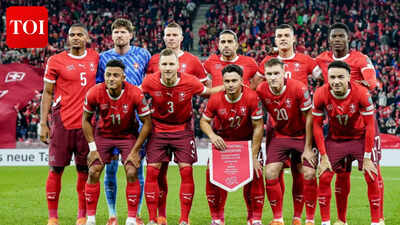
The real reason FIFA uses 'SUI' for Switzerland (Getty Images)
If you have been watching the 2026 FIFA World Cup standings and noticed "SUI" next to Switzerland's name instead of "SWI" or "CHE", you are not alone. The three-letter code displayed on scoreboards and official FIFA graphics often throws casual fans off.
The abbreviation comes from "Suisse", the French name for the country, and FIFA has used it for decades across World Cup competitions. It is a linguistic legacy, not a typo.
Why doesn't FIFA use SWI or CHE for Switzerland?
FIFA officially identifies Switzerland as SUI in its member association database, and that designation appears on everything from World Cup scoreboards to FIFA rankings documents. The code traces directly to "Suisse", France's name for the country, reflecting a long-standing tradition of using the French form in international sporting contexts.CHE, on the other hand, belongs to a completely different system. It is Switzerland's ISO 3166 alpha-3 code, derived from Confoederatio Helvetica, the Latin name for the Swiss Confederation. Switzerland leans on Latin in many official international settings precisely because the country has four national languages: German, French, Italian, and Romansh. Latin offers a neutral ground where none of the four regional languages takes precedence.
FIFA, however, operates under its own classification system, and SUI has remained the fixed identifier regardless of what other international bodies use.
What is Switzerland called in International Football and how have they performed?
Switzerland's national team is most commonly called "Nati" by supporters, a shortened form of the German word Nationalmannschaft, meaning national team. The nickname has crossed language barriers and is widely used both inside and outside the country. In Italian-speaking regions, the team also goes by Rossocrociati, meaning Red Crosses, a nod to the country's white cross on a red flag.On the pitch, Switzerland has built a reputation as one of Europe's more dependable World Cup participants. They have qualified for the tournament 13 times and have never been easy to beat. Their best historical performances came in 1934, 1938, and 1954, when they reached the quarterfinals on each occasion. The 1954 edition holds particular significance because Switzerland hosted that tournament and played in one of the most chaotic matches in World Cup history, losing 7-5 to Austria in the quarterfinals.In the modern era, consistency has defined the Swiss. Since 1994, they have reached the Round of 16 five times and arrived at the 2026 World Cup on a run of six consecutive appearances. Players like Granit Xhaka, Xherdan Shaqiri, Yann Sommer, and Nico Elvedi have been central to sustaining that run, keeping Switzerland a steady presence at the sport's biggest stage.








 English (US) ·