

 1 week ago
13
1 week ago
13
ARTICLE AD BOX
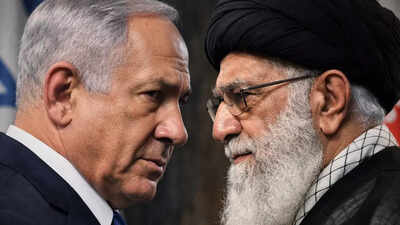
Israel's PM Netanyahu, Iran's supreme leader Khamenei
Israel and US on Saturday launched a daylight "preventive attack" against Iran, following which Iran carried out retaliatory strikes on American military bases across the Middle East under an operation it named “Truthful Promise 4”, hours after joint US-Israel airstrikes hit Tehran.
Iran's Revolutionary Guard said it targeted the US Fifth Fleet headquarters in Bahrain, bases in Qatar and the United Arab Emirates, and military sites in Israel. The latest strikes mark a major escalation in tensions that have been building for months. Diplomatic efforts between Washington and Tehran stalled this week, with no agreement reached on Iran’s nuclear programme, missile capabilities, or regional proxy networks.
Both sides have repeatedly exchanged warnings, while military deployments and retaliatory threats had raised fears of a broader regional conflict.
Run-up to the strikes
In recent weeks, the US had deployed a large naval force, hundreds of fighter jets, refuelling planes, and anti-missile systems around Iran, signalling preparation for possible military action.US president Donald Trump, during his State of the Union address this week, reaffirmed that Iran must not be allowed to produce a nuclear weapon.
He also cited Tehran’s killing of thousands of protesters, its missile capabilities, and support for proxy forces such as Hezbollah and Hamas to justify military measures. None of these issues were part of the ongoing negotiations.
June 2025 conflict
The war erupted on June 13, 2025, when Israel launched Operation Rising Lion, striking Iranian nuclear sites like Natanz, Fordow, and Isfahan, plus military bases, assassinating IRGC leaders and nuclear scientists.
Iran retaliated with over ballistic missiles and drones targeting Israeli cities, killing civilians and injuring many. The US joined on June 22, bombing three nuclear facilities, delaying but not destroying Iran's program. After Iran's strike on a US base in Qatar, president Trump brokered a ceasefire on June 24 amid mutual accusations of violations.Trump described the strikes as having “obliterated” Iran’s nuclear programme, though some US officials said the operation likely delayed the programme by years rather than completely destroying it.
Key points of contention
Iran’s nuclear programme remains a central issue. While the US demands a total ban on uranium enrichment, Iran maintains that its programme is peaceful, despite allegedly enriching uranium up to 60 percent. Recent indirect talks in Geneva failed, as Washington sought to include Iran’s missile programme and regional proxy networks.Ballistic missiles also remain a major concern. US and Israeli officials say Iran’s missile arsenal threatens the region, Europe, and US bases overseas.
Tehran, however, refuses to negotiate on missiles, asserting its right to self-defence.The US and Israel have also raised concerns over Iran-backed groups, including Hezbollah, Hamas, the Houthis, and militias in Iraq, citing repeated attacks on US forces, commercial and naval vessels, and threats to regional stability.







 English (US) ·