

 1 hour ago
4
1 hour ago
4
ARTICLE AD BOX
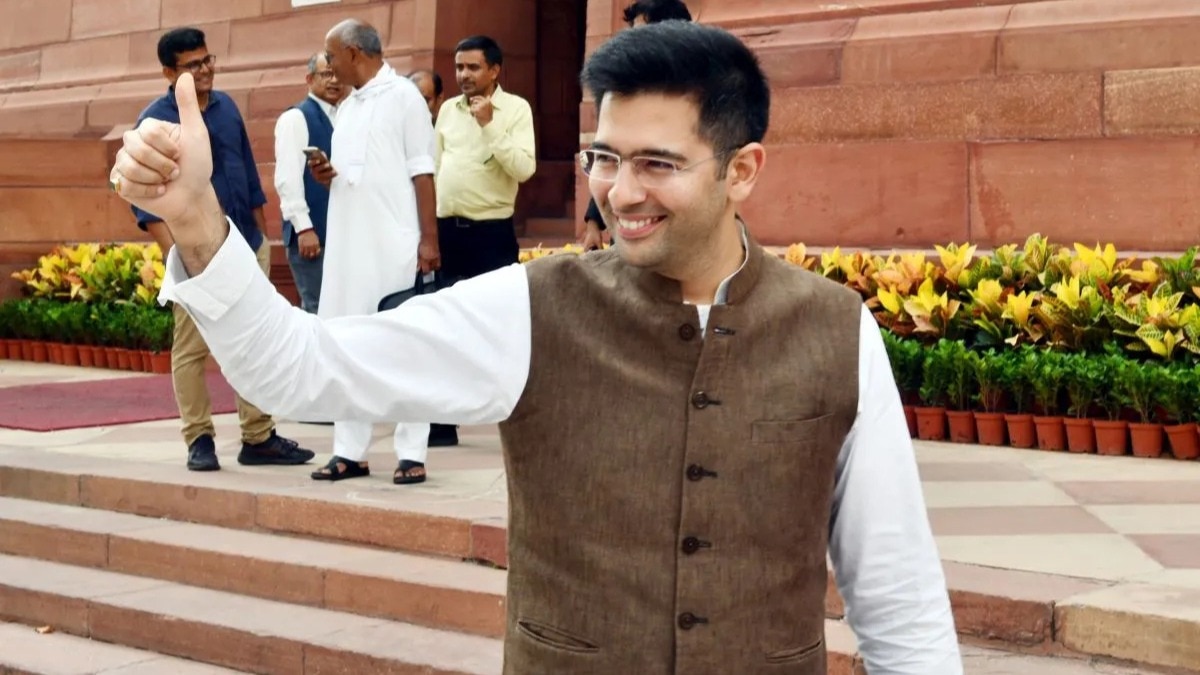
The announcement by AAP Rajya Sabha MPs Raghav Chadha, Swati Maliwal and five others has sent shock waves in political corridors. They have announced that seven of 10 Rajya Sabha MPs, the 2/3 majority of the legislature party of the House, have decided to merge with the BJP. Chadha also announced that they are resigning from the membership of the Aam Aadmi Party, causing an immediate political storm.
The AAP has responded with sharp criticism, with Punjab CM Bhagwant Mann calling them "traitors" while fellow parliamentarian Sanjay Singh saying that Chadha "cannot claim to be clean" after he joined the BJP "which has committed the biggest financial scam through electoral bonds".
But the big question is – will the MPs lose their seats in the House?
The Anti-Defection law, defined under Schedule 10 of the Constitution of India, says that a legislator who resigns from party membership would be disqualified. But Clause 4 of the 10th Schedule, which was meant to "protect intra-party dissent" lays down conditions that protect a legislator from being disqualified under the Anti-Defection law.
Disqualification on grounds of defection not to apply in case of merger.—
(1) A member of a House shall not be disqualified under subparagraph (1) of paragraph 2 where his original political party merges with another political party, and he claims that he and any other members of his original political party—
(a) have become members of such other political party or, as the case may be, of a new political party formed by such merger; or
(b) have not accepted the merger and opted to function as a separate group, and from the time of such merger, such other political party or new political party or group, as the case may be, shall be deemed to be the political party to which he belongs for the purposes of sub-paragraph (1) of paragraph 2 and to be his original political party for the purposes of this sub-paragraph.
(2) For the purposes of sub-paragraph (1) of this paragraph, the merger of the original political party of a member of a House shall be deemed to have taken place if, and only if, not less than two-thirds of the members of the legislature party concerned have agreed to such merger
Sub-Clause 2 specifically creates a 'deeming provision'–that if at least 2/3 members of the legislative party agree to merge, it would legally be counted as "merger of the party" in the House.
Senior Advocate Neeraj Kishan Kaul, who earlier represented Maharashtra leader Eknath Shinde in the Shiv Sena split case, said that this deeming provision would protect the MPs from being disqualified and losing their seat.
"Schedule 10 clause 4(2) says that if 2/3 of the members of the House agree, then the 'party' is deemed to have merged. The merger of the "original political party" is not needed – the Defence against schedule 10 anti-defection is there," said Kaul.
He added that the Shiv Sena case was legally different because these two factions of a party had claimed to be the "original" party.
Senior advocate Sanjay Hegde disagreed with this analysis. He said that while a merger is different from claiming ownership of the party, there are still questions to be considered whether 'House' means one House of Parliament or would it mean the total number in Parliament.
"At the moment, 2/3 of the legislature party, in one house has claimed that they are merging. It could be argued that to escape the anti-defection law you need 2/3 of the total number in Parliament. In my opinion, the anti-defection provisions will be attracted because, unlike MLAs where there is a unicameral legislature and the MLAs can claim to separate and merge, Parliament has two Houses," said Hegde.
Kaul, however, said that since the Constitutional language clearly says "House" and not "legislature". Rajya Sabha and Lok Sabha are separate Houses with separate legislature parties.
Senior Advocate Nizam Pasha has also raised whether the "original party" has to agree to the merger. "My understanding of the law is that they will be disqualified because there is no merger of the original party in this case. Only 2/3 of the Rajya Sabha MPs have merged. They have not claimed to be the 'original political party'," said Pasha.
DOES THIS MEAN THE PARTY HAS SPLIT AND NOW MLAs WILL HAVE TO TAKE SIDES?
Experts said that this is legally a different issue. According to NK Kaul, merger and resignation from the original party is legally different from claiming “ownership” of the party.
"In the Shiv Sena case, the Shinde and the Thackaray faction had both said, 'We are the original Shiv Sena'. That is where the issue of proving whether someone has the majority of the 'original political party' had to be decided. There you need to see who is supported by MLAs, MLCs, Party cadre and office bearers at all levels. In this case, it is not required to be seen what the original party's decision is because 2/3 of the legislature party has decided to merge. They are not claiming ownership of the party identity," said Kaul.
Politically, the resignation of Raghav Chadha and others is a huge jolt for the beleaguered AAP. Experts also said that in case the AAP decides to file disqualification petitions against its rebel MPs, the final decision will be taken by the Chairman of the Rajya Sabha, which is the Vice President of India, CP Radhakrishnan.
- Ends
Published On:
Apr 24, 2026 19:35 IST
Tune In





 English (US) ·