

 1 hour ago
5
1 hour ago
5
ARTICLE AD BOX

The scramble to adopt artificial intelligence across businesses has become impossible to ignore. New tools are being deployed, employees are being trained, and leaders are under pressure to show results.
Yet for many organisations, the impact remains underwhelming, especially when you consider the promise of AI.The problem, said industry leaders during a Times Techies Talks session as part of Publicis Sapient’s ‘AI that’s built to deliver’ series, is that most companies are trying to make people faster rather than rethink how work itself is done.“If you only train people in AI, you’re just creating a faster caterpillar.
To become a butterfly, you have to change the work, the workplace, and the worker together,” said Shefali Sharma Garg, chief talent officer – India at Publicis Sapient.
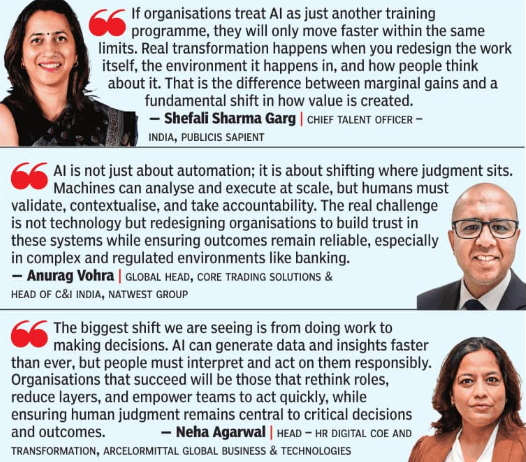
What experts say
It is a simple analogy. AI is not just another software upgrade. It changes how tasks are carried out, how teams are structured, and how decisions are made. Training employees without redesigning the system around them often leads to limited gains.Publicis Sapient reco gnised this early. Instead of focusing only on upskilling, it approached AI as a full organisational transformation.
“AI doesn’t just affect people,” Garg said. “It changes the nature of work itself and the environment in which that work happens. You have to address all three at the same time.”To do that, the company created a dedicated transformation team to rethink everything from career paths to learning models. Traditional training, Garg argues, is no longer enough. “Learning is not about sending people courses anymore. It’s about continuously building capability for the future,” she said.
“And it starts with mindset.”That mindset shift is often the hardest part. Many organisations are still trying to fit AI into old, step-by-step processes. But AI works dif-ferently. It can run multiple tasks at once, speeding up entire workflows.Garg pointed to a project where a team of 50 people was replaced by a much smaller group working alongside AI tools. “We delivered faster and more efficiently,” she said. “But the real change was in how we worked.
AI lets you do things simultaneously, not step by step.”Finding that balanceFor large enterprises, however, redesigning work is not straightforward. Anurag Vohra, global head of core trading solutions and head of C&I India at NatWest Group, said organisations must rethink how decisions are made and who is accountable for them.“AI can do a lot of the heavy lifting, but humans still need to apply judgment and take responsibility for outcomes,” he said.
“The shift is from people doing the work to people guiding and validating it.”This requires a deeper structural change. Many companies are still built around layers of approval and sequential workflows, which slow down the benefits AI can deliver. “Our structures were not designed for this kind of speed and interaction,” Vohra said. “To really benefit, organisations have to rethink those structures, not just add AI into them.”In industrial settings, the shift is less about uniform adoption and more about where AI can meaningfully augment work.“In heavy industry, a lot of work is still physical and safety-driven,” said Neha Agarwal, head – HR digital CoE and transformation at ArcelorMittal Global Business & Technologies. “AI adoption is much stronger in corporate functions than on the shop floor.”Even there, however, the nature of work is changing. Routine, repetitive tasks are increasingly automated, while human roles are shifting towards judgment and decision-making. AI is also speeding up decision-making by reducing layers of analysis. “Earlier, you might have had multiple layers reviewing data,” she explained. “Now AI can compress that process, so teams can act faster."





 English (US) ·