

 1 week ago
11
1 week ago
11
ARTICLE AD BOX
Just before midnight off the coast of Nusa Penida, a small Indonesian island near Bali, Barny Dillarstone lowered a remote camera into water he knows well. The YouTuber has dived these currents before, a place he describes as having “a history of demons and sorcery,” and being “surrounded by an angry ocean that can turn in a second.
” But this drop would go far deeper than his earlier attempts.Dillarstone has long experimented with sending cameras into the sea, chasing footage of species rarely observed alive. He previously dropped remote rigs in the same region while learning to dive there, driven by the hope of finding “a species new to science.” This time, using the Insta360 Ace Pro 2, he sent the device nearly 200 meters down into darkness.Looking back, he admitted in the video that he was “stupid” enough to send a camera hundreds of feet below the surface.
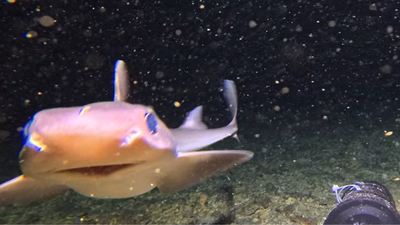
Yet he insists the risk paid off. He says he “managed to record the first ever footage of at least two large, deep water species swimming around in the wild.”The first to emerge from the black water was a spurdog, a species of dogfish shark.Recognisable by its smooth dorsal fin spines, large eyes and slender build, the shark circled the bait fixed to the camera rig. Unlike great white sharks, whose teeth are built for slicing, Dillarstone explained that these predators tend to “grab and twist” their prey.
Describing the animal in detail, he said: “This shark has a slender body, short snout, very tall, erect dorsal fins with pale tips and long dorsal spines, and a caudal or tail fin with a broad white margin and no dark patches.”
I Recorded a Deep Sea Creature No One Has Seen Alive
The footage shows the shark attempting to bite at the bait pipe. With powerful lights cutting through the deep, he added: “Their enormous eyes suck in so much of it that when illuminated, they likely just see a big glowing object, rather than details that might trigger caution.”
He noted that several spurdogs appeared on camera, though he could not determine how many were circling in total.But it was the second visitor that shifted the tone of the experiment.“Throughout this entire drop, a large, flattened animal kept appearing, but it didn't look like anything I'd seen before. It's a ray, of course, and the head and snout looked like that of shallower water eagle rays,” Dillarstone said.The ray, brown-purple in the artificial light, drifted repeatedly into frame. According to him, it carried venomous barbs along its tail and is “capable of rapid bursts of speed.” He suggested the sighting could be significant, stating: “Like the Western highfin spurdog sighting, this discovery is particularly exciting because it's likely that this is the first footage of this species alive in the wild.”While formal identification would require expert confirmation, the recording captures behaviour rarely seen outside submersible expeditions. Much of what is known about deep-water species comes from specimens brought up in nets, not from live footage in their habitat.For Dillarstone, the most striking lesson was timing. He argued that midnight changes everything beneath the surface, saying that “the small sharks we recorded in the day are but a small snack for the predators that really dominate.”







 English (US) ·