

 1 hour ago
3
1 hour ago
3
ARTICLE AD BOX
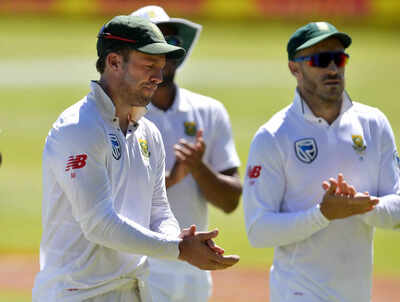
AB de Villiers and Faf du Plessis of South Africa (Photo by Ashley Vlotman/Gallo Images/Getty Images)
South Africa have long been known for chasing the impossible. They still hold the world record for the highest successful run chase in ODI cricket, when they hunted down 438 vs Australia.
But 12 years ago at the Wanderers, they came within touching distance of pulling off something even more extraordinary in Test cricket.Set a target of 458 against India on a cracked, uneven surface, South Africa began the fifth day with far more modest ambitions. Needing 320 runs with eight wickets in hand, a draw or an India win felt like the realistic outcome. Few could have imagined that by the final hour, victory would be within reach for the Proteas.
Why Rohit Sharma got really emotional at a promotional event
Early wickets shifted the balance back towards India, but then Faf du Plessis and AB de Villiers came together with clarity and purpose. Time at the crease mattered more than the scoreboard. What followed was a partnership built on patience, courage and immense control.For almost four hours, the pair batted with discipline on a pitch that offered variable bounce and plenty of movement. They faced 375 deliveries together and added 205 runs, taking South Africa from 197 for 4, still 261 away, to the brink of a historic chase.
Cracks opened up, balls reared up and down, edges flew over the slips, but both batters absorbed it all and kept moving forward.By the final session, the equation had shifted dramatically. South Africa needed 66 runs from 15 overs with both batters unbeaten on hundreds. The chase was suddenly real.Against the flow of the game, Ishant Sharma struck. De Villiers chopped on from a back-of-a-length delivery, giving India an opening. JP Duminy followed soon after, inside-edging a cover drive. Momentum swung again when du Plessis was run out, exhausted after a long innings, following a magnificent direct hit from Ajinkya Rahane.With 20 runs needed and the score reading 438, the dream was still alive. But only Vernon Philander and
Dale Steyn
remained, with an injured Morne Morkel and Imran Tahir unable to contribute meaningfully with the bat. Safety became the priority. Philander and Steyn blocked, left and survived. Steyn even sent the final ball of
Mohammed Shami
into the stands for a huge six, but it came too late. South Africa finished just eight runs short, securing one of the greatest draws the game has seen.It felt intense, dramatic and strangely anti-climactic all at once. A draw had been the morning goal, yet victory slipped away by the narrowest of margins.While du Plessis and de Villiers defined the day, the Test also marked an important chapter for India. Batting first, India were bowled out for 280, with
Virat Kohli
standing tall with a superb 119. Ajinkya Rahane was the next best scorer with 47. In reply, South Africa made 244, led by captain Graeme Smith’s 68, while Vernon Philander provided crucial lower-order support with a valuable 59.
Zaheer Khan and Ishant Sharma picked up four wickets each. India then batted again with a slender lead of 36. Although Shikhar Dhawan fell cheaply for 15, Murali Vijay scored 39 and added 70 for the second wicket with
Cheteshwar Pujara
. Pujara went on to play a brilliant innings of 153 and then added 222 runs with Virat Kohli, who agonisingly missed out on a century by just four runs. India were all out for 421, setting South Africa a daunting target of 458.
In the chase, Alviro Petersen’s 76 and Graeme Smith’s 44 laid a strong foundation with an opening stand of 108 before the first wicket fell.After the match, du Plessis reflected on the escape, saying: “If you had asked us this morning whether we would have taken saving the game, we definitely would have taken it. I was struggling a bit with cramps and some stomach aches too, which I don’t normally get. I was thinking about Adelaide.
I knew I had done it before and I just placed a very high price on my wicket and made sure the Indians found it difficult to get me. The wicket was just a blur.
In hindsight, I should have been out there holding one end while Vern went and took it on. India bowled very skilfully.”Virat Kohli was named Player of the Match for scores of 119 and 96. Cheteshwar Pujara showcased his class with a commanding 153 in the second innings. It was a period of transition, the first major overseas assignment for Kohli, Pujara and Rahane as a group.India lost the series 1-0 and went down by 10 wickets in the second Test, but they discovered something lasting. Kohli, Pujara and Rahane finished as the three highest run scorers in the series. Pujara made 280 runs at an average of 70. Kohli followed with 272 at 68. Rahane added 209 at 69.66. Together, they would go on to shape India’s batting for the next decade. Twelve years on, that final day at the Wanderers remains unforgettable.








 English (US) ·