

 4 hours ago
4
4 hours ago
4
ARTICLE AD BOX
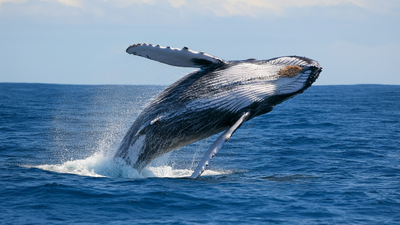
A humpback whale photographed off the coast of Brazil in 2003 was spotted again in Hervey Bay, Australia, in September 2025. The distance between those two sightings is approximately 15,100 kilometres, making it the longest confirmed movement ever recorded between sightings of the same individual humpback whale anywhere in the world.
A second whale made a similar crossing in the opposite direction. Together, the two cases mark the first time scientists have confirmed that individual humpback whales can move between breeding grounds off eastern Australia and Brazil, two populations that were previously thought to be entirely separate. The findings were published in Royal Society Open Science in May 2026.
How scientists identified the same humpback whale across two oceans and two decades
The method behind the discovery is deceptively simple. Every humpback whale has a unique pattern on the underside of its tail, called a fluke, and researchers have been photographing these patterns for decades to track individuals over time.
The technique works in much the same way as a fingerprint database, except the database spans multiple countries, multiple decades, and tens of thousands of animals.For this study, published in Royal Society Open Science, researchers compiled 19,283 high-quality fluke photographs collected between 1984 and 2025 from eastern Australia and Latin America. An automated image recognition system scanned the archive for potential matches, and every match flagged by the system was then independently confirmed by researchers.
Out of nearly 20,000 identified whales across more than four decades of data, only two individuals were found to have crossed between the Australian and Brazilian breeding grounds.
The two humpback whales that crossed entire oceans between Australia and Brazil
The first whale was photographed in Hervey Bay, Queensland, in 2007 and again in 2013, before turning up off São Paulo, Brazil, in 2019. The straight-line distance between those two breeding regions is roughly 14,200 kilometres, about the same as the distance between Sydney and London.The second whale's journey was even more striking. It was first photographed in 2003 at Abrolhos Bank, Brazil's primary humpback nursery off the coast of Bahia, as part of a group of nine adult whales. Twenty-two years later, in September 2025, it appeared alone in Hervey Bay, Australia. That gap of 15,100 kilometres between sightings is the longest ever documented for any individual humpback whale.Because researchers only know where the whales were photographed and not the routes they actually swam, the real distances travelled could have been considerably greater.
Why citizen scientists and the platform that made this discovery possible
The research relied heavily on photographs contributed by members of the public through Happywhale, a global whale identification platform that allows anyone who has photographed a whale at sea to upload the image and potentially contribute to scientific records. Without that network of citizen scientists submitting observations over decades, a match between a whale photographed in Brazil in 2003 and the same animal in Australia in 2025 would have been nearly impossible to make."Every photo contributes to our understanding of whale biology," said lead researcher Dr Cristina Castro from Pacific Whale Foundation. "And in this case, helped uncover one of the most extreme movements ever recorded." Griffith University PhD candidate and co-author Stephanie Stack noted that the discovery was only possible because of investment in long-term, multi-decade research programmes and international collaboration between scientists working on opposite sides of the world.
What the Southern Ocean exchange hypothesis explains about rare humpback migrations
Scientists do not think these ocean crossings happen because whales are simply wandering. The most likely explanation is what researchers call the Southern Ocean Exchange hypothesis. Under this idea, humpback whales from different breeding populations occasionally meet while feeding together in Antarctic waters, which serve as a shared summer feeding ground for whales from across the Southern Hemisphere.
Some whales may then follow a different group back along its migration route, eventually ending up in an entirely new breeding population.Research on humpback whale population structure and movement has shown that while populations are generally distinct, the Southern Ocean provides an opportunity for mixing that is not fully reflected in breeding ground data alone. The Antarctic feeding grounds effectively act as a crossroads, and occasionally, a whale takes a different road home.
How climate change and shifting Antarctic krill could increase humpback ocean crossings
The researchers note that these crossings, while extremely rare, are not biologically trivial. Out of nearly 20,000 identified whales in the study, only two made this journey. That is 0.01 per cent of the total. But even at that frequency, the genetic and cultural consequences could matter over time."Occasional individuals moving between distant breeding grounds can help maintain genetic diversity across populations," Stack said, "and may even carry new song styles from one region to another.
Humpback whale songs are known to spread culturally across ocean basins, much like music trends in human populations."The researchers also flag that environmental changes in the Southern Ocean may be shifting the odds. Climate-driven changes in sea ice extent and the distribution of Antarctic krill, the whale's primary prey, could alter how and where whales from different populations overlap during feeding season, potentially making these rare crossings slightly less rare in the years ahead.
What this record-breaking humpback whale journey means for conservation
For conservation, the finding adds an important layer of complexity to how humpback whale populations are managed. If breeding populations that appear separate are occasionally exchanging individuals, then decisions made about one population, whether around shipping lanes, whale watching regulations, or hunting quotas, could have consequences that ripple across to a population on the other side of the ocean.The humpback whale has been one of conservation's genuine success stories. After being hunted to the edge of extinction in the twentieth century, populations have recovered substantially following international protections. But that recovery has mostly been tracked and managed at the level of individual breeding populations. This research suggests the full picture is a little more connected than that, and a little harder to map from one coastline alone.









 English (US) ·