

 1 hour ago
3
1 hour ago
3
ARTICLE AD BOX
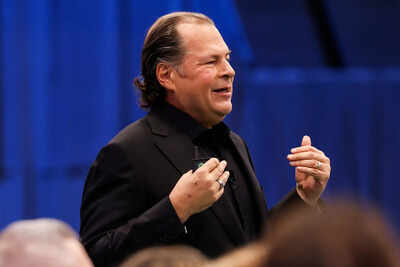
Salesforce is scaling back its reliance on large language models due to reliability issues, as acknowledged by executives. The company is shifting towards more predictable 'deterministic' automation in its Agentforce product, aiming to eliminate AI's inherent randomness.
Salesforce, one of the world's most valuable enterprise software companies, is pulling back from its heavy reliance on large language models after encountering reliability issues that have shaken executive confidence.
Sanjna Parulekar, Senior Vice President of Product Marketing, acknowledged that trust in AI models has declined over the past year, according to a report by The Information."All of us were more confident about large language models a year ago," Parulekar stated, revealing the company's strategic shift away from generative AI toward more predictable "deterministic" automation in its flagship product, Agentforce.
This admission comes after Salesforce reduced its support staff from 9,000 to 5,000 employees—approximately 4,000 roles—through AI agent deployment, as CEO Marc Benioff disclosed in a podcast appearance.The company is now emphasizing that Agentforce can help "eliminate the inherent randomness of large models," marking a significant departure from the AI-first messaging that dominated the industry just months ago.
Models are failing, customers report missing surveys
Salesforce encountered several critical technical challenges with large language models during real-world applications. Muralidhar Krishnaprasad, Chief Technology Officer of Agentforce, pointed out that when given more than eight instructions, the models begin omitting directives—a serious flaw for precision-dependent business tasks.Home security company Vivint, which uses Agentforce to handle customer support for 2.5 million customers, experienced these reliability problems firsthand.
Despite providing clear instructions to send satisfaction surveys after each customer interaction, The Information reported that Agentforce sometimes failed to send surveys for unexplained reasons. Vivint worked with Salesforce to implement "deterministic triggers" to ensure consistent survey delivery.Another challenge emerged in what executive Phil Mui described as AI "drift" in an October blog post.
When users ask irrelevant questions, AI agents lose focus on their primary objectives. For instance, a chatbot designed to guide form completion may become distracted when customers ask unrelated questions.
Salesforce CEO Benioff's AI ambitions collide with market reality
The retreat from large language models represents an ironic twist for CEO Marc Benioff, who has aggressively bet on AI transformation. Benioff had recently told Business Insider that he's drafting the company's annual strategic document with data foundations—not AI models—as the top priority, explicitly citing concerns about "hallucinations" without proper data context.Benioff even suggested the company might rebrand itself as "Agentforce," telling Business Insider "that would not shock me," after learning from focus groups that customers no longer want to hear about cloud computing. However, this rebranding enthusiasm contrasts sharply with the technical challenges executives are now acknowledging.The company's stock has declined approximately 34% from its December 2024 peak, though Agentforce is projected to generate over $500 million in annual revenue. Salesforce's partial retreat from large models could impact thousands of enterprises currently relying on this technology, as the company navigates the gap between AI innovation and practical business implementation.









 English (US) ·