

 5 days ago
7
5 days ago
7
ARTICLE AD BOX
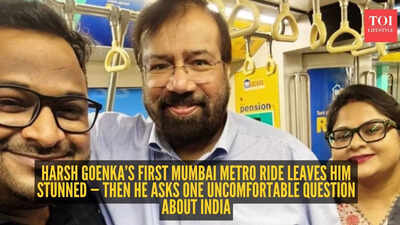
Industrialist Harsh Goenka's inaugural ride on Mumbai Metro Line 3 sparked national debate on India's infrastructure. His positive experience, highlighting efficiency and cleanliness, contrasted sharply with typical urban travel, prompting questions about why city roads lag behind. The metro's success fuels expectations for consistent civic amenity standards across India.
The first ride on the Mumbai Metro Line 3 by Harsh Goenka generates greater debate about the infrastructure in India.One metro ride is sometimes enough to create a national controversy.The industrialist Harsh Goenka was the first passenger to ride on the recently opened Mumbai Metro Line 3. What started as a normal morning commute has soon become a bigger debate on the way India constructs its infrastructure - and sustains it.And, frankly enough, he did not anticipate being impressed.Goenka posted his experience online, and he admitted that he was not that high about the metro. Almost immediately the journey changed him.I had travelled on the Mumbai Metro yesterday, the first time. I was surprised, I must admit, and this was a mere statement that gained fresh momentum shortly.Another commute of a different kind.The typical image of what is seen in the city travel in India is well known to any person who travels through it; crowds, delays, noise and a feeling that there is always a hurry. Therefore when Goenka wrote about his experience with the metro people saw the contrast immediately.
He talked of clean stations, the organisation of access points and trains that would get there in good time. No chaos. No confusion. A mere system that functioned in the manner in which the public transport is meant to.The fluidity of the ride was the best. The ticketing, boarding and leaving the station were all smooth. Even the press turned out to astonish him. It was a comfortable ride, borderline relaxing, which is unusual at any time of the day, especially in the city when people are commuting.And on a happier note, he stated that he had bumped into colleagues in the trip and that the metro is rapidly becoming the new networking network in Mumbai.It felt more like a commute which was not stressful but rather like what travelling in a modern city should feel like.Mumbai versus world cities.The most talked about online was the fact that Goenka compared it with international transport systems.After travelling a lot, he highlighted that he has been exposed to metro systems in such cities as Paris, London, and the New York City: cities that have long been regarded as models in terms of effective public transit.However, the Aqua Line of Mumbai according to him, had its own to contend with these international giants. The experience was, in a way, even better as he proposed.This sentence was sufficient to make the social media ablaze. To most Indians accustomed to hearing that the Western infrastructures are superior, the thought that an Indian metro would be able to compete with the rest of the world seemed to be unexpected and at the same time, comforting.Compliment--then a stinging inquiry.However, it was not only praise that Goenka posted. There was a deeper observation that it bore.Having hugged the efficiency of the metro and its global execution, he posed a question, which many commuters have long gone without responding to: since India is able to construct a metro system as good, why are the city roads still unable to perform by the same level of efficiency?It was a simple question.
But it struck a nerve.This is due to the fact that the contrast is difficult to miss. At the metro stations, it all is up to date and accurate. Go out of the door, and commuters soon go back to potholes, traffic congestions, bumpy roads and erratic commuting.The disparity draws attention to a painful fact excellence obviously could. It is difficult to ensure that it is made consistent in all sections of urban infrastructure.The social media has a well-known frustration.The internet was respondent nearly immediately.The Aqua Line was highly rated by many users and they described their own experience of having clean platforms, trains that run on time and being stress free. Some daily commuters claimed that the metro has finally made commuting in a dignified way and not a tiresome affair.But with appreciation, there was frustration.Some commentators noted that though the projects of metro projects demonstrate what India can do, the current situation with roads has remained poor. It was epitomized well by one user who stated that the metro is world-class with roads being a daily battle.It was no longer a businessman review, but general commuter feeling.What the metro tells about transforming urban India.The metro systems in India have been changing the movement in cities silently.
These systems are a symbol of thoughtful planning, good implementation, and visionary thinking in terms of Delhi, Bengaluru, and Mumbai.They demonstrate that when infrastructure projects are given special attention in terms of funding and responsibility, they may perform at global standards.And that is why the post by Goenka touched other cities than Mumbai. Indians had found the metro as an indication of possibility - evidences that big public mechanisms in India could be effective, hygienic, and dependable.But it had increased expectations.Since the citizens have enjoyed the ease of traveling in one section of a city, they automatically start questioning why they should not be given the same efficiency in the roads, sidewalks, buses, and daily civic structures.A little excursion, a greater discussion.After all, the transportation was not the only thing in the metro ride of Goenka.It was an expression of new attitude among the urban Indian population - less inclined to tolerate disparities in the norms and more ambitious to insist on uniformity in civic amenities.The Aqua Line is an innovation. However, it is also a reminder that the world-class experiences should not be in vacuum.They have now been shown what works.And when the expectations have changed, there is no turning around.





 English (US) ·