

 3 hours ago
5
3 hours ago
5
ARTICLE AD BOX
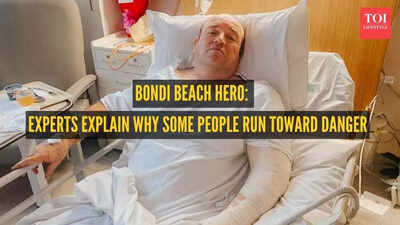
It is acts like these that truly make up the essence of the word 'hero'.
When danger strikes, most flee instinctually. It is normal for humans to turn away from danger and escape. Yet every so often, some individuals would rather run towards danger, to stop it.
Case in point, is the Bondi Beach hero, Ahmed al Ahmed, who wrestled a gun off one of the attackers and saved lives. The incident has reignited the human fascination with this rare yet powerful instinct, prompting experts to ask: What makes some people run toward danger and not away from it?
What do the experts say?
The beginnings of this courage lie in the brain. In moments of crisis, the brain is trained with three emotions, fight, flight or freeze.
For most people the latter of the two emotions is an immediate reaction. But for a small group, the former is an instinct. In a conversation with The Guardian, Dr Daniel Glaser said that humans, like all mammals, exhibit a natural "fight or flight" response to threat or surprise. However, that does not determine the course of action they choose. “It prepares your muscles, and to some extent your brain, for action, but the action that you take depends on a bunch of other things,” he said.
How you perceive the event changes your reaction and your perception is driven by prejudice and expectations. He said that the kind of bravery that caused people to run towards danger while others were running away was not "instinct." It was based on the life experiences and training they may have had. Professor Craig Jackson, a chartered member of the British Psychological Society, who has a specialist interest in gun violence and mass killings said that there was no "profile" for the kind of person who would "have a go."“It’s just as likely to be an angry mum in defence mode as it could be a fit, healthy rugby-playing male,” said the professor. “That’s reassuring because that means that attackers, either lone wolves or terrorists, they’re never quite sure who’s going to be the hero who could challenge them.”
Personality traits linked to heroism
According to David Berez, MAPP, DRE and a retired police officer and drug recognition expert, three psychological forces explain the instinct to run towards danger, self-determination, self-efficacy and courage. Self-determination answers the "why" of the heroic action. It's the knowledge that a particular choice reflects your true personality, knowing that it can make a difference, it's about the identity you align yourself with, your purpose. But determination alone doesn't fill the cup and that is where self-efficacy pours in. Bandura defined self-efficacy as the belief in one's capability to execute the actions needed to manage a situation.
For first responders, this is done through training, for the common people, it could be previous experiences that both kick in as muscle memory takes over. When one has the why and the how, it's time just to do it. But that inkling of fear remains, making you rethink your decision and that's where courage fills you up. It allows you to overcome every emotion and move ahead even in the face of danger. And all of these, combine into a well-oiled machine of optimism where a cognitive framework of these three occurs to allow you to execute tasks like running towards danger and fighting in the face of it.
James Pawelski's reversible cape metaphor
There is a reversible cape metaphor adapted from James Pawelski's work. It shows two sides of a cape, one red and the other green. The red side represents the fight against evil, violence and injustice. This perspective is practical and real and makes one view actions through the lens of what they are fighting against. It can make one pessimistic and hypervigilant and cause burnout and cynicism. The other side, green, represents goodness, safety and positivity.
It sees actions as forms of prevention for a better future. The point here is that there is no either-or side of the reversible cape. You can wear it either way. While some might fight with the thought of defeating an opponent others might do it with the thought of achieving a victory and both work. In case of danger, one could run toward it with the thought of stopping the criminal or saving the victim, and both work.
What do the heroes say?
During the London Bridge attack on November 29, 2019, Darryn Fost pinned a knife-wielding terrorist wearing a fake suicide belt, to the ground. “I don’t think it comes naturally to anyone. I saw Saskia ( who was killed by the attacker) fall to the stairs, and she was very clearly severely injured. So the next thought in my mind was: ‘I need to prevent that from happening to anyone else’,” he told The Guardian.During the London Bridge attack in 2017, Roy Larner was stabbed in his hands, chest and head as he fought off three knife-wielding terrorists. "I started fighting back with them, but it gave that 20 or 30 people a chance to get out in front of me. It nearly cost me my life,” he recalled to the outlet. He said he made a split-second decision to intervene. “You should run. [But] you can be an idiot and take three on,” he said. “There was an older bloke with us, about 78, and I think that was the reason why I stood there.
But obviously it gave other people a chance to get out as well,” he said. While the inspiration might be different for all, it is acts like these that truly make up the essence of the word 'hero'. When you think of fictional superheroes, it is vital to remember that people like the Bondi Beach hero are the ones who inspire them, who save real lives with not one weapon but courage.









 English (US) ·