

 1 hour ago
3
1 hour ago
3
ARTICLE AD BOX
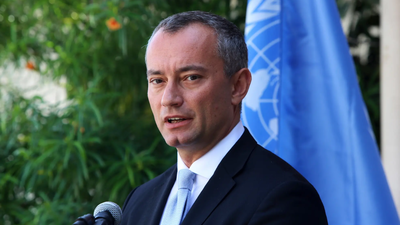
High Representative for Gaza Nickolay Mladenov (AP)
“As we step into 2026, here’s hoping it becomes a year where common sense prevails, where rules are respected, facts carry more weight than slogans, and strength is measured not by reckless escalation, but by thoughtful restraint and wise choices.
”Nickolay Mladenov posted those words on X at the start of the year. Days later, he was named High Representative for Gaza, stepping into a role that places him at the center of one of the world’s most fragile and contested conflicts.Years earlier, when Rumiana Bachvarova had just begun her posting as Bulgaria’s ambassador to Israel, she paid a visit to her compatriot in Jerusalem. Mladenov took her to the Mount of Olives, overlooking the Old City.“This small place is the cornerstone of all the conflicts here,” he told her. “But see how beautiful it is.”At the time, Mladenov was several years into his role as the United Nations Special Coordinator for the Middle East Peace Process, a position long viewed as symbolic and largely ineffective.Now 53, Mladenov faces perhaps his most difficult assignment. As High Representative for Gaza, he will serve as the main link between US President Donald Trump’s “Board of Peace” and a technocratic committee of Palestinian officials meant to govern the devastated enclave.
His task is to turn a US-brokered, 20-point ceasefire plan—still lacking crucial details—into a functioning framework that can rebuild Gaza, disarm Hamas, and govern a population of about two million people.For it to work, it must be acceptable to Israel, the Palestinians, and the United States.Alongside Mladenov on the Board of Peace are major figures, including US Secretary of State Marco Rubio, Special Envoy Steve Witkoff, Jared Kushner, and former UK Prime Minister Tony Blair.
While they do not share his direct responsibility toward the technocratic committee, they shape the political environment in which the plan must operate.With little publicity, Mladenov has already met Israeli Prime Minister Benjamin Netanyahu and senior Palestinian officials as he prepares to take up his new role.Mladenov has declined to comment publicly on his appointment. When Witkoff announced the launch of the second phase of the ceasefire, Mladenov reposted the message without adding his own words.For a diplomat known for working quietly behind the scenes, the silence is familiar. Whether that approach can now help turn a fragile ceasefire into lasting peace for Gaza remains the central question.
Turning a marginal job into a working one
Before Mladenov’s tenure, UN envoys had focused on issuing statements—condemning Israeli settlement expansion in the occupied West Bank and repeating support for a two-state solution. Their influence was limited, their warnings largely ignored.Mladenov arrived in Jerusalem in 2015 with a different approach. In an interview with the New York Times as he was leaving the role in late 2020, he said he was initially struck by how irrelevant the position seemed. Instead of relying on public statements, he focused on building trust.He shuttled between Israeli officials, the Palestinian Authority in the West Bank, and Hamas leaders in Gaza, while also delivering his mandated monthly briefings to the UN Security Council in New York.Mladenov rarely made headlines, but behind the scenes he was deeply involved. Alongside Egypt, he played a role in bringing repeated escalations between Israel and Hamas to quick conclusions, helping prevent wider wars.Not everyone approved of his choices. Some diplomats in Jerusalem believed he paid too little attention to the Palestinian Authority, the body created in the 1990s as part of peace efforts and which still governs parts of the West Bank.
A divided Palestinian landscape
A sympathetic reading of Mladenov’s strategy suggests he focused on the most influential actors under his mandate. But it also suited Israeli prime minister Benjamin Netanyahu to have the most senior UN official in the region engage with Hamas while the Palestinian leadership remained divided.That division weakened the Palestinian cause internationally. Although Israel’s tacit approach toward Hamas collapsed after the October 7, 2023 attacks, concerns persist in Ramallah that new governance structures for Gaza could again sideline the Palestinian Authority by creating rival centers of power.Mladenov’s background helps explain why he was chosen for this moment. The Bulgarian politician became his country’s defense minister at just 37, then served as foreign minister for three years. Earlier, he was a member of the European Parliament and later the UN’s Special Representative for Iraq.Those roles built his reputation as a diplomat comfortable operating in fractured political environments.








 English (US) ·