

 2 hours ago
5
2 hours ago
5
ARTICLE AD BOX
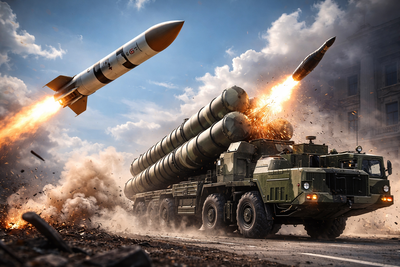
With the US and Israel intensifying their military campaign against Iran, a new battlefield has emerged, not on the ground, but in the skies, where advanced missile systems are testing the limits of traditional air defence.
At the centre of this contest is a critical question. Can Russia’s S-300 withstand Israel's Blue Sparrow missile?The question has gained urgency after reports of precision Israeli strikes deep inside Iran, allegedly using air-launched ballistic missiles designed to outsmart conventional air defences. At the centre of the debate are two systems built for entirely different purposes, yet now locked in a deadly "versus" scenario.The Russian-made S-300, first deployed in the late 1970s, is a long-range surface-to-air missile system designed to intercept aircraft, drones and incoming cruise or ballistic missiles. Over decades, it has earned a reputation as a robust shield, used by countries from Russia and Ukraine to Iran and Nato members like Greece. Its architecture relies on powerful radars such as the 30N6E2 "Tombstone" to track targets and guide interceptor missiles with high precision.
But the system was fundamentally designed for threats moving across the horizon like fighter jets, bombers, and low-flying cruise missiles. Its radar geometry, like most ground-based planar arrays, prioritises outward scanning. This leaves a critical vulnerability. A "zenith blind spot," a cone of limited visibility directly overhead.This is precisely where Israel’s Blue Sparrow missile appears to exploit an edge.Originally developed as a target missile to simulate ballistic threats, the Blue Sparrow has evolved into a formidable operational weapon. Launched from aircraft such as the F-15, it follows a quasi-ballistic trajectory, soaring to the edge of space before re-entering the atmosphere at hypersonic speeds exceeding Mach 5. In its terminal phase, the missile descends almost vertically.
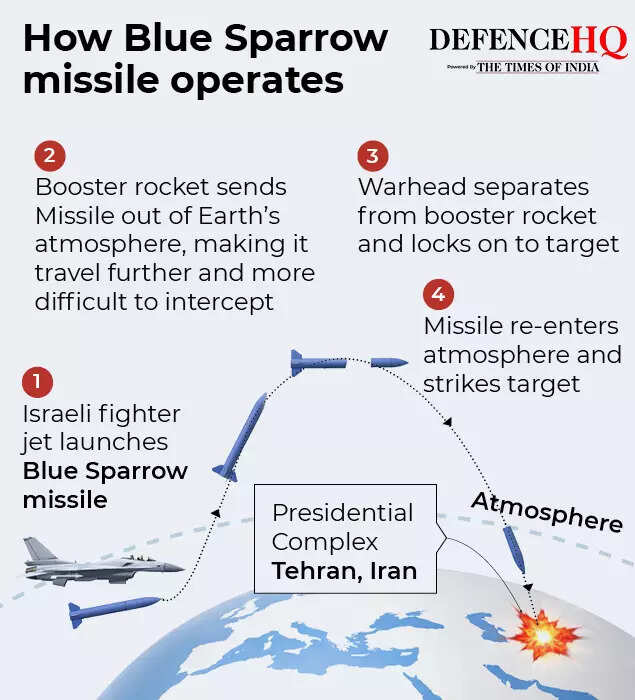
How Blue Sparrow operates
This steep, top-down attack profile compresses reaction time to mere seconds.
Even if early-warning radars detect the launch, the S-300's engagement systems must calculate a firing solution almost instantaneously, a challenge for a platform designed decades ago.More critically, a near-vertical descent can push the incoming weapon into the radar’s blind spot. Instead of approaching from the horizon, the missile effectively "drops in" from above, bypassing the system’s primary field of view.
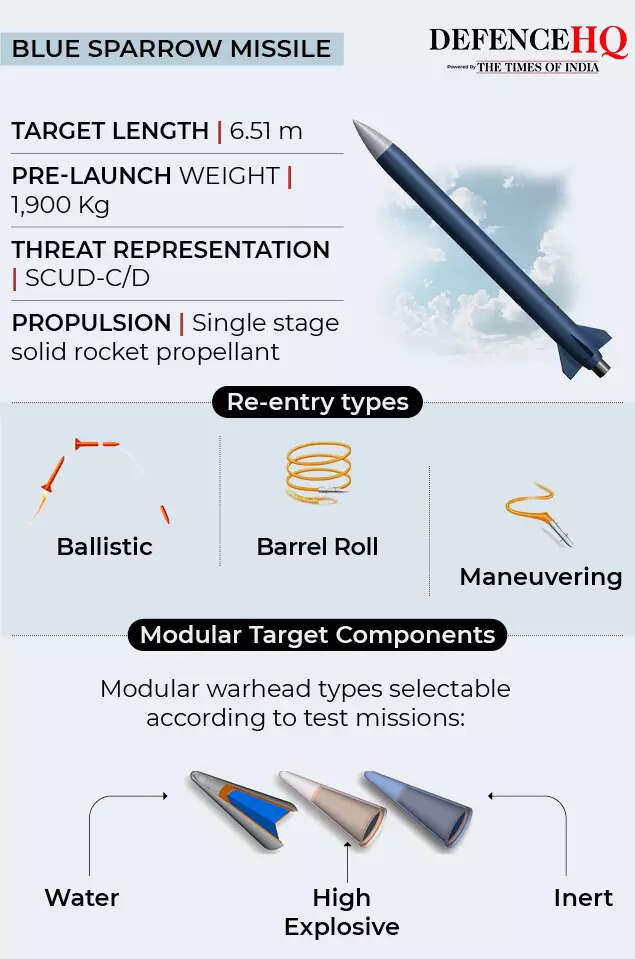
About Blue Sparrow
Even in a best-case scenario, where the S-300 detects and fires, interception is far from guaranteed. At hypersonic speeds, destroying a dense, nearly two-tonne penetrator mid-air does not neutralise the threat entirely. The resulting debris retains enormous kinetic energy and can still strike the target area with devastating effect.Recent reports of Israeli strikes, including those targeting high-value sites in Iran, suggest that such tactics are no longer theoretical.
Analysts point to the growing use of manoeuvrable, high-speed, air-launched systems that are specifically engineered to exploit legacy air defence gaps.Iran has sought to counter this vulnerability with its indigenous Bavar-373 system, often touted as a rival to more advanced Russian platforms. However, defence experts note that it shares similar radar architecture and, potentially, similar limitations.This does not render the S-300 obsolete. Against conventional aerial threats, it remains a potent and widely respected system, capable of engaging multiple targets simultaneously and defending large areas. But the evolving nature of warfare, particularly the rise of hypersonic and quasi-ballistic weapons, has begun to challenge its design assumptions.In the emerging Israel-Iran theatre, the contest is no longer just about firepower, but geometry, speed and seconds. By and large, the Blue Sparrow does not overpower the S-300 in a traditional sense, it sidesteps it.And in modern warfare, that may be the more decisive advantage.









 English (US) ·