

 1 hour ago
5
1 hour ago
5
ARTICLE AD BOX
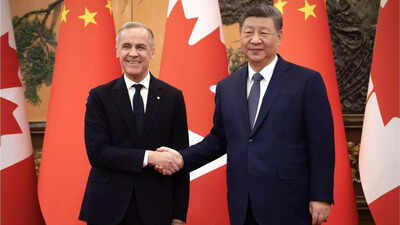
After years of diplomatic deep-freeze, Canada has finally taken its parka off in Beijing — and Mark Carney arrived not just with a handshake, but with talk of a “new world order.”On his first visit to China as prime minister, and the first such trip by a Canadian leader in nearly a decade, Carney walked into the Great Hall seeking trade, thawed relations, and a little less dependence on the United States.
What he walked out with, he said, was a “preliminary but landmark” deal — and Beijing’s warm approval of his world-view.Here's what Carney cracked during his China visitChinese leader Xi Jinping and Canadian PM Mark Carney announced lower tariffs after a key meeting in Beijing, signalling a reset in their countries' relationship.China was expected to lower levies on Canadian canola oil from 85% to 15% by 1 March, while Ottawa agreed to tax Chinese electric vehicles at the most-favoured-nation rate of 6.1%, Carney told reporters.
The deal, struck on Friday, was described as a breakthrough after years of strained ties and tit-for-tat levies, BBC reported.Xi hailed the "turnaround" in their relationship. The agreement also marked a win for Carney, the first Canadian leader to visit China in nearly a decade, as he tried to diversify Canadian trade away from the US, Canada biggest trading partner, following uncertainty caused by Trump on-again-off-again tariffs.
The deal could also see more Chinese investments in Canada. Carney appeared to allude to Trump tariffs as a factor, telling reporters that Canada relationship with China had been more "predictable" in recent months and that he found talks with Beijing "realistic and respectful".He said Ottawa did not agree with Beijing on everything, adding that in his discussions with Xi he made clear Canada "red lines", including human rights, concerns over election interference and the need for "guardrails".
"We take the world as it is - not as we wish it to be," he said when asked about China human rights record.Earlier in his three-day visit, he said the Canada-China partnership set the two countries up for a "new world order". He later added that the multilateral system had been "eroded, to use a polite term, or undercut".As the Chinese and Canadian delegations sat down in the Great Hall of the People on Friday, Xi said: "The healthy and stable development of China-Canada relations is conducive to world peace, stability, development, and prosperity."The major point in their relationship was tariff. In 2024, Canada imposed 100% tariffs on Chinese electric vehicles, following similar US curbs. Last year, Beijing retaliated with tariffs on more than $2bn (£1.5bn) of Canadian farm and food products like canola seed and oil. As a result, Chinese imports of Canadian goods fell by 10% in 2025.Under the deal struck on Friday, Canada was to allow only 49,000 Chinese electric vehicles into the Canadian market at the 6.1% tariff rate.
The cap responded to Canadian automakers fears of an influx of affordable Chinese EVs. Along with relief for canola producers, there were also reduced tariffs on Canadian lobsters, crabs and peas.How Trump's 51st state threat and tariffs help Carney to become Canada's PM Trump's tariff has somehow helped Carney to become the next prime minister of Canada. Earlier, Trump constantly threatened to take over Canada and make it its 51st state. And the tariff threat was shaking up the country but then Mark Carney came as a hero. Carney may appear an unlikely champion of greater state intervention, having built his career as a technocrat within global finance and long supported economic integration with the United States. A former head of the Bank of Canada and the Bank of England, with experience at Goldman Sachs and Brookfield, Carney earned a reputation for steady crisis management rather than political activism.Why Trump would be furious?It seems that US President Donald Trump is not really angry as when he was asked about the deal by reporters at the White House, Trump said Carney was doing the right thing.“That’s what he should be doing. It’s a good thing for him to sign a trade deal. If you can get a deal with China, you should do that,” Trump said.But the fact is that the Trump's tariffs brought them together. And Canada's increasing closeness with China will reduce his country’s precarious reliance on the United States.China was Canada second-largest trading partner but remained far behind the US in volume. Economic ties with China were increasingly important for Carney.







 English (US) ·