

 1 hour ago
4
1 hour ago
4
ARTICLE AD BOX
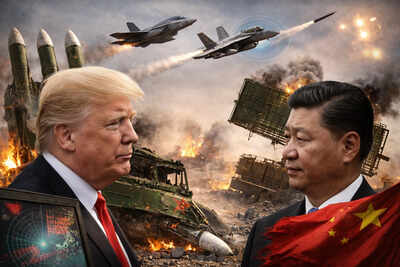
China’s image as a rising military technology powerhouse has come under renewed scrutiny after a series of conflicts exposed what analysts say are serious shortcomings in Chinese-supplied defence systems.Air defence equipment promoted by Beijing as advanced and reliable has faced questions after failing to prevent major military operations in Pakistan, Venezuela and most recently Iran. The incidents have prompted defence experts and policymakers to examine whether Chinese systems perform as advertised when confronted with technologically sophisticated adversaries.
'Where Are Iranian Nukes, You Liars?': Russia, China Team Up Against US-Israel At UN To Defend Iran
For years, Chinese leaders showcased the HQ-9B air defence missile system and associated radar technologies at military parades and defence exhibitions.
The system was marketed as a powerful long-range air defence shield capable of tracking and destroying multiple targets simultaneously.However, a series of recent military operations has cast doubt on those claims.
Growing questions over China’s air defence systems
The HQ-9B, also known as Red Flag 9, is widely viewed as China’s flagship long-range surface-to-air missile system. Developed by the China Aerospace Science and Industry Corporation, it draws technological inspiration from both the American Patriot missile system and Russia’s S-300 air defence platform.
In theory, the system incorporates advanced radar tracking, electronic countermeasures and the ability to engage multiple aerial targets simultaneously. It is designed to intercept aircraft, cruise missiles and some ballistic missiles at ranges of up to 260 kilometres and altitudes of approximately 50 kilometres.China has deployed variants of the system domestically in strategically important locations including Beijing, Tibet and the South China Sea.Yet the system’s battlefield performance outside China has raised serious questions.Critics argue that the HQ-9B and associated radar networks have looked impressive in military displays but have struggled in real combat conditions.“Returning to China, the HQ-9B missiles and JY-27A radars were always impressive at military parades, but they have performed poorly in actual combat. They are blind, deaf, and mute.”
Pakistan: Early warning signs during Operation Sindoor
Concerns about Chinese systems first intensified following India’s Operation Sindoor, launched after the Pahalgam terror attack.During the operation, Indian forces carried out a series of precision strikes targeting militant and military infrastructure across the border. According to military assessments, Chinese-supplied air defence systems deployed by Pakistan struggled to intercept incoming threats.The most visible problems were associated with Chinese platforms such as the HQ-9 and HQ-16 air defence systems, which were expected to shield high-value installations.Instead, reports suggested that incoming missiles and aircraft penetrated the defensive shield repeatedly.Since May of last year, serious concerns have been raised about the HQ-9B’s inadequacy. In India’s Operation Sindoor against Pakistan, the Chinese missiles were soundly defeated for four consecutive days.
They were unable to defend, destroy or track anything.Fragments of the Chinese PL-15 air-to-air missile, which had failed to hit its target, were later displayed by Indian officials, adding to questions about the reliability of Chinese weapons exports.Pakistan, one of China’s largest arms customers, sources nearly 82 per cent of its military imports from Beijing.The episode therefore sparked concern among countries that rely heavily on Chinese defence equipment.
Venezuela operation exposes radar vulnerabilities
The doubts surrounding Chinese defence technology deepened further during a dramatic American military operation in Venezuela.During the mission, US forces carried out a large-scale operation involving stealth aircraft, electronic warfare platforms and special forces units.The operation reportedly succeeded in capturing Venezuelan leader Nicolás Maduro without any US fatalities.The mission also exposed vulnerabilities in Venezuela’s radar and air defence network, which included Chinese-supplied JY-27A early warning radar systems.China’s JY-27 radar is a system capable of identifying and scanning targets between 280 and 390 kilometers away. It specializes in the early detection of fast, supersonic F-22 and F-35 fighter jets.However, reports suggested that the radar systems failed to detect the incoming aircraft involved in the operation.But in real combat, when Maduro was captured in Venezuela, the Chinese radars became a point of national humiliation and shame, failing to detect even one of the 150 aircraft that penetrated Venezuelan airspace.The incident delivered a major reputational setback to Beijing’s defence industry, particularly because the JY-27A radar had been promoted as capable of detecting stealth aircraft.Electronic warfare aircraft such as the EA-18 Growler, designed specifically to disrupt radar and communications networks, reportedly played a crucial role in neutralising the Venezuelan defence system.Operation Absolute Resolve also humiliated Russia. Venezuela had invested more than $2 billion in S-300 missiles.
Despite their power, they were rendered immobile by powerful American fighters, bombers and electronic warfare aircraft.
Iran strikes intensify scrutiny
The most recent test of Chinese-linked air defence capabilities came during the large-scale US and Israeli strikes on Iran.Coordinated airstrikes targeted military infrastructure and strategic installations across more than 20 Iranian provinces, causing widespread damage and reportedly killing senior military officials.Iran’s air defence system was designed to operate in layers.The long-range tier was reportedly anchored by the HQ-9B, supported by Russian S-300PMU-2 systems and Iran’s indigenous Bavar-373 platform. Medium-range systems such as Khordad-15 and Raad were expected to cover additional gaps, while short-range systems including Tor-M2 and Pantsir-S1 were intended to intercept low-flying threats.Despite this layered defence structure, the strikes caused extensive destruction.During Operation Epic Fury in Iran, the Chinese HQ-9B missile defense system was once again defeated with deadly strikes on Khamenei and some 49 high-ranking military officers. Chinese power failed miserably. The U.S. has demonstrated technological capability and extraordinary military expertise.The scale of the damage has prompted analysts to examine whether the system failed because of technical limitations or because it was overwhelmed by the complexity of the assault.Modern air campaigns frequently rely on saturation tactics, in which dozens or even hundreds of missiles and drones are launched simultaneously. Even advanced air defence systems can struggle under such conditions.Another possibility is that the air defence network itself was degraded early in the attack.Electronic warfare, cyber operations and stealth aircraft can disable radar systems and command nodes before the main strike begins.
Export credibility under pressure
China has become one of the world’s largest arms exporters, selling military equipment across Asia, Africa, the Middle East and Latin America.Countries including Pakistan, Iran, Egypt and Azerbaijan have purchased Chinese air defence systems in recent years.However, the recent conflicts have led some observers to question the reliability of these systems in high-intensity warfare.China’s propaganda is effective, but its military technology is not.
A few years ago, countries like Egypt, Azerbaijan, Pakistan and Iran spent billions on Chinese air defense systems; today, they regret it.For many buyers, cost has been a major factor in choosing Chinese equipment.Chinese systems are often significantly cheaper than Western alternatives such as the Patriot missile defence system or advanced European platforms.But critics argue that lower cost may come at the expense of reliability and technological maturity.
Strategic implications for Taiwan
The debate over Chinese defence capabilities also carries broader geopolitical implications.Some analysts believe that the performance of Chinese systems abroad could influence perceptions about China’s own military strength, particularly in relation to Taiwan.Events in Pakistan, Venezuela and Iran also give hope to Taiwan. China has lost credibility, and its arms race is no longer as formidable.Although Beijing remains a nuclear power with a rapidly expanding navy and air force, critics argue that its combat technology and radar networks may still lag behind those of the United States.Although Beijing is still a nuclear power, its combat technology and radars have already proven unreliable, vulnerable and of low quality when compared to those of the US.
US military dominance remains intact
Despite growing competition from China and Russia, recent events have reinforced the perception that the United States remains the dominant global military power.The speed and precision of recent operations have drawn comparisons with earlier military campaigns.Recall that it took President George H.W. Bush several days to capture General Manuel Noriega in Panama; the tracking and elimination of Osama Bin Laden took almost 10 years.Here is a historical fact for which no is crediting the current administration: Operations Absolute Resolve and Epic Fury have set a new standard.Supporters of the current US strategy argue that decisive military action combined with technological superiority has reshaped the global strategic landscape.The war in Iran has achieved the unthinkable: bringing together many European and Arab countries against the terrorist threat posed by Iran. This is only happening thanks to strong and decisive U.S. leadership.
A global power balance in transition
China remains a major economic power and continues to expand its military capabilities.However, recent events suggest that the gap between Chinese military technology and that of the United States remains significant in certain areas, particularly in air defence integration, electronic warfare and stealth penetration.China remains an economic power, but the U.S. has military, economic and political power. It is using all these elements to reshape the world.This is not a jazz improvisation — it is a harmonious melody that is helping to attain peace through strength.The debate over the effectiveness of Chinese defence systems is likely to intensify as analysts continue to examine the outcomes of recent conflicts.For now, the battlefield performance of these systems has placed China’s defence industry under unprecedented scrutiny.







 English (US) ·