

 1 week ago
6
1 week ago
6
ARTICLE AD BOX
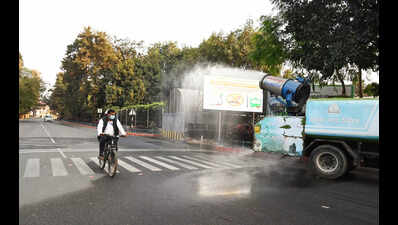
Patna: Providing much-needed relief to residents, Patna’s pollution level improved noticeably on Wednesday, with the Air Quality Index (AQI) dropping to 198. This change pulled the city back to “moderate” from the “poor” zone it occupied for the previous two days, with recordings of 214 on Dec 8 and 215 on Dec 9.Yet, the relief remains patchy and fragile. While the city-wide average eased, several localities continued to record alarmingly high pollution levels. Samanpura bore the brunt with a staggering AQI of 317, deep inside the “very poor” category that can trigger respiratory trouble even among healthy individuals.The air monitoring station at DRM Office in Khagaul logged 235, the Planetarium area 227, Patna City 216, and Rajbanshi Nagar 209—all firmly in the “poor” zone.
Only Muradpur station offered a cleaner pocket at 149, still moderate but a world apart from Samanpura just a few kilometres away.As per the Central Pollution Control Board (CPCB) bulletin, the overall AQI of the city stood at 198 at 4pm on Wednesday. It was earlier at 214 in the morning hours, with hazy air. Moderate AQI can cause breathing discomfort to people with lung, asthma, and heart diseases.Meteorologists attribute the improvement to a slight increase in surface winds during the day, which helped disperse the thick layer of PM2.5 (particulate matter with a diameter of 2.5 micrometres or smaller) that dominated the past 48 hours.
The primary pollutant remains particulate matter, but its concentration has fallen enough to push the overall index below the 200 mark. However, the relief may be short-lived. The AQI calendar forecasts another rise in pollution levels, suggesting the improvement is temporary unless stronger winds or rainfall intervene.Speaking on the sharp variations between the air monitoring stations in the city, Devendra Kumar Shukla, chairman of the Bihar State Pollution Control Board, explained that Patna’s air is extremely sensitive to local activity.
“The moment there is a traffic jam, idling vehicles, or any construction, the reading shoots up instantly,” he said.“Three factors decide the AQI: meteorology, air-shed movement, and local sources. Right now, the larger air-shed is carrying pollution towards West Bengal and eastern India, but within Patna, the difference of even a few kilometres is dramatic because of hyper-local factors,” Shukla said, while pointed out specific hotspots—road dust from continuous diesel-run machinery and movement of heavy vehicles near BIT campus and railway siding activity and construction materials near DRM office-Khagaul.









 English (US) ·