

 1 hour ago
3
1 hour ago
3
ARTICLE AD BOX
The assumption has been comfortable and long-standing: creativity is a product of abundance. When ancient humans had enough food, enough warmth, enough security, they had the mental space to innovate.
Lean times produced lean thinking. It was a tidy, persuasive story, one that shaped how archaeologists interpreted almost every major prehistoric discovery for decades. Now, a cave in central China has complicated it considerably. A new analysis of crystals found inside an animal bone at the Lingjing archaeological site has pushed the site's age back by 20,000 years, dropping it squarely into one of Earth's harshest ice ages.
Inside the Lingjing archaeological site in Central China
For more than a decade, scientists have been excavating the Lingjing archaeological site in Henan Province, central China, a location where ancient humans once processed animal remains, leaving behind bones and stone tools in quantities that have kept researchers busy for years. The site had already drawn attention for the complexity of its finds. But a new analysis, published in the Journal of Human Evolution in May 2026, has shifted the entire frame around what Lingjing represents.
How a 20,000-year dating shift rewrote the entire story
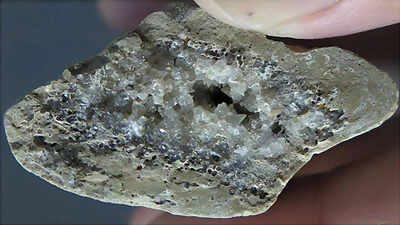
The key came not from a tool, but from a bone. Inside a rib fragment belonging to a deer-like animal, researchers found crystals that had formed naturally over millennia within the organic material. Those crystals could be dated with precision. And when they were, they pushed the age of the site back significantly, from 126,000 years old to 146,000 years old. Twenty thousand years may not sound dramatic. In this case, it changes everything.
At 126,000 years ago, Lingjing would have fallen within a warm interglacial period stable climate, richer resources, and more forgiving conditions. That timing would have fit the prevailing theory neatly.At 146,000 years ago, the picture is entirely different. That period corresponds to a harsh glacial era, severe cold, reduced resources, and significant environmental stress. The humans at Lingjing were not innovating in comfort.
They were innovating under pressure."Even though these tools are just a little bit older than we'd previously thought, the entire story is changed," said lead author Yuchao Zhao, assistant curator of East Asian archaeology at the Field Museum in Chicago. "We used to think these tools were made during a warm interglacial period, but based on the new dates suggested by the crystals, some of these tools were actually produced during a harsh, cold glacial period.
"
What the stone disc tools actually reveal
The stone objects recovered from Lingjing are discs, and at first glance, they are easy to underestimate. But the process behind them tells a more demanding story. Researchers identified a technique known as centripetal flaking, in which stones of different sizes are struck together in a deliberate sequence. The discs were not end products in themselves; they were instruments used to shape other stones into precise final forms.
Different discs were designed to produce different results, some to generate sharper flakes, others used at specific angles to achieve particular fracture patterns. The strikes were not random.The entire system required planning, an understanding of stone properties, and an ability to think several steps ahead to envision not just the tool being made, but the tools needed to make it."This was not casual flake production, but a technology that required planning, precision, and a deep understanding of stone properties and fracture mechanics," Zhao noted.
Overturning a long-held bias
The significance of the find extends beyond the question of when creativity happens. It also strikes at a longstanding geographical assumption in archaeology, the idea that while ancient humans in Africa and western Europe were forging sophisticated technologies, their counterparts in East Asia were lagging, relying on simpler and more conservative stone-working traditions. Lingjing, and a growing body of similar discoveries in China, tells a different story.
The cognitive logic in the centripetal flaking system closely mirrors Middle Palaeolithic technologies associated with Neanderthals in Europe and early human ancestors in Africa.The implication is significant: advanced technological thinking was not the exclusive property of Western Eurasia. It was arriving independently or spreading more broadly across the ancient world. The humans at Lingjing are believed to be Homo juluensis, a large-brained hominin combining features of archaic East Asian humans and Neanderthals, who likely came into contact with Homo sapiens at some point in the deep past.
Creativity born of necessity
What emerges from this research is a reframing of one of the most fundamental questions in human prehistory: what actually drives innovation? The comfortable answer, abundance, leisure, surplus, may be only part of the picture. "People often imagine creativity as something that flourishes in good times," Zhao said. "Finding out that these stone tools were made during a harsh ice age tells a different story. Hard times can force us to adapt.
" The crystals inside a deer rib, formed in darkness over 146 millennia, preserved exactly that argument. The humans who sheltered at Lingjing during one of Earth's coldest chapters did not wait for warmer times to think carefully. They thought carefully because they could not afford not to.








 English (US) ·