

 9 hours ago
6
9 hours ago
6
ARTICLE AD BOX
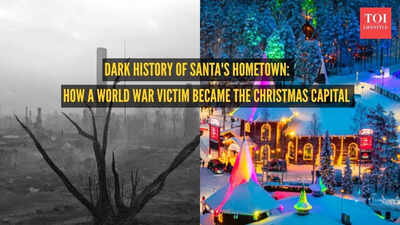
The place that guarantees happiness had to burn itself down to create some for itself.
Santa Claus is coming along riding on a sleigh! But where does Santa really come from? It's from his hometown of Rovaniemi. Marketed as the magical "official hometown of Santa Claus," when you think of the place you think of snow-covered landscapes, reindeer, elves and a Christmas cheer that makes the soul sing.
But only a few know that the place that guarantees happiness had to burn itself down to create some for itself. Beneath the fairy lights and sleigh rides, lies a troubling history, one that is hidden in layers of snow, one that is shaped by war, colonial exploitation and survival.
The dark history of Santa's hometown
Long before Santa miraculously changed everything with his magic, Rovaniemi, a city in Lapland, England was at the centre of the northern trade routes. Lapland itself is the ancestral homeland of the Sami, Europe's only recognised indigenous people. Their culture revolved around reindeer and has survived on them for years as they provided the families with meat, milk hides, shoes, tents, bones, antlers, and sinews. For years, the Sami communities subsisted through reindeer herding, fishing, and seasonal immigration all guided by the elders of the generation.
As Nordic nation-states expanded from the 17th century onwards, the Sami land was gradually absorbed, taxed and regulated. Borders split the communities into Finland, Sweden, Norway and Russia. Their languages were discouraged and even banned and children were forced to believe that the Indigenous culture was "backward."By the time Rovaniemi began to develop, the Sami presence had been disintegrated and marginalised.
Even today, they are fighting for land rights, mining and religion.
Rovaniemi's burning history
However, this was just the beginning of the darkness that the land had to go through. In the 1930s, Rovaniemi was a quiet town of 6,000 that engaged in trading until Russia invaded in 1939. The Finns fought a battle in a winter war of 1939-40 and then allied with Germany for protection from further Russian attacks. The Germans changed the town's population and architecture.
They doubled the first and built an airfield that is now "Santa's official airport" and barracks that became the site of Santa Claus Village. But when the war turned against the Axis powers, Russia ordered the people to expel the Germans. But when the Germans left in 1944, they burned the town to the ground and laid mines all around. The fire destroyed about 90% of the town and left nothing for the residents to return to after they came back from Sweden, where they had been moved.
Creating Santa's hometown
As soon as you land at the Rovaniemi airport in Lapland you can feel the Christmas cheer in the air. Just a couple of miles away is the Santa Claus Village, an amusement park that has elves, real reindeer, huskies, shops and restaurants that draw in more than 600,000 visitors a year. While reindeer form the symbol of this town, there is one reindeer head embedded in the city's street plans. That, is the work of Finland's greatest architect Alvar Aalto, who rebuilt the capital after the German burning.
Aalto was commissioned by the Association of Finnish Architects to reconstruct the town in 1945. Partly inspired by the US president Franklin Roosevelt's Tennessee Valley Authority, the architect created a plan for the entirety of Lapland. He began by building single housing units in the city. He factored in the hydroelectric plants being built on the rivers of Lapland and commissioned impact assessments to see the effects on the environment and people.He then created the "reindeer antler" street plan imposing a reindeer head outline on existing topography. In June 1950, Eleanor Roosevelt wanted to visit the Arctic Circle and thus the Finns built a log cabin near Rovaniemi airport in a week. The cabin later became a tourist attraction and was visited by world leaders. As tourism grew, the town was rebuilt. While the zoning aspect of Aalto's plan was never realised, he designed three buildings for the town's municipal centre: a concert hall, a town hall and a library. It was in 1984 that Concorde was bringing visitors to Rovaniemi to see the Arctic Circle and the local entrepreneurs created the Santa Claus Village. While, as per Finnish myth, Santa came from Korvatunturi, a place 200 miles north of Rovaniemi, it is inaccessible. Thus, the people created a rural-style village near Roosevelt's cabin and started a tradition that is heartily believed in to date. For visitors, Rovaniemi has always been the place of happiness, of Santa's charm. And for the people of the town, it is a remarkable example of how belief makes it all real, life after destruction and Santa during Christmas.







 English (US) ·