

 2 hours ago
4
2 hours ago
4
ARTICLE AD BOX
Responding to whether India needs more than one Jaishankar, S Jaishankar said the premise was flawed, stressing that nations are defined by leadership and vision, drawing a parallel with Lord Hanuman serving Ram.
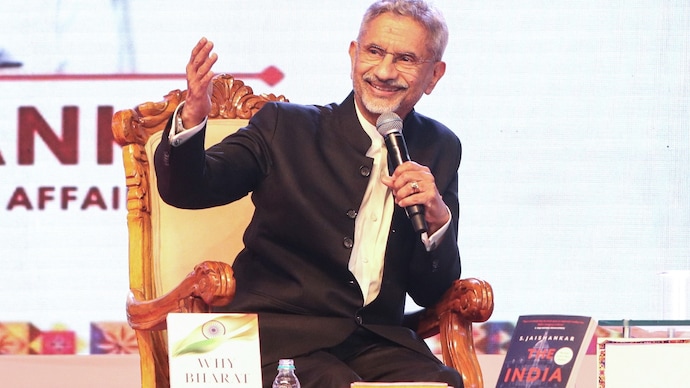
External Affairs Minister S Jaishankar during an interaction at the Pune Literature Festival 2025. (Image: PTI)

New Delhi,UPDATED: Dec 20, 2025 23:49 IST
Does India need more than one Jaishankar? Responding to the question, External Affairs Minister S Jaishankar said the premise itself was flawed, drawing a parallel with Lord Hanuman to underline the primacy of leadership and vision in defining a nation’s direction.
Speaking at the Diplomacy to Discourse session at the Pune Literature Festival on Saturday, Jaishankar said the question should instead focus on leadership. “You should have asked me: there is one Modi. Because ultimately, Shri Hanuman finally serves,” he said, adding that countries are shaped by leaders, their vision and confidence, while others execute that mandate.
Jaishankar said the current international order resembles coalition politics, with constantly shifting alignments and no single dominant power bloc. In such a multipolar world, he stressed, India must remain agile and make choices based strictly on national interest.
“There is no majority of anyone. Combinations are formed, deals are struck, and partners change depending on the issue,” he said, adding that India must have the flexibility to work with different countries simultaneously without being locked into rigid alliances. His guiding principle, he said, is simple: whatever helps India.
The external affairs minister said managing India’s foreign relations has become significantly more complex over the past five years. Engagement with the United States requires constant recalibration, ties with China remain difficult, and reassuring Russia has become challenging amid pressure linked to the Ukraine war.
Jaishankar said bringing Japan into play has also grown more complicated as Tokyo moves at its own pace, while Europe has emerged as an increasingly important partner requiring deeper engagement.
On India’s neighbourhood, Jaishankar said relations are shaped by asymmetry and volatile domestic politics in neighbouring countries. Smaller nations closely linked to India often oscillate between praise and criticism, making it difficult to keep ties steady.
Despite this, he said, India has consistently acted as a first responder. He cited assistance to Sri Lanka during a recent cyclone, vaccine supplies to neighbouring countries during the COVID-19 pandemic, and support with fuel and fertilisers when global supply chains were disrupted by the Ukraine conflict.
India, he said, must behave like the head of a family, taking responsibility for regional stability even when differences arise.
On whether India should speak out on global issues, Jaishankar said silence can lead to marginalisation in a multipolar world. At the same time, diplomacy demands judgement on when to assert and when to exercise restraint.
“If you don’t speak, the world will suppress you. It is important to raise your voice when required,” he said.
Addressing concerns over brain drain, Jaishankar said the global demand for Indian professionals reflects India’s growing reputation. Many Indians work abroad for a few years and return to build businesses at home, he said.
With Indian workers in demand across sectors worldwide, the minister said young Indians should increasingly view the world as a shared workplace, reflecting the rise of a strong global brand for India.
The Pune Literature Festival is being held on the sidelines of the ongoing Pune Book Festival.
- Ends
With PTI inputs.
Published By:
Akshat Trivedi
Published On:
Dec 20, 2025
Tune In



 English (US) ·