

 5 days ago
7
5 days ago
7
ARTICLE AD BOX

Gujarati cinema is experiencing a significant transformation, with box office revenues more than doubling in a decade and theatrical footfalls reaching a ten-year high. Driven by thematic diversity, improved production values, and a renewed cultural connection, films like 'Laalo- Krishna Sada Sahaayate' are leading this remarkable growth, surpassing other regional industries.
For decades, discussions around Indian cinema largely meant one thing: Hindi cinema. At best, conversations expanded to include Tamil and Telugu films in the last decade, thanks to pan-India blockbusters.
But somewhere between these dominant industries, a small, rooted, and fiercely passionate cinema began quietly reinventing itself. Against all odds, Gujarati cinema once considered as niche, or simply ‘local’ is now emerging as one of India’s fastest-growing regional industries.It is not a minor uptick, it is a transformation.A Decade of Growth - From Rs 46 Cr to Rs 104 CrAccording to a study by Ormax Media, the Gujarati film industry’s box office revenues jumped from Rs 46 crore in 2015 to Rs 104 crore by October 2025 , it multiplied more than twice in a decade.
Even more significant is the rise in theatrical footfalls. The industry recorded over 10 million admissions this year, the highest of the decade.And the shift is not limited to numbers. In the last three years alone, Gujarati cinema’s collections have surpassed Punjabi, Bengali, and Marathi cinema, making it one of India’s most vibrant regional film ecosystems. This is an extraordinary feat for an industry that, until recently, struggled with budget limitations, lack of infrastructure, and a perception problem.
The Films Behind the Momentum
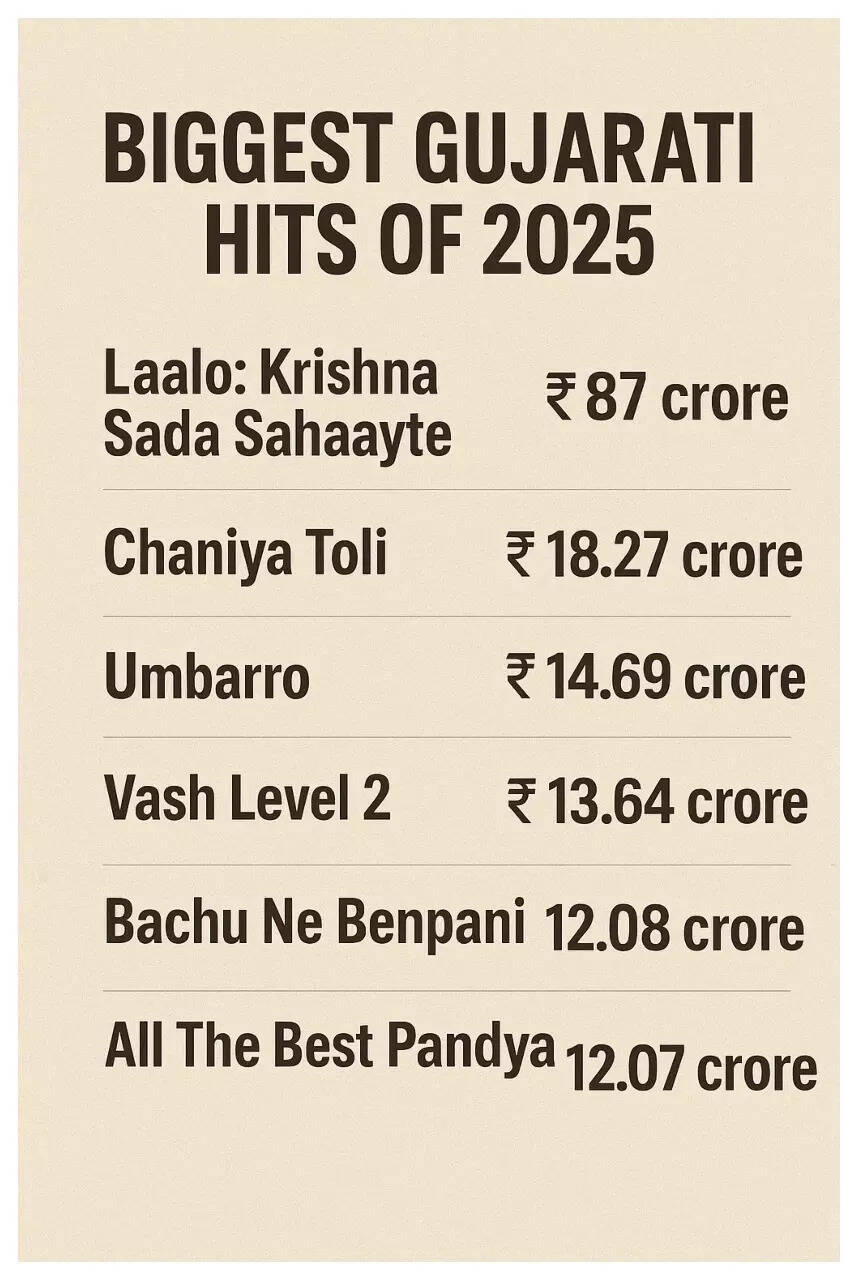
A glance at 2025’s lineup clarifies why the industry is being taken seriously. Gujarati films such as:Laalo -Krishna Sada SahaayateChaniya ToliVash Level 2UmbarroAll The Best PandyaBachu Ni BenpaniThese films have drawn audiences back to theatres in a way the industry hasn’t seen before. These releases demonstrate not just commercial confidence but a thematic diversity that Gujarati cinema was long accused of lacking. Yash Soni’s Chaniya Toli was a heist comedy directed by Jay Bodas and Parth Trivedi collected Rs 18.29 crore. Krishnadev Yagnik’s Vash Level 2 starring Janki Bodiwala and Hitu Kanodia collected Rs 13.64 crore. Umbarro , a story of 7 women who moved to London, directed by Abhishek and starring names like Vandana Pathak and Suchita Trivedi minted Rs 14.69 crore. Malhar Thakkar’s All The Best Pandya directed by Rahul Bhole and Vinit Kanojia minted Rs 12.07 crore.
And Bachu Ni Benpani with Ratna Pathak Shah and Siddharth Randeria, directed by Vipul Mehta earned Rs 12.08 crore. Producer Anand Pandit, whose banner has delivered hits like Fakt Mahilao Maate, Fakt Purusho Maate, Tron Ekk’, and Chaniya Toli, believes 2025 marks a turning point.In an exclusive conversation with ETimes, he says, “ This year in particular has been an exceptional year for Gujarati cinema. Many films have performed well and have attracted audiences in big numbers, which bodes well for the future of Gujarati cinema. The good news is that the industry is now displaying thematic diversity. Our cinematic language is evolving and is more contemporary while being rooted in Gujarat's cultural richness”Pandit emphasises improvements in production values and the contribution of OTT platforms in expanding Gujarati cinema’s reach.
He said , “Our production values and technical expertise have improved, the storytelling has become more self-assured, and the genres have become richer. Post-pandemic, multilingual cinema has also reached a diverse audience via OTT streamers.”
What he says next reveals the heart of the movement, “ More young filmmakers are entering the industry, and collaborations with national studios are increasing. With better distribution networks and audiences showing confidence in homegrown content, we will see bigger films, more experimentation, and perhaps the widest theatrical acceptance the industry has ever enjoyed.
Gujarati cinema is on the brink of a new creative and commercial breakthrough for sure”.The Laalo Phenomenon -A Film That Broke Every RuleAt the centre of Gujarati cinema’s meteoric rise stands one film: Ankit Sakhiya’s Laalo – Krishna Sada Sahaayate. With a staggering collection of Rs 93.05 crore crore in 66 days, the film is Gujarati cinema’s biggest hit ever and currently ranks as the 32nd highest-grossing Indian film of 2025.But what makes Laalo remarkable isn’t just the final number. It is the path it took to get there.Where most films peak early, Laalo grew with every passing week, a phenomenon almost unheard of in Indian theatrical business.
Laalo Official Trailer | Krishna Sada Sahaayate | New Gujarati Film,Indian Gujarati Devotional Film
The Unusual Box Office TrajectoryWeek 1: Rs 33 lakhWeek 2: Rs 27 lakhWeek 3: Rs 62 lakhWeek 4: Rs 12.08 croreWeek 5: Rs 25.70 croreWeek 6: Rs 24.40 croreWeek 7: Rs 15.70 croreWeek 8 : Rs8.50 croreWeek 9: Rs 4.15 crore What began as a modest release transformed into a cultural wave.Director Ankit Sakhiya, still overwhelmed by the film’s success, tells ETimes, “We knew we had made a good film. We were confident it would connect. But no one imagined it would reach this level. We weren’t worried about the film’s fate. Our entire focus was on ensuring enough shows, getting people to watch it, and letting word-of-mouth do its job. The success is all Lord’s blessings.”Sakhiya believes Laalo resonated because it spoke directly to the audience’s emotions.
“People felt Laalo was their personal story. They felt it was their biopic. In a way, all of us are Laalos, stuck in our thoughts, waiting for a Krishna to guide us.”Why Gujarati Cinema Is Rising - Culture, Community, and a New GenerationThe success of Laalo reflects a broader cultural shift. Sakhiya explains, “The newest swag in life is celebrating your culture. There is a renewed interest in God, spirituality, and community bonding.
You’ll see young people fasting or dancing to bhajans at ISKCON. In today’s time, we all need hope.”The director believes Gujarati cinema is connecting because it mirrors daily life, values, and philosophy that people cherish but rarely see represented authentically on screen.“We didn’t say anything new — we simply echoed what Krishna said in the Geeta: Do your work and leave the rest to Him. People found comfort in that message.” The Ecosystem Finally Comes TogetherGujarati cinema’s rise is not accidental. It is powered by an ecosystem that has matured steadily:1. Stronger Production HousesSeveral Gujarati banners are now functioning with discipline and ambition, backing films consistently.2. OTT Streamers Opening DoorsPlatforms have begun acquiring Gujarati titles, giving filmmakers a national and international audience.3. Community Groups & Word-of-Mouth CultureGujarati audiences are known to promote films within extended family and community circles - a marketing advantage few industries enjoy.4. Growing Talent PoolYoung filmmakers, actors, technicians, and writers are entering the field with confidence and modern sensibilities.5. Government SupportThe Gujarat government offers subsidies up to Rs 75 lakh, making film production financially viable for many.Together, these elements have created a perfect growth environment one where creative ambition meets audience enthusiasm.A Small Industry Ready for Big LeapsGujarati cinema’s rise is not just a regional story , it mirrors a larger shift in Indian entertainment. Audiences today want authenticity, rootedness, and emotional truth more than ever before. Gujarati films are delivering that with clarity, warmth, and cultural pride.






 English (US) ·