

 1 week ago
7
1 week ago
7
ARTICLE AD BOX

Ramesh was accused of murdering his wife and four young daughters. After cops claimed he “confessed”, a lower court sentenced him to death. Twelve years later — years spent by Ramesh inside a prison cell — the Supreme Court acquitted him, calling the purported confession “suspicious” and uncorroborated.For Ramesh, a poor, uneducated labourer from Uttar Pradesh, the real punishment was the process. He was moved from one hearing to another without him ever seeing the inside of a courtroom. And he neither knew the lawyer assigned to defend him, nor did he have the foggiest about who testified, or what they said.Ramesh’s story might have ended there, had the Square Circle Clinic at Nalsar University of Law, Hyderabad, not stepped in.
Their team pored over every page of the trial and high court records, uncovering several contradictions and procedural lapses that ultimately led to an acquittal from the top court.The story of Naveen, from Punjab, is similar. He, too, spent over a decade in prison after being sentenced to death in a case of murder of four people — a conviction later confirmed by the high court. Naveen’s case, too, was taken up by the Square Circle Clinic, leading to a Supreme Court acquittal.
“When at stake are human lives and the cost is blood, the matter needs utmost sincerity,” the top court observed during the acquittal.
.
More Than ‘Reasonable Doubt’
In the last three years, Supreme Court has not upheld a single death penalty. In the last two years alone, the top court acquitted 11 persons on death row, even as high courts across the country either acquitted or commuted the death sentences of 163 people in the same period.Yet, lower courts continue to award death penalties. Square Circle found the case against Ramesh riddled with missing links and procedural lapses.
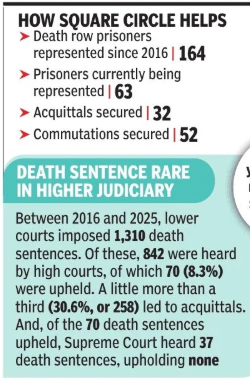
Apart from the “confession” that no one heard nor recorded, the case records were contradictory. Still, the lower court sentenced him to death — without really understanding how the case against him had been built.“In jail, I used to lie awake thinking only of one thing — how to get out,” Ramesh said. “Other prisoners told me I would never see the outside again.”Between 2016 and 2025, lower courts imposed 1,310 death sentences.
Of these, 842 were heard by high courts, of which 70 (8.3%) were upheld. A little more than a third (30.6%, or 258) led to acquittals. And, of the 70 death sentences upheld, Supreme Court heard 37 death sentences, upholding none.
.
Helping The Condemned
Ramesh and Naveen are not exceptions. Across the country, hundreds of people — overwhelmingly poor, rural or marginalised — land on death row on the basis of incomplete records, weak defence and errors that go unnoticed for years.
The clinic’s lawyers say they see the same failures repeatedly: missing documents, inaccessible case files, inconsistent evidence and trialcourt mistakes that should never have survived judicial scrutiny.Square Circle Clinic’s efforts have secured 32 acquittals and 52 commutations since 2016, when it was founded — then as Project 39A at National Law University, Delhi. Its team of criminal law practitioners, forensic experts, legal researchers, social workers, psychologists and anthropologists has provided free representation to 164 death row prisoners to date.The clinic is now representing 63 individuals on death row.
‘Can’t Have Death Penalty’
According to the latest Death Penalty in India report, released on Feb 4, as many as 574 persons (550 men and 24 women) were on death row in the country as of Dec 31, 2025. This is the highest death row count recorded since 2016, when it was 400.The largest number of death row prisoners are in Uttar Pradesh (151), followed by Gujarat (70), Haryana (41), Maharashtra (39), and Kerala (34).
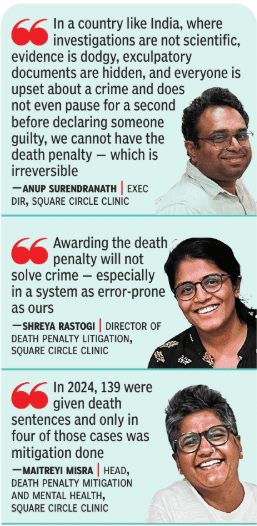
Most of those on death row (254 persons) had been convicted for the offence of ‘murder simpliciter’ — murder with the primary intention of killing — followed by murder involving sexual offences (213).“The kind of offence involved cannot determine whether or not someone gets a fair process or trial. Unfortunately, that is what was happening at the ground level, where someone arrested for a crime was being declared a murderer and put on death row,” said Anup Surendranath, professor of law at Nalsar, the clinic’s executive director.“Once you see the reality, the plight of individuals, it is difficult not to be against the death penalty. In a country like India, where investigations are not scientific, evidence is dodgy, exculpatory documents are hidden, and everyone is upset about a crime and does not even pause for a second before declaring someone guilty, we cannot have the death penalty — which is irreversible,” he added.In a previous report, the clinic had found that 74% of prisoners on death row were from socio-economically vulnerable backgrounds.
“Prisons are filled with poor people, and nobody is talking about wrongful convictions,” Surendranath said.So, does he not worry about the possibility of him helping someone guilty walk free? “It doesn’t matter to a criminal lawyer whether the accused is innocent or guilty,” he answered. “All we care about is whether the legal process was followed, and whether the trial was fair. Why are we not asking why our prosecution is so unreliable? Why are we not strengthening it? Why are we not pushing for scientific investigation and reforms in policing, where investigations have become unreliable — maybe because of lack of resources, training or freedom?” Not even a fraction of prisoners have access to the kind of support the clinic provides, he stressed.
No Mitigation Despite Rules
What the clinic uncovered, through these cases, goes beyond individual errors. It reveals a structural gap at the heart of capital sentencing: the absence of meaningful mitigation.In criminal law, mitigating circumstances (for example remorse, no criminal history, potential for rehabilitation) should be considered during sentencing to reduce severity. But, despite Supreme Court directions and detailed 2022 guidelines requiring defence teams to submit mitigation reports, the rule remains largely on paper.“In 2024, 139 were given death sentences and only in four of those cases was mitigation done,” said Maitreyi Misra, who heads the clinic’s work on death penalty mitigation and mental health.Misra, who received the World Psychiatric Association Presidential Commendation in 2023 for her work with death row prisoners, said courts typically grant only 16-20 weeks for mitigation — barely enough time to build rapport, understand a prisoner’s life history and gather records.“It might seem like a long time, but for an investigator to meet a client, build rapport, and reach a stage where they are ready to open up about their private and innermost problems, this is not sufficient,” she said.Misra said that due to lack of awareness at all levels, one may have to spend a lot of time — in some cases — convincing the judge on why someone accused of a horrible crime should even be given access to mitigation.
The same goes for prisons, as they are asked why someone is meeting the same prisoner three days a week. The lack of good spaces to interview accused persons inside prisons and the lack of a trained pool of mitigators are some of the other challenges.“I have seen cases where the accused had serious disabilities that were not diagnosed. Some were on psychiatric medication, which affected their communication,” she said, adding that mitigation should be made available to all accused persons, right from the trial court level.
Knee-Jerk Death Penalty
In India, death sentences are often awarded as a reflex to public outrage, the team felt. “Awarding the death penalty will not solve crime — especially in a system as error-prone as ours,” said Shreya Rastogi, director of Death Penalty Litigation at the clinic. “Across the world, 131 countries either do not have or do not use the death penalty. This should make us pause and think, instead of using the death penalty — which is irreversible — as a knee-jerk reaction.
”She said securing acquittals or commutations is extraordinarily difficult, as the Supreme Court must overturn findings of both the trial court and the high court — a threshold that demands extreme caution.So, what happens if an acquitted client re-offends? “We cannot perform the state’s function,” she said, adding, “All we care about is rule of law, fair trial and a fair chance for everyone — whether actually innocent or guilty.”
The legal system, she said, “focuses on who — prosecution or defence — managed to put up a better case, and not on whether someone committed the crime.”Rastogi feels the death penalty “does nothing” to make streets safer and has no redemption value. “The way it is administered causes more suffering, as it is being used as punitive action in an already broken system with poor-quality legal representation,” she said.Rastogi, a recipient of the prestigious Magnus Mukoro Award for Integrity in Forensic Science, also highlighted that no rehabilitation programmes are available for acquitted people, who are left to fend for themselves. In certain cases, they are targeted again, either by police or by victims’ families, she said.(Names of accused people have been changed)







 English (US) ·