

 1 hour ago
3
1 hour ago
3
ARTICLE AD BOX

Urban expansion driving higher rainfall in Hyderabad’s built-up areas (Representative image)
HYDERABAD: Hyderabad's rapid urban expansion over the past three decades is reshaping not just its skyline but its climate. A new study has found that the city is now receiving significantly higher rainfall than its surrounding rural areas — a shift researchers link directly to unchecked urban growth.The findings, published in the ‘Journal of Hydrology', show that built-up areas have steadily replaced agricultural land and open spaces, leaving Hyderabad facing a ‘double whammy' of urban flooding and water scarcity. While total rainfall has increased, it is increasingly arriving in sudden, intense bursts rather than being evenly spread through the year. The trend raises serious concerns over unplanned growth, mounting environmental stress and the long-term sustainability of the expanding metropolitan region.
Hyderabad’s urban sprawl linked to rising rainfall
Titled ‘Urbanisation-induced changes in rainfall and drought patterns: a study across six Indian states with mega-cities', the research analysed satellite data from 1991 to 2019. Conducted by researchers from Indian Institute of Technology Bhubaneswar and India Meteorological Department Pune, it examined the Hyderabad Metropolitan Region — covering the urban core, peri-urban and rural belts — along with major metros in Karnataka, Maharashtra, Tamil Nadu, West Bengal and Delhi.
Using multi-resolution satellite imagery, the team mapped land-use and land-cover changes with high precision.
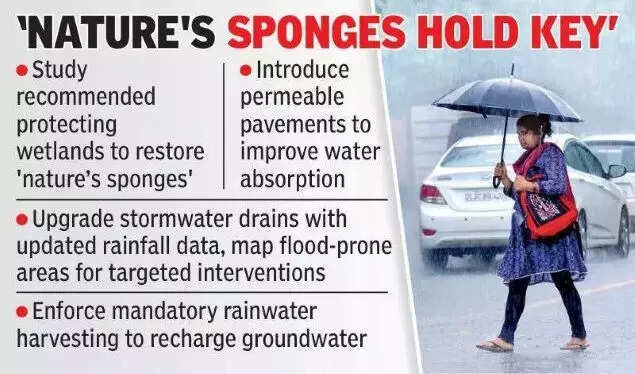
Built-up area expandsThe study found that Hyderabad's built-up area began expanding sharply after 2005, driven by rising population and economic activity. Agricultural land, vegetation and open spaces along the city's outskirts were steadily converted into residential layouts, commercial complexes and industrial zones, particularly along major road corridors and peripheral stretches. Urbanisation was identified as the primary driver of the climatic shift. Hyderabad's built-up area has grown at an average annual rate of 3.7% since 1999, with its physical footprint expanding from 600 sq km in 1985 to 1,100 sq km by 2015. One of the researchers, Saket Dubey from the School of Infrastructure at IIT Bhubaneswar, stated that the construction boom is directly responsible for the erratic weather currently observed. He noted that nearly 78% of the increase in Mumbai's total rainfall and 54% of the spike in Bengaluru are attributable to the way those cities have been built. According to the study, Hyderabad's rise as a global IT and BPO hub accelerated this transformation, replacing natural green cover and rock formations with heat-absorbing concrete and glass. Among major cities analysed, Kolkata was the only one to record a decline in rainfall, likely because its primary construction phase occurred decades earlier, in the mid-1980s. ‘Nature's sponges'To counter these extremes, the study recommended restoring ‘nature's sponges' by protecting wetlands and introducing permeable pavements to improve water absorption. It also called for upgrading stormwater drains using updated rainfall data, mapping flood-prone hotspots for targeted interventions, enforcing mandatory rainwater harvesting to recharge groundwater, and linking land use regulations directly to climate-risk maps to prevent dense construction in vulnerable zones.








 English (US) ·