

 3 days ago
6
3 days ago
6
ARTICLE AD BOX
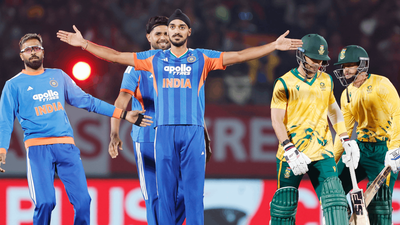
Arshdeep Singh and teammates. (Image: X/BCCI)
DHARAMSHALA: For a long time leading up to the T20 World Cup in 2024, India copped a lot of criticism for their rather conservative approach to batting in the format. When the transition happened under new coach Gautam Gambhir and captain Suryakumar Yadav, the batting line-up was filled with those who could play an ultra-aggressive brand of cricket. However, with India’s T20 World Cup title defence starting in less than two months at home, the batting has become a major cause for concern. For a team management that has primarily believed in a batting-heavy XI, it may be time to revisit its strategies.
Abhishek Sharma's sister is very proud of her brother, and India win
Barring Abhishek Sharma’s starts at the top of the order, consistency has eluded the rest of the batters. With strike-rates falling, India may well be more comfortable not playing high-scoring games at all.
Since the Asia Cup, most of the wins have come in matches in which India have chased below 160. Sunday night’s win in the third T20I against South Africa in challenging conditions in Dharamshala was another reference point. The Asia Cup campaign was similar.
Over the last 12 months, for all the noise around India’s renewed approach based on uninhibited, uninterrupted power-hitting, it is the bowling department that has held the team together.
In fact, it has actually been hard to hide the continued struggles of the batters.

Scratch the surface and one will find that the problems run deeper than captain Suryakumar Yadav and vice-captain Shubman Gill’s poor form, which has become a coffee-table discussion these days. In the last 14 matches, Tilak Varma’s strike-rate has largely hovered below 120. He has gone past a strike-rate of 150 only twice. Much of this is because he is tasked with repairing the innings.
The whimsical changes in the batting order haven’t let the others settle down. Axar Patel — identified as the floater in the line-up — too hasn’t been able to break free.There is much clamour for Sanju Samson’s inclusion but his numbers since facing the raw pace of England at home earlier this year aren’t very inspiring either.

“I always try to give the team a good start. I have that intent so that the other batters can just play along the ground or probably take their time.
So that’s what our team plan always been like. I have to express myself and take down the bowlers,” opener Abhishek Sharma said after Sunday’s big 7-wicket win. Incidentally, the other Indian batters took over 10 overs to score the remaining 58 runs after Abhishek fell for an 18-ball 35, with the score at 60 in 5.2 overs. Abhishek also backed Gill and Surya to come good. “Trust me, these two guys are going to win matches in World Cup and in this series as well,” he said.
“Because I’ve been playing with them since so long, especially with Shubman, I know which match he can win and in what conditions, irrespective of the team. I hope everyone will see him coming good very soon and have faith in him.”

Varun big factor in potent attack With the batters struggling to live up to the hype, India’s bowling has been at the forefront of their T20 game. Varun Chakravarthy coming into the team with his consistently incisive and miserly spells is a cushion for the batters. As he showed on Sunday night, Varun can thrive in any condition. His unconventional deliveries are still hard to pick for players who don’t face him much. The bowling attack — comprising Jasprit Bumrah, Arshdeep Singh, Hardik Pandya and Chakravarthy as frontline bowlers — is bound to test a lot of batting line-ups. If a couple of these bowlers have a good day together, they can be the difference even in high-scoring games.
On a placid pitch in the second T20I in Chandigarh last week, South Africa posted 213 and still felt they were a few short. Yet the Indian batters fell 51 runs short even with dew having a heavy effect during the chase.
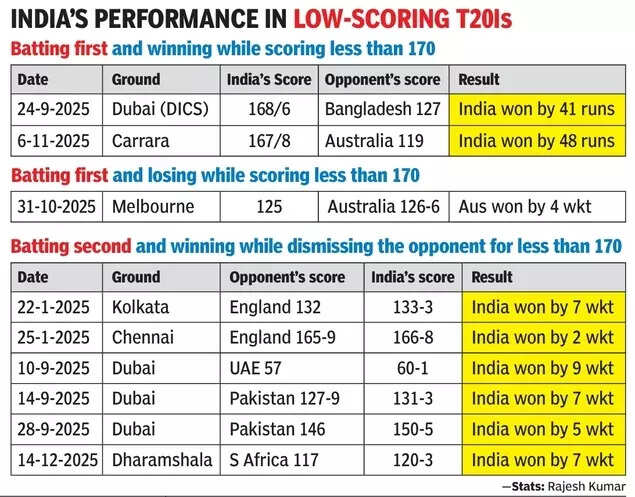
With Chakravarthy’s induction, India can strike hard in the middle phase of the innings. Even in the Asia Cup final, Kuldeep Yadav and Chakravarthy restricted Pakistan to a low score, allowing India to scrape past the target.
Most of the team’s recent T20I wins have been set up by the bowlers. There are just seven games left before the T20 World Cup starts. Five of them will be played against New Zealand in Jan after the squad is picked for the World Cup. One must not be surprised if India stop being so bullish about an ultra aggressive brand of batting and instead devise a game plan where the batters get a breather from the pressures of high-scoring games.









 English (US) ·