

 1 week ago
13
1 week ago
13
ARTICLE AD BOX
Working from home has become one of the most talked-about topics in offices today. Employees want flexibility, managers worry about control, and every request seems to come with a hidden test of trust.
In the middle of this debate, a story from Dubai is catching attention because it is honest, human, and a little painful.An Indian-origin founder has publicly shared how denying a simple work-from-home request ended up costing him one of his “best employees.” His post has sparked conversations across LinkedIn about leadership, trust, and what flexibility really means at work.The entrepreneur is Malik A., co-founder of Virtualpartner, and his reflection offers a lesson many managers can relate to.
A simple request, a hard decision
Malik shared that the employee had asked to work from home on Fridays. Her role was largely independent, meaning she could get her work done without being in the office all the time.
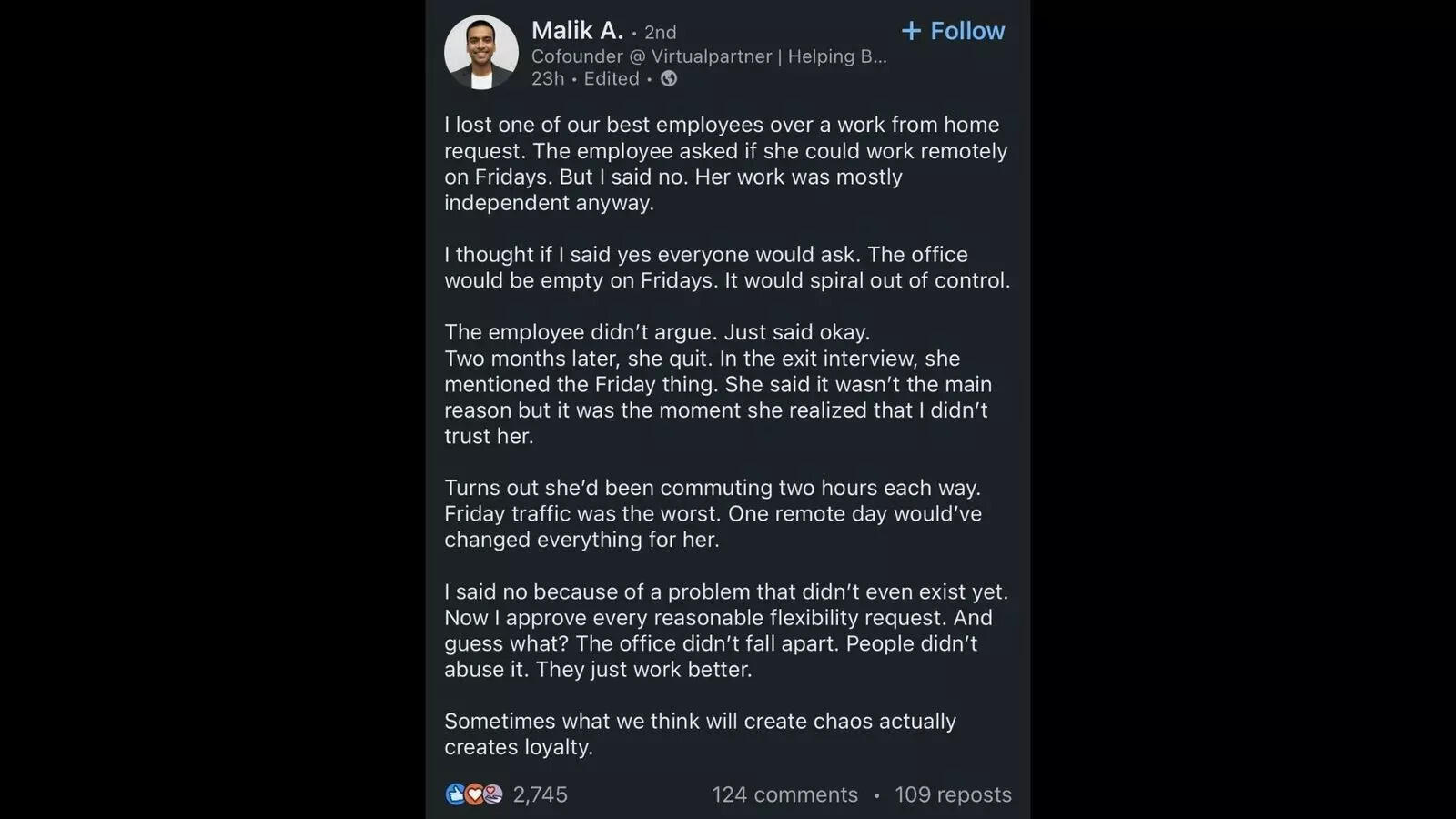
Yet, he refused.“I thought if I said yes, everyone would ask. The office would be empty on Fridays. It would spiral out of control,” he wrote.He feared that approving one request would create a trend. He imagined empty offices and a loss of structure.
The employee did not argue.“She didn’t argue. Just said okay,” Malik noted.At that moment, it seemed like a small decision. But its impact turned out to be far greater.
When resignation brings clarity
Two months later, the employee resigned.During her exit interview, she mentioned the Friday request. She clarified that it was not the only reason she left, but it was the moment she realized something important.She said it was when she felt her manager did not trust her.That insight stayed with Malik.Later, he learned she had been commuting two hours each way, with Friday traffic being the worst. “One remote day would’ve changed everything for her,” he wrote.Looking back, he admitted, “I said no because of a problem that didn’t even exist yet.”The scenario he feared never came to pass, but the consequences of saying no did.
Rethinking flexibility
After this experience, Malik changed his approach.He started approving “every reasonable flexibility request.”“The office didn’t fall apart. People didn’t abuse it. They just work better,” he wrote.His fears about misuse were unfounded. Flexibility, it turned out, built trust and loyalty rather than chaos.
LinkedIn reacts
The post drew strong reactions online.“It’s funny how companies suddenly start listening only after someone resigns. When employees are still around and trying to address real problems, their voices often go unheard,” one user wrote.Another said, “You were not totally wrong initially; at least the intention was not bad. We all learn the hard way. Constant communication is required to achieve and maintain trust.”Some praised Malik for admitting his mistake publicly. “Great to see that someone is actually appreciating the true value of their resources and admitting the wrong judgments publicly,” a user commented.Others highlighted the need for balance. “I agree mostly and have had my own sort of revelation on this topic. However, many would take advantage of the remote work situation, so it requires a different kind of management style IMO. Like many other things, balance is key,” said another.Disclaimer: This article is based on content shared on LinkedIn. The Times of India does not independently verify the authenticity or full context of such posts.Thumb image: Canva (for representative purposes only)







 English (US) ·